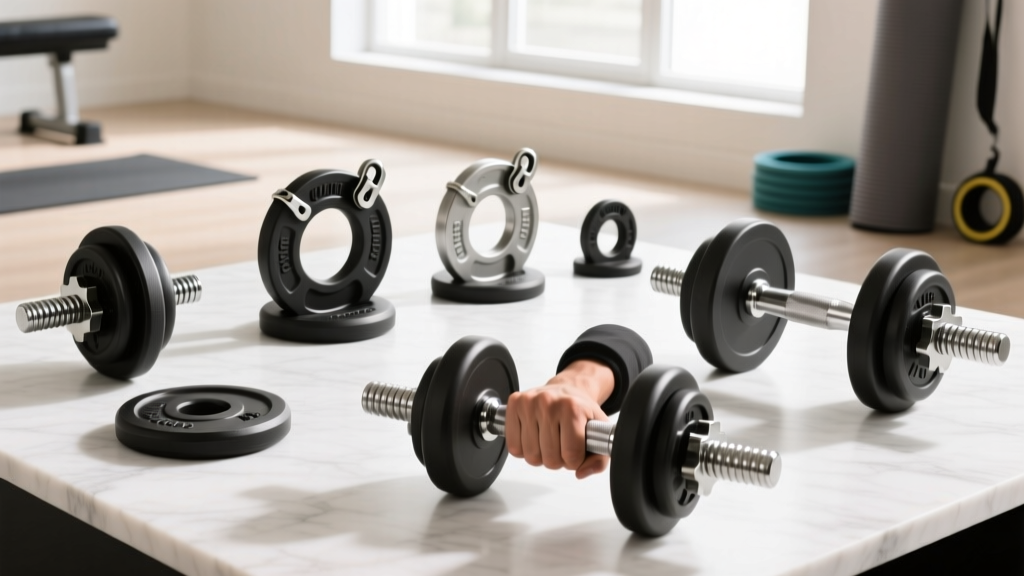
Barbell Clamp Types & How to Work Out Triceps with Dumbbells
Compare top barbell collar types for 2026, from spring clips to lever clamps. Plus, learn how to work out triceps with dumbbells for maximum isolation.

The Ultimate Barbell Collar and Clamp Types Comparison
When you are squatting 315 lbs or performing heavy overhead presses, the last thing you want is a weight plate sliding off the sleeve. Barbell collars are not just accessories; they are critical safety equipment. In 2026, the market has segmented into four distinct categories, each with specific failure modes, price points, and use cases. According to safety guidelines emphasized by the National Strength and Conditioning Association (NSCA), securing the barbell is a non-negotiable baseline for both commercial and home gym environments.
1. Spring Clips (The Budget Baseline)
Spring clips are the ubiquitous, low-cost option found in most commercial gyms. Constructed from bent steel wire, they rely on spring tension to grip the barbell sleeve.
- Top Model: CAP Barbell Spring Clips
- Price Range: $8 - $12 per pair
- Best For: Light bench pressing, strict curls, and budget setups.
- Failure Mode: Spring fatigue. After 6 to 12 months of repeated expansion and dropping, the steel loses its temper, resulting in a weak grip that will allow plates to slide during dynamic movements like the push press.
2. Nylon Clamp Collars (The CrossFit Standard)
These utilize a heavy-duty nylon body with a cam-lock or squeeze-release mechanism. They are incredibly fast to put on and take off, making them ideal for high-intensity interval training where every second counts.
- Top Model: Lock-Jawz Pro 2.0
- Price Range: $25 - $35 per pair
- Best For: CrossFit, Olympic lifting complexes, and fast-paced circuit training.
- Failure Mode: Nylon teeth degradation. On heavily chalked or worn zinc-coated barbell shafts, the plastic teeth can strip over a 2-to-3-year period, causing the collar to slip under heavy lateral loads.
3. Aluminum Screw Collars (The Powerlifting Gold Standard)
Machined from aircraft-grade aluminum, these collars thread onto themselves or use a heavy-duty set screw to clamp down on the sleeve. They add noticeable weight to the bar (often 2.5 kg per collar in competition settings) and provide an immovable lock.
- Top Model: Rogue AH-1 Aluminum Collars
- Price Range: $45 - $60 per pair
- Best For: Powerlifting, heavy squats, and bench pressing where absolute zero plate shift is required.
- Failure Mode: Cross-threading. If rushed and threaded at an angle, the aluminum threads can strip, rendering the collar useless. They are also slow to remove during plate changes.
4. Lever-Action Collars (The Olympic Weightlifting Choice)
Featuring a precision-machined aluminum body and a steel lever cam, these collars offer the security of a screw collar with the speed of a clamp. As noted in equipment specifications by Rogue Fitness, lever collars are engineered to withstand the massive downward impact forces of dropped bumper plates.
- Top Model: Eleiko Olympic Lever Collars
- Price Range: $85 - $110 per pair
- Best For: Olympic weightlifting (snatch, clean and jerk) and high-end home gyms.
- Failure Mode: Cam mechanism wear. Over 3 to 5 years of heavy Olympic drops, the internal steel cam can lose its micro-tension, requiring replacement or tightening.
Collar Comparison Matrix
| Collar Type | Grip Security | Change Speed | Avg. Price (2026) |
|---|---|---|---|
| Spring Clips | Low | Fast | $10 |
| Nylon Clamps | Medium-High | Very Fast | $30 |
| Aluminum Screw | Maximum | Slow | $50 |
| Lever-Action | High | Fast | $95 |
Bridging the Gap: How to Work Out Triceps with Dumbbells
Once your heavy compound barbell lifts are secured, a well-rounded 2026 training program demands precise isolation work. The triceps brachii make up roughly two-thirds of your upper arm mass, yet they are frequently under-stimulated by generic pushdowns. If you are wondering how to work out triceps with dumbbells effectively, you must target all three heads (long, lateral, and medial) through specific ranges of motion. According to kinesiology data from ExRx.net, the long head of the triceps is only fully activated when the shoulder is flexed (arm raised overhead).
1. The Overhead Dumbbell Extension (Long Head Focus)
To maximize the stretch and contraction of the long head, the overhead extension is mandatory.
- Setup: Sit on a bench with back support (set to 75-80 degrees to protect the lumbar spine). Hold a single heavy dumbbell or two lighter dumbbells pressed together.
- Execution: Raise the weight directly overhead. Keeping your elbows tucked close to your ears, lower the weight behind your head until you feel a deep stretch in the triceps.
- Pro-Tip: Do not flare your elbows outward. Flaring shifts the load to the anterior deltoid and reduces triceps tension. Aim for 3 sets of 10-12 reps with a controlled 2-second eccentric (lowering) phase.
2. Neutral-Grip Dumbbell Skull Crushers (Lateral & Medial Focus)
Traditional barbell skull crushers can wreck the elbows over time. Dumbbells allow for a natural, joint-friendly neutral grip.
- Setup: Lie flat on a bench holding two dumbbells with a neutral grip (palms facing each other), arms extended straight up.
- Execution: Hinge strictly at the elbow joint, lowering the dumbbells down to the sides of your head (ear-level). Pause for one second, then drive back up using the lateral head.
- Edge Case Warning: Avoid lowering the dumbbells past 90 degrees of elbow flexion if you have a history of triceps tendinopathy. Keep the tension on the muscle belly, not the tendon insertion.
Coach's Insight: When learning how to work out triceps with dumbbells, leave your ego at the door. The triceps are a relatively small muscle group compared to the pecs or lats. Using 15 lb dumbbells with perfect, strict isolation will yield vastly more hypertrophy than swinging 40 lb dumbbells with momentum and shoulder compensation.
Frequently Asked Questions
- Do I need collars for dumbbell work?
No, collars are strictly for barbells and dumbbell handles that utilize slide-on plates (like spinlock dumbbells). If you are using fixed hex or urethane dumbbells, collars are not applicable. - Which barbell collar is best for a home gym in 2026?
For a mixed-use home gym, the Lock-Jawz Pro nylon clamps offer the best balance of price ($30), security, and speed. If you exclusively powerlift, invest in the Rogue AH-1 aluminum screw collars. - How often should I train triceps with dumbbells?
The triceps recover relatively quickly but are heavily taxed during chest and shoulder days. Direct dumbbell isolation work 2 times per week (e.g., 3-4 sets per session) is optimal for hypertrophy without overtraining the elbow joint.
More gear to consider
All reviews
Power Rack vs Squat Rack vs Stand for Dumbbell Abduction Rows

Olympic vs Standard Plates Setup & Back Exercises Dumbbells Only

Barbell Collar Types Comparison: Flat Dumbbell Bench & Rack Safety
Rubber Hex vs Urethane: Best Gear for Different Arm Workouts with Dumbbells
Olympic vs Standard Plates: Neutral Grip Dumbbell Shoulder Press Guide
