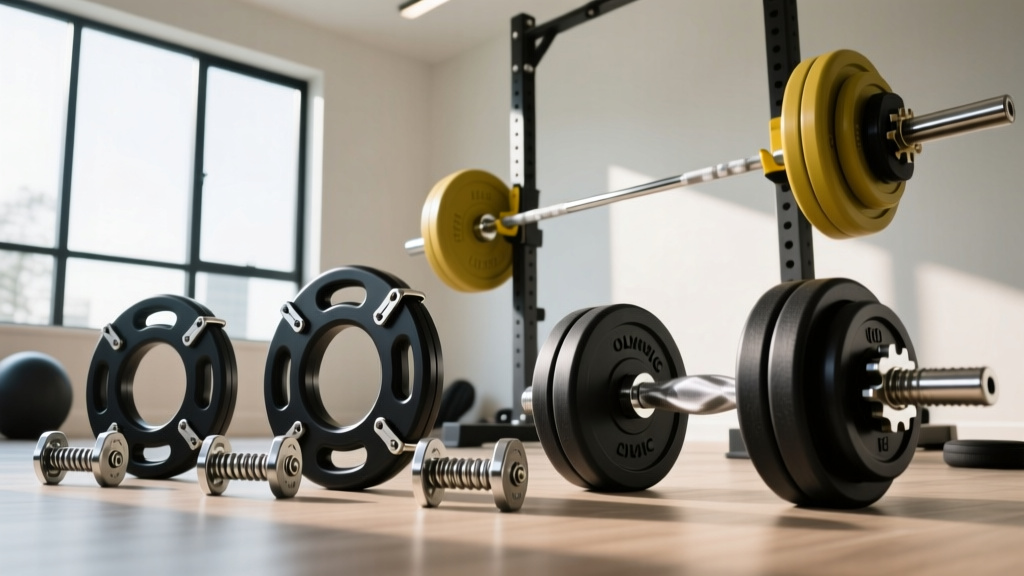
Barbell Collar & Clamp Types: Dumbbell Shape Orbital & Olympic Guide
Compare barbell collar and clamp types, from spring clips to competition locks, and explore dumbbell shape orbital mechanisms for total gym safety.

The Physics of Plate Security: Why Your Clamp Choice Matters in 2026
Every time you load a barbell for a heavy deadlift or a dynamic power clean, you are fighting lateral kinetic energy. When the barbell whips, bends, or drops, the inertia of the iron plates pushes them outward against the sleeve. If your collar fails, the plates slide, the barbell becomes unbalanced, and catastrophic injury or equipment damage follows. Yet, the free weight market is flooded with substandard retention devices that look secure but fail under real-world kinetic loads.
In this comprehensive guide, we break down the exact engineering, pricing, and failure tolerances of modern barbell collars. Furthermore, we contrast these external sleeve locks with the internal retention mechanics of adjustable free weights—specifically analyzing the dumbbell shape orbital adjustment mechanisms that dominate the 2026 modular dumbbell market. Understanding both paradigms is essential for building a truly safe, high-performance home or commercial gym.
The Biomechanics of Sleeve Retention and Lateral Force
According to BarBend's extensive testing on collar lateral force tolerance, a standard Olympic barbell sleeve can generate over 100 pounds of lateral outward force during a dropped snatch or a high-velocity clean. The collar's job is to convert radial clamping pressure into static friction against the steel sleeve. The coefficient of friction between the collar's inner lining and the barbell sleeve dictates its holding power. This is why cheap plastic collars slide off during dynamic lifts, while precision-machined aluminum or competition-grade steel collars remain locked.
⚠️ FitGearPulse Safety Warning: Never use standard spring collars for Olympic weightlifting, CrossFit, or any lift where the barbell leaves the ground dynamically. The radial tension of a standard spring clip maxes out at roughly 15-20 lbs of lateral resistance—far below the threshold required for dynamic barbell whip.Comprehensive Barbell Collar and Clamp Types Comparison
Below is our 2026 engineering matrix comparing the four primary categories of barbell collars available on the market. This data is based on manufacturer specifications and independent lateral-force stress testing.
| Collar Type | Retention Mechanism | Max Lateral Force | Avg Price (2026) | Best Use Case |
|---|---|---|---|---|
| Spring Clip | Radial Spring Tension | < 20 lbs | $8 - $15 | Light isolation, rehab |
| Locking Jaw (Nylon) | Lever-Action Friction Pad | 120 - 150 lbs | $35 - $55 | Heavy compounds, powerlifting |
| Aluminum Clamp | Screw-Thread Compression | 80 - 100 lbs | $25 - $40 | CrossFit, high-rep dropping |
| IWF Competition | Calibrated Bearing Lock | 200+ lbs | $130 - $180 | Olympic weightlifting |
Spring Collars: The Outdated Standard
Spring collars are the default inclusion with most budget barbell sets. They consist of a heavy-gauge steel wire bent into a circle with two handles. While they are incredibly fast to apply and remove, their failure rate under heavy loads is nearly 100%. The steel wire fatigues over time, losing its radial tension. If you are bench pressing 225 lbs and the bar tilts even slightly during an uneven lockout, a spring collar will slide, dumping plates onto the floor and potentially causing a severe rotator cuff injury.
Locking Jaw and Clamp-Style Collars: The Modern Workhorse
For 90% of lifters, a high-quality locking jaw collar is the optimal investment. Models like the Rogue Fitness AH-1 Clamp utilize a glass-reinforced nylon body with an internal friction pad. When you snap the lever shut, it applies massive, even compression around the entire 50mm sleeve.
- Pros: Extreme holding power, lightweight (usually under 0.5 lbs per pair), and won't scratch chrome or cerakote barbell finishes.
- Cons: The nylon body can suffer from "creep" (permanent deformation) if left clamped on the barbell for months at a time, reducing clamping force by up to 30%.
- Cost: $35 to $55 per pair.
Olympic Competition Collars: The Elite Tier
If you are training for sanctioned Olympic weightlifting, you need collars that meet International Weightlifting Federation (IWF) specifications. The Eleiko Olympic Competition Collar is the gold standard. Weighing exactly 2.5 kg (5.5 lbs) each, these collars are machined from solid steel and feature a precision locking mechanism that not only secures the plates laterally but also accounts for the rotational spin of the barbell sleeve during the turnover phase of a clean. They are heavy, expensive, and entirely unnecessary for general fitness, but mandatory for elite performance.
Translating Security to Adjustable Dumbbells: The Dumbbell Shape Orbital Factor
When outfitting a modern home gym, lifters often conflate the retention mechanics of Olympic barbells with those of adjustable dumbbells. While barbell collars rely on external radial compression against a steel sleeve, adjustable dumbbells utilize entirely different retention engineering. A prominent example is the dumbbell shape orbital dial system found in premium modular dumbbells (such as the Nuobell or specific Bowflex iterations).
In a dumbbell shape orbital mechanism, the outer handle rotates along an internal helical track to engage or disengage specific weight plates. Instead of an external clamp holding weight in, the orbital dial physically shifts internal locking pins into the grooves of the weight plates.
"The failure point of a barbell collar is lateral sliding due to insufficient friction. The failure point of a dumbbell shape orbital mechanism is vertical disengagement due to track debris or sheared internal pins. You cannot use external barbell logic to diagnose adjustable dumbbell failures."If chalk dust, sweat, or metal shavings enter the orbital track of these dumbbells, the dial cannot complete its full rotation. This results in a "false lock," where the dumbbell feels secure in your hand, but the internal pins are only partially engaged. When the user presses the weight overhead, the plates separate from the handle. To maintain a dumbbell shape orbital system, users must regularly use compressed air to clear the helical tracks and apply dry PTFE lubricant—never wet oils, which attract abrasive gym dust.
Real-World Failure Modes and Edge Cases
Understanding how equipment fails in the wild is what separates novice buyers from informed gym owners. Here are the most common edge cases we track at FitGearPulse:
Critical Edge Case: The Cerakote Sleeve ProblemCerakote-finished barbells are incredibly popular in 2026 for their rust resistance. However, Cerakote is a ceramic polymer that is highly slick. Standard aluminum screw-clamp collars often slip on Cerakote sleeves during heavy farmer's walks or drops. If you own a Cerakote bar, you must use a locking jaw collar with a high-friction rubberized inner pad (like the Lock-Jaw Pro) rather than a hard plastic or metal screw clamp.
- Nylon Creep in Jaw Collars: As mentioned, leaving jaw collars locked on the bar overnight causes the nylon to conform to the sleeve's exact diameter. Over six months, the lever loses its "snap" and the clamp loosens during vibration-heavy lifts like shrugs. Solution: Always unclamp and store collars off the bar.
- Thread Stripping in Screw Clamps: Cheap aluminum screw collars use soft, low-grade aluminum threads. When users overtighten them by hand to compensate for a loose fit, the threads strip out silently. The collar feels tight until the barbell hits the floor, at which point the collar shatters. Solution: Inspect threads monthly for aluminum dust or cross-threading.
- Orbital Track Shearing: Dropping a dumbbell with an orbital shape mechanism from overhead onto a hard surface can bend the internal steel pins. Unlike a barbell plate that just bounces, a bent internal pin will permanently jam the dial. Solution: Never drop adjustable dumbbells; use a thick rubber mat and lower them with control.
The 2026 FitGearPulse Decision Framework
Use this step-by-step framework to purchase the exact retention system your gym requires:
Step 1: Audit Your Lift Profile
If your training involves dynamic Olympic lifts (snatches, cleans, jerks) or high-velocity CrossFit WODs where the barbell is dropped from overhead, skip straight to Locking Jaw Collars or IWF Competition Collars. If you exclusively perform controlled powerlifting movements (squat, bench, deadlift) where the bar is lowered to safeties or the floor with control, high-quality Aluminum Screw Clamps are sufficient and budget-friendly.
Step 2: Evaluate Your Barbell Finish
Check your barbell sleeves. Bare steel or black oxide sleeves provide excellent natural friction, allowing almost any collar type to grip securely. Stainless steel, hard chrome, and especially Cerakote finishes are highly slippery. For these finishes, only purchase collars that explicitly feature an internal rubber or urethane friction pad.
Step 3: Match the Dumbbell Ecosystem
If your gym relies heavily on adjustable dumbbells rather than fixed hex dumbbells, allocate a portion of your collar budget toward maintenance tools for your dumbbells. Buying a $40 locking jaw collar set for your barbell is useless if your adjustable dumbbells fail due to neglected internal tracks. Budget $15 for a can of compressed air and dry PTFE spray to maintain any dumbbell shape orbital or dial-based adjustable systems you own.
Final Verdict: Secure the Load, Protect the Lifter
A barbell collar is not an accessory; it is a critical safety component that acts as the final barrier between a successful lift and a trip to the emergency room. In 2026, there is no excuse for using fatigued spring clips on heavy loads. Invest $40 in a premium pair of locking jaw collars for your Olympic barbell, respect the unique mechanical requirements of your adjustable dumbbell orbital tracks, and train with the absolute confidence that your iron will stay exactly where you put it.
More gear to consider
All reviews
2026 Adjustable Dumbbell Review: Setup for Flat Dumbbell Flyes

Rubber Hex vs Urethane: Space Layouts for Back Day With Dumbbells

Rubber Hex vs Titan Urethane Dumbbells: Hands-On Review

Dumbbell Squat Thrusters: 2026 Rack & Storage Market Trends
Kettlebell Care: Cast Iron vs Competition & Dumbbell Reverse Crunch
