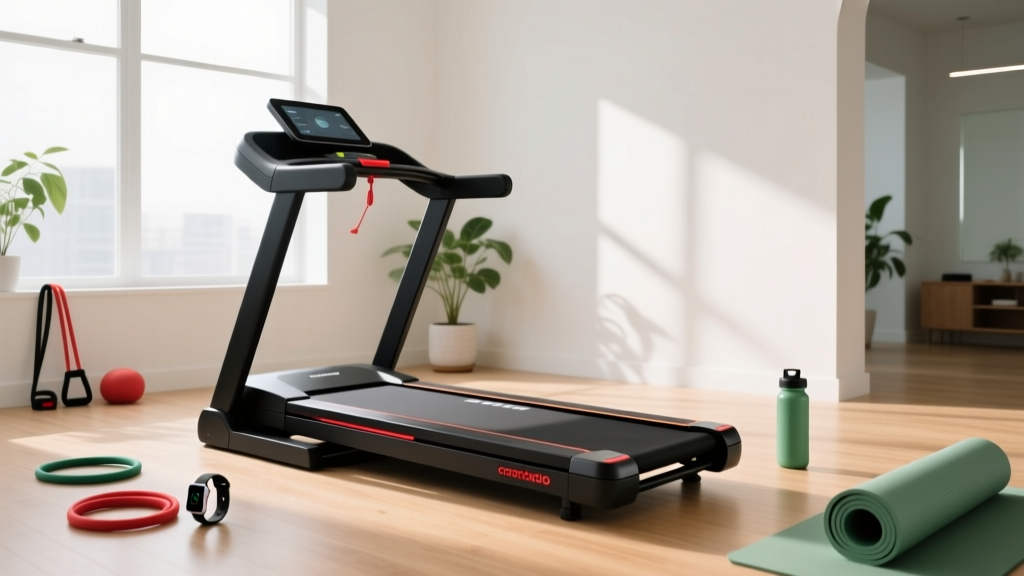
The "Airplane on a Treadmill" Physics Test: 2026 Folding Treadmill Value Review
We apply the airplane on a treadmill physics test to 2026 folding treadmills. Discover true value, motor mechanics, and space-saving budget breakdowns.

The "Airplane on a Treadmill" Thought Experiment: What It Means for Your Workout
If you spend any time in physics forums or fitness communities, you have likely encountered the famous "airplane on a treadmill" thought experiment. The premise: If a plane sits on a massive treadmill that moves backward at the exact speed the plane's wheels spin forward, can the plane take off? The answer, confirmed by physicists and popular science shows alike, is yes. The plane's engines generate thrust against the air, not the ground. The wheels simply spin faster, but the plane achieves liftoff.
So, how does this apply to a folding treadmill for small spaces in 2026? It is the perfect analogy for evaluating budget cardio equipment. When you buy a cheap, ultra-compact folding treadmill, the belt acts like that mythical treadmill. You are running, your legs are spinning, but because of severe mechanical inefficiencies—belt slip, deck flex, and underpowered motors—your forward "thrust" is entirely absorbed by friction and poor engineering. You are expending energy, but you aren't achieving biomechanical liftoff. Your joints take the impact, and the motor bogs down.
In this 2026 budget breakdown and value analysis, we are putting the top small-space folding treadmills through our "Airplane Physics Test." We will analyze Continuous Horsepower (CHP), deck elastomers, and spatial footprints to determine which machines actually deliver value, and which ones just spin their wheels.
The Mechanics of Budget Treadmill Failure
Before diving into specific models, we must establish why budget folding treadmills fail the physics test. According to extensive durability testing noted by Consumer Reports, the primary failure points in sub-$600 treadmills are the motor controller and the deck friction coefficient.
The Peak HP vs. CHP Trap
Many budget brands advertise "2.5 Peak Horsepower." Peak HP is the maximum output the motor can hit for a fraction of a second before tripping the thermal overload switch. What you actually need is Continuous Horsepower (CHP), which measures the motor's ability to sustain output during a 45-minute run. A 1.5 Peak HP motor often yields less than 0.75 CHP, meaning a 180-lb runner will cause the Pulse Width Modulation (PWM) controller to overheat and fail within six months.
2026 Small-Space Contenders: Value & Physics Breakdown
We selected three of the most popular folding treadmills for small apartments in 2026, evaluating them on their ability to generate true "thrust" (stability and power) while maintaining a compact storage footprint.
1. Horizon Fitness T101 (2026 Edition) – The Reliable Thrust
Price: $599 | Motor: 3.0 CHP | Belt: 20" x 55" | Weight: 140 lbs
The Horizon T101 remains the gold standard for budget-conscious buyers who refuse to compromise on biomechanics. Weighing in at 140 lbs, it is heavier than its competitors, but this mass is exactly what grounds the machine. The 3.0 CHP motor effortlessly handles runners up to 275 lbs without the belt stuttering. Furthermore, Horizon utilizes a variable-durometer elastomer cushioning system. The deck is softer at the front (strike zone) and firmer at the back (push-off zone), mimicking the natural physics of outdoor running.
- The Physics Verdict: Passes with flying colors. The thrust is efficiently transferred into forward momentum rather than lost to deck flex.
- Space Footprint: 70" L x 30" W (in use). Folds vertically via a hydraulic soft-drop system to roughly 42" L x 30" W.
2. NordicTrack T Series 5 – The Space-Saving Compromise
Price: $449 | Motor: 2.6 CHP | Belt: 18" x 50" | Weight: 115 lbs
The NordicTrack T5 is designed explicitly for the small-space dweller who primarily walks or jogs. The 2.6 CHP motor is adequate for users under 200 lbs, but the real compromise is the 18-inch belt width. Biomechanically, an 18-inch width forces a narrower gait. If you are used to a standard 20-inch or 22-inch running surface, the T5 will feel restrictive, increasing the likelihood of clipping the side rails.
- The Physics Verdict: Conditional pass. Excellent for walking and light jogging, but heavy runners will experience belt drag and motor strain at speeds above 6.0 MPH.
- Space Footprint: 65" L x 26" W (in use). Folds down to an incredibly compact 46" L x 26" W, making it ideal for sliding under a bed or into a narrow closet.
3. Sunny Health & Fitness SF-T723016 – The "Wheels Spinning" Trap
Price: $259 | Motor: 1.5 Peak HP (~0.75 CHP) | Belt: 16" x 45" | Weight: 75 lbs
This is the quintessential "airplane on a treadmill" failure. The Sunny SF-T723016 is exceptionally cheap and highly portable, but it lacks the structural rigidity for actual running. The 1-inch MDF deck flexes significantly underfoot, absorbing your kinetic energy. The narrow 16-inch belt and 45-inch length make it physically impossible for anyone over 5'6" to run safely without overstriding and risking a fall.
- The Physics Verdict: Fails the test. The energy you expend is lost to deck flex and belt friction. It is strictly a walking pad masquerading as a running treadmill.
- Space Footprint: 55" L x 22" W. Extremely easy to move and store, but at the cost of all functional running utility.
Cost-Per-Usable-Year Matrix: The True Value Analysis
When evaluating budget fitness gear, the initial price tag is only half the equation. A $250 treadmill that burns out its PWM controller in year one is infinitely more expensive than a $599 treadmill that lasts a decade. Based on historical failure rates of brushed DC motors in budget treadmills, here is the 2026 value matrix:
| Model | Initial Cost | Est. Lifespan (3x/week) | Cost Per Usable Year | Value Grade |
|---|---|---|---|---|
| Horizon T101 | $599 | 7 - 10 Years | $60 - $85 | A |
| NordicTrack T5 | $449 | 4 - 6 Years | $75 - $112 | B+ |
| Sunny SF-T723016 | $259 | 1 - 2 Years | $129 - $259 | D |
Small Space Dimensions & Safety Clearances
Buying a folding treadmill for a small apartment requires more than just measuring the storage footprint. You must account for operational safety. The Mayo Clinic and physical therapy guidelines consistently emphasize the necessity of fall-zone clearances to prevent severe friction burns and head trauma in the event of a misstep.
The 2026 Apartment Clearance Rule
Always leave a minimum of 24 inches of clear space directly behind the treadmill. If your apartment layout only allows for 10 inches behind the machine, a slip will result in your body wedging between the spinning belt and the wall, causing severe injury. Additionally, ensure your ceiling height accommodates the deck elevation. Most budget folding treadmills raise the user 5 to 7 inches off the ground. If you have standard 8-foot (96-inch) ceilings, runners over 5'10" may experience head-strike risks when utilizing maximum incline settings.
Achieving Biomechanical Liftoff: Final Verdict
When evaluating the intersection of small-space living and budget constraints, the physics of running cannot be cheated. As studies on treadmill biomechanics versus outdoor running highlight, the surface you run on dictates joint loading and energy return. A flimsy, underpowered deck forces your stabilizing muscles to overcompensate, leading to shin splints and IT band syndrome.
If your budget is strictly under $300, do not buy the Sunny SF-T723016 expecting to run. Accept it as a walking pad and adjust your workout expectations accordingly. However, if you want a machine that actually passes the "airplane on a treadmill" test—allowing you to generate true running thrust without mechanical failure—the Horizon Fitness T101 is the undisputed value champion of 2026. It requires slightly more floor space, but the return on investment, joint protection, and motor longevity make it the only budget folding treadmill that truly helps you achieve liftoff.
More gear to consider
All reviews
Bike Types & Care: Is StairMaster or Treadmill Better for Fat Loss?
NordicTrack Elite 900 Treadmill Setup & Motor Horsepower Guide

Choosing the Right Treadmill Lube Oil for Portable Walking Pads

9 Incline on Treadmill: Is It Good? 2026 Workout Guide
Walking Pad vs Treadmill: Best for HIIT Exercises in 2026