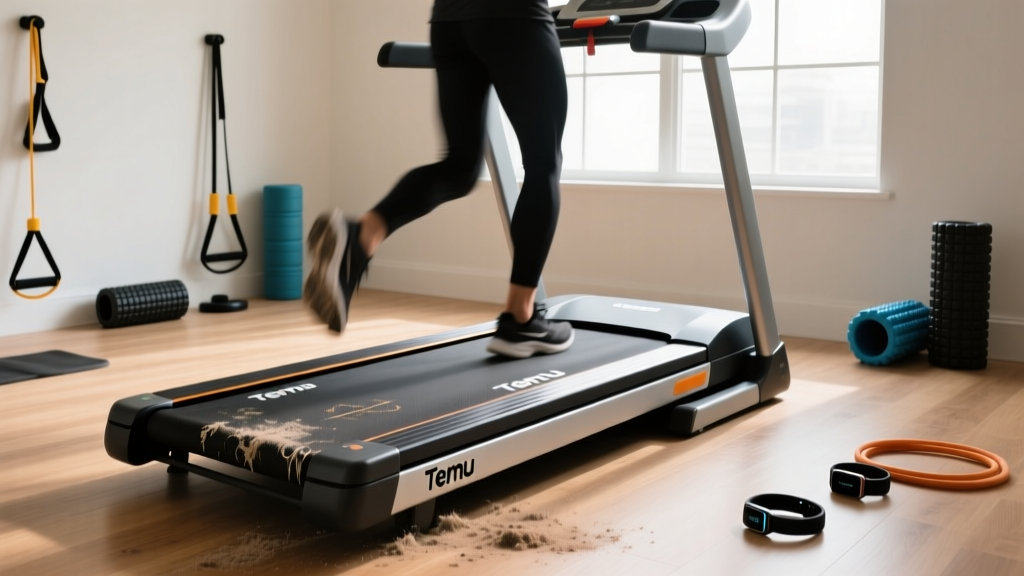
Temu Treadmill Belt Maintenance: True Cost & Value Analysis
Discover the true cost of owning a Temu treadmill. We break down belt maintenance, lubrication schedules, and long-term value for budget buyers.

The Hidden Reality of Ultra-Budget Cardio Gear
As of 2026, direct-to-consumer marketplaces have completely disrupted the home fitness economy. The allure of a "Temu treadmill"—often priced between $130 and $220 with free shipping and a folding footprint—is undeniable for budget-conscious buyers. However, the initial price tag is only a fraction of the Total Cost of Ownership (TCO). When you strip away the marketing, these ultra-budget machines are essentially generic, white-label frames equipped with low-tolerance parts. The single most critical factor that determines whether your budget treadmill lasts six months or three years is treadmill belt maintenance and lubrication.
Unlike premium brands that use pre-waxed, multi-ply belts and phenolic-coated decks, budget marketplace treadmills rely on high-friction, single-ply PVC belts resting on raw or poorly sealed MDF (Medium-Density Fiberboard) decks. If you treat a Temu treadmill like a $2,000 NordicTrack, the motor will overheat and the lower control board will fry within weeks. This guide provides a deep-dive budget breakdown and value analysis of maintaining these specific machines, helping you decide if the sweat equity is worth the upfront savings.
The Anatomy of a Budget Treadmill Belt (And Why Friction is the Enemy)
To understand the value proposition, you must understand the engineering compromises made to hit a sub-$200 price point. According to Wirecutter's extensive treadmill testing, budget treadmills frequently misrepresent motor sizes, advertising "Peak HP" rather than "Continuous Duty HP" (CHP). A typical Temu folding treadmill features a 1.0 to 1.5 Peak HP motor, which translates to roughly 0.75 CHP.
Because the motor is underpowered, it is highly susceptible to friction. When a belt lacks proper lubrication, the coefficient of friction between the belt and the deck spikes. This forces the motor to draw significantly more amperage to maintain your walking or jogging speed. An unlubricated belt on a budget deck can increase motor amp draw by 30% to 50%. This excess heat degrades the motor's internal windings and sends voltage spikes back to the lower control board, resulting in catastrophic electronic failure.
⚠️ CRITICAL LUBRICANT WARNING: Never use WD-40, aerosol silicone sprays, or petroleum-based oils on a Temu treadmill. Petroleum products will instantly dissolve the PVC backing of cheap belts and destroy the MDF deck. You must use 100% pure liquid silicone specifically formulated for fitness equipment. As noted by the experts at Treadmill Doctor, petroleum-based lubricants are the number one cause of voided warranties and ruined belts in the repair industry.Budget Breakdown: The Hidden Costs of Skipping Maintenance
Let us look at the actual financial impact of neglecting belt lubrication on a generic white-label treadmill versus a name-brand entry-level model (like the Horizon T101 or XTERRA TR150). The data below illustrates the replacement costs when friction-induced failures occur.
| Component | Temu / White-Label Cost | Name-Brand Cost | Failure Cause & Notes |
|---|---|---|---|
| Replacement Belt | $25 - $40 | $60 - $90 | Budget belts stretch and fray at the seams within 6 months if run dry. |
| Drive Motor | $65 - $95 | $200 - $350 | Overheating from friction burns out the copper windings. |
| Lower Control Board | $35 - $55 | $120 - $180 | Voltage spikes from a straining motor fry the board's capacitors. |
| Deck Replacement | N/A (Usually unreplaceable) | $100 - $150 | Budget MDF decks warp and groove; name brands use reversible phenolic decks. |
According to Consumer Reports' treadmill buying guide, the longevity of a treadmill is inextricably linked to the user's willingness to perform routine maintenance and the manufacturer's use of durable deck materials. On a Temu treadmill, the deck is often made of low-density MDF. Once the factory wax wears off (usually around the 30-mile mark), the belt grinds directly into the wood fibers, creating a permanent groove. At this point, no amount of liquid silicone will save the deck, and because generic frames lack standardized part numbers, you cannot simply order a replacement deck. The machine becomes e-waste.
Step-by-Step: Lubricating a White-Label Budget Treadmill
Because Temu treadmills rarely come with accurate, model-specific manuals, you must rely on universal mechanical principles to maintain the belt. Here is the exact protocol for lubricating a generic folding treadmill to maximize its lifespan.
1. Gather the Correct Tools
- 100% Pure Liquid Silicone Treadmill Lubricant (with an extended applicator tube).
- 6mm or 8mm Allen Wrench (Hex key). Budget treadmills almost universally use metric hardware for the rear roller bolts.
- Microfiber cloth and mild degreaser.
2. Clean the Belt Edges and Deck Lip
Before applying new silicone, you must remove the black rubber dust and dried sweat that accumulates along the edges of the belt. Use a damp microfiber cloth with a drop of dish soap to wipe down the exposed edges of the deck. Dirt trapped under the belt acts like sandpaper, accelerating the wear on the MDF deck.
3. Loosen the Rear Roller (If Required)
On some ultra-budget models, the belt is tensioned so tightly from the factory that you cannot slide the applicator tube underneath. Locate the two rear roller adjustment bolts at the very back of the treadmill frame. Turn both bolts counter-clockwise exactly three full turns. Keep track of your turns so you can re-tension it evenly later.
4. Apply the Silicone
Lift the edge of the belt near the middle of the deck. Insert the applicator tube as close to the center of the deck as possible. Squeeze exactly 15ml (half an ounce) of silicone in a zig-zag pattern from the center out toward the edge. Repeat on the opposite side. Do not over-apply; excess silicone will leak out the sides and create a slipping hazard on your floor.
5. Re-Tension and Distribute
If you loosened the rear roller, tighten both bolts clockwise exactly three turns to restore the original tension. Plug the treadmill in, start it at 2.0 MPH, and let it run for three minutes. Walk on it gently to help spread the silicone evenly across the entire deck surface.
Expert Insight: "The factory 'pre-lubrication' on direct-from-manufacturer marketplace treadmills is notoriously inconsistent. We frequently see brand-new budget treadmills arrive with completely dry spots in the center of the deck where the belt folds during shipping. Always perform a manual lubrication within the first 10 miles of use, regardless of what the listing claims."
Value Analysis: Is the Temu Treadmill Actually a Deal?
To determine the true value, we must run a 24-month cost projection comparing a heavy-use maintenance schedule on a Temu treadmill versus buying an entry-level name-brand alternative.
Scenario A: The Temu Treadmill ($180 Initial Cost)
Assuming a user walks 10 miles a week (approx. 500 miles a year). To prevent the MDF deck from grooving and the 1.0 Peak HP motor from burning out, the user must lubricate the belt every 30 days (instead of the standard 90 days for premium machines) and replace the belt once at the 14-month mark due to edge fraying.
- Initial Purchase: $180
- Silicone Lubricant (2 bottles/year): $24
- Replacement Belt (Month 14): $35
- Lower Control Board Replacement (Month 18 - highly common on budget boards): $45
- 24-Month TCO: $284
The Catch: This assumes the user is mechanically inclined enough to source generic replacement parts via eBay or AliExpress when the board inevitably fails, and is willing to spend hours troubleshooting error codes like E02 or E05.
Scenario B: Entry-Level Name Brand ($499 Initial Cost)
Comparing against a machine like the Horizon T101 or similar entry-level model with a 2.25 CHP motor and a reversible, wax-infused deck.
- Initial Purchase: $499
- Silicone Lubricant (1 bottle every 6 months): $12
- Parts Replacements: $0 (Covered by standard 1-year parts / lifetime frame warranty)
- 24-Month TCO: $511
The Final Verdict on Budget Treadmill Value
The financial gap between the Temu treadmill and a reputable entry-level brand narrows significantly when you factor in the aggressive maintenance schedule and inevitable part replacements required to keep a white-label machine alive. Furthermore, the safety and reliability metrics heavily favor name brands, which undergo rigorous UL testing and feature proper motor shrouds and emergency stop mechanisms.
If your budget is strictly capped at $200, a Temu treadmill can provide value, but only if you treat belt maintenance as a mandatory monthly chore rather than an afterthought. You must proactively lubricate the deck with 100% silicone, monitor the motor heat, and accept that the machine is essentially a disposable, 18-month appliance. However, if you view fitness as a long-term investment and want to avoid the frustration of sourcing generic control boards and dealing with warped MDF decks, saving up for an entry-level name-brand treadmill remains the undisputed champion of long-term value.
More gear to consider
All reviews
Christopher Gregor Treadmill: Under-Desk Review & Maintenance

4.0 HP Treadmill Noise vs. Quiet Cardio: 2026 Buying Guide

Air Bike vs Assault Bike Guide & NordicTrack Treadmill Manuals

Walking Pad Review: Setup & Treadmill Belt Seam Guide
ProForm Treadmill Power 995i Motor Troubleshooting & HP Guide