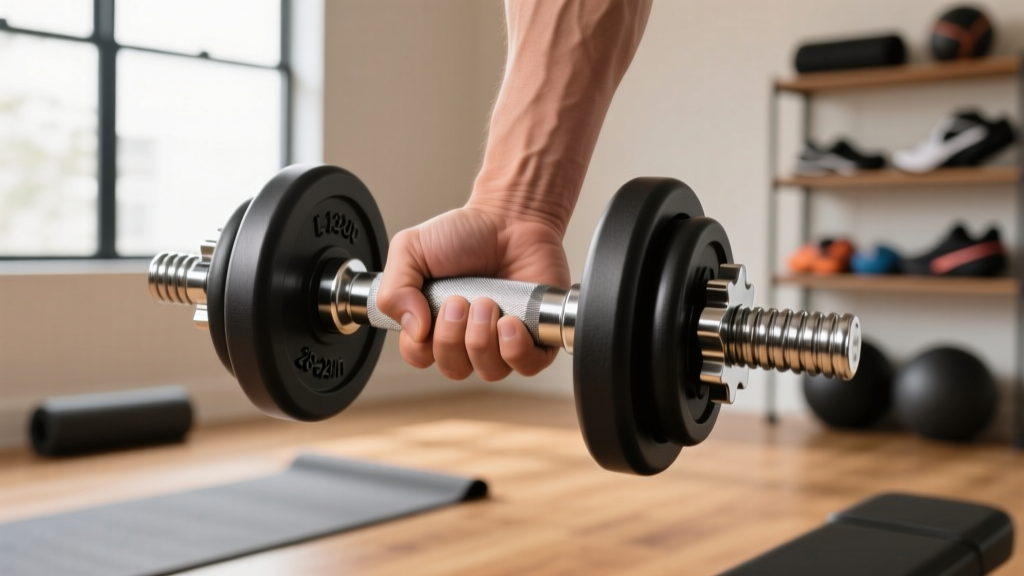
Best Adjustable Dumbbells for Your Wrist Dumbbell Workout (2026)
Discover the best adjustable dumbbells for your wrist dumbbell workout in 2026. Compare handle diameters, micro-loading, and top models for forearm gains.

The Hidden Biomechanics of Forearm Isolation
Forearm and wrist musculature—specifically the flexor carpi radialis, extensor carpi ulnaris, and brachioradialis—are notoriously stubborn. They are composed of a high density of slow-twitch muscle fibers, requiring high-volume training, precise time-under-tension, and meticulous progressive overload. When designing a dedicated wrist dumbbell workout, the limiting factor is rarely your effort; it is almost always your equipment.
In 2026, the adjustable dumbbell market is saturated, but the vast majority of models are engineered for compound movements like presses and rows. They fail the wrist isolation test for three critical reasons: aggressive 5-pound weight jumps (which cause immediate tendon strain on small joints), bulky end-caps that prevent the forearm from resting flush on a bench, and handle diameters that prematurely fatigue the finger flexors before the wrist flexors reach mechanical failure.
This guide cuts through the marketing fluff to evaluate the best adjustable dumbbells specifically for wrist isolation, micro-loading capabilities, and ergonomic handle profiles.
⚠️ Tendonitis Warning: The wrist flexor group is highly susceptible to overuse injuries like medial epicondylitis. Jumping from 15 lbs to 20 lbs represents a 33% load increase. According to the National Strength and Conditioning Association (NSCA), small, distal muscle groups require micro-loading increments of 10% or less to safely adapt. Standard fixed dumbbells simply cannot accommodate this.2026 Comparison Matrix: Wrist & Forearm Ergonomics
Before diving into individual reviews, it is crucial to understand how the physical dimensions of adjustable dumbbells impact wrist biomechanics. A handle that is too thick forces the finger flexors to work overtime, robbing tension from the wrist. Conversely, a cage-style dumbbell can dig into the forearm during heavy flexion.
| Brand & Model | Handle Diameter | Min Increment | Wrist Curl Ergonomics | 2026 Price |
|---|---|---|---|---|
| Nuobell 50lb | 34mm (Traditional) | 2.2 lbs (1 kg) | Excellent (Flush ends) | $329 |
| PowerBlock Sport 24 | 1.25" (Caged) | 2.5 lbs | Fair (Cage interference) | $179 |
| Bowflex SelectTech 552 | 1.35" (Bulky Dials) | 2.5 lbs (up to 25lbs) | Poor (Dials scratch bench) | $399 |
| Flybird Fast Adjust 25lb | 32mm (Traditional) | 5.0 lbs | Good (Compact profile) | $119 |
In-Depth Reviews: Top Models for Forearm Isolation
1. Nuobell 50lb: The Ergonomic Champion
When executing a strict dumbbell wrist curl, the forearm must rest flat against a bench while the hand hangs freely over the edge. The Nuobell 50lb is currently the undisputed king of this movement in the adjustable market. Because it utilizes a twisting handle mechanism rather than bulky side dials or cages, the physical footprint of the dumbbell mimics a traditional cast-iron hex dumbbell.
- Micro-loading: The 2.2 lb (1 kg) increments are a game-changer for wrist extensions, where the extensor muscles are significantly weaker than the flexors.
- Handle Profile: The 34mm diameter with mild knurling provides enough grip security without tearing calluses during high-rep sets of 20+.
- Failure Mode: The internal plastic gears can strip if dropped from bench height. Treat them like precision instruments, not drop-proof bumper plates.
2. PowerBlock Sport 24: The Compact Micro-Loader
PowerBlock’s cage design is legendary for durability, but it presents a unique edge case for wrist workouts. The Sport 24 maxes out at 24 lbs, which is actually the sweet spot for most intermediate lifters performing wrist radial and ulnar deviations. The 2.5 lb increments allow for safe progressive overload.
The Ergonomic Compromise: The rectangular cage means that when you rest your forearm on a bench, the steel side-rails can dig into your flesh if the bench pad is too soft, or cause the dumbbell to tilt if the pad is too hard. Pro-Tip: Wrap a microfiber towel around your forearm to bridge the gap between the cage and the bench pad during heavy flexion sets.
3. Bowflex SelectTech 552: The Heavy-Duty Compromise
The Bowflex 552 is a staple in home gyms, and its 2.5 lb increments up to 25 lbs are excellent for forearm work. However, it ranks lowest on our wrist-specific matrix due to its end-caps. The large plastic dials extend nearly 2.5 inches past the handle. When you press your forearm into a bench for wrist curls, these dials will either scratch your upholstery or prevent your arm from sitting flush, altering the biomechanical lever arm and reducing isolation.
Structuring Your Wrist Dumbbell Workout
To maximize hypertrophy and tendon resilience, your wrist dumbbell workout must target all four primary functions of the wrist joint. Using the micro-loading capabilities of the Nuobell or PowerBlock, structure your routine as follows:
- Wrist Flexion (Palm Up): 3 sets of 15-20 reps. Focus on the flexor carpi radialis. Allow the dumbbell to roll down to the fingertips at the bottom of the movement to maximize the stretch reflex.
- Wrist Extension (Palm Down): 3 sets of 12-15 reps. Targeting the extensor carpi ulnaris. This movement requires significantly less weight; drop your load by 30-40% compared to flexion.
- Radial/Ulnar Deviation (Hammer Grip): 2 sets of 15 reps per side. Hold the dumbbell vertically (like a hammer) and tilt the wrist side-to-side to target the brachioradialis and stabilizers.
For a comprehensive visual breakdown of joint angles and muscle activation, refer to the ExRx wrist extension database, which remains the gold standard for kinesiology mapping.
Edge Cases: Handle Diameter and Grip Fatigue
The most common reason lifters abandon a wrist dumbbell workout is premature grip failure. The finger flexors (flexor digitorum superficialis) often fatigue before the wrist flexors are fully stimulated, especially when using adjustable dumbbells with thicker handles or aggressive knurling.
If your fingers are burning and your wrist isn't, you aren't isolating the wrist. You are just doing an isometric grip hold.
The Solution: Use lifting straps (like Versa Gripps or standard cotton loops). Wrap the strap securely around the dumbbell handle and your wrist, bypassing the fingers entirely. This forces the wrist flexors to move the load without the fingers acting as the weak link in the kinetic chain.
Frequently Asked Questions
Can I build massive forearms with just 25lb adjustable dumbbells?
Yes. The forearm muscles respond exceptionally well to high-rep, metabolic stress training. A 20lb dumbbell used for strict, slow-eccentric wrist curls (3 seconds down, 1 second up) with zero momentum will stimulate more hypertrophy than a 45lb dumbbell swung with momentum. Micro-loading up to 25 lbs is sufficient for 90% of the population.
Why do my wrists click during dumbbell extensions?
Clicking (crepitus) during wrist extensions often occurs when the extensor tendons snap over the bony prominences of the carpal bones. Switching to a neutral (hammer) grip or reducing the weight by 2.5 lbs while increasing the rep count usually resolves this. If accompanied by pain, cease the movement and consult a physical therapist.
Are rubber-coated adjustable dumbbells better for wrist workouts?
No. Rubber or urethane coatings on the handles increase the diameter and create a 'tacky' friction that causes severe skin tearing during the high-rep rotational friction inherent to wrist curls. Always opt for bare steel, mild knurling, or chrome-finished handles for distal joint isolation.
More gear to consider
All reviews
HIIT Workout With Dumbbells PDF-Style Guide: Neoprene

Best Loadable Pec Fly Dumbbells: 2026 Hands-On Review

Barbell Collar Types and Alt Dumbbell Press Locks Compared
Bent Over Two Dumbbell Row with Palms In: Olympic vs Standard Plate Fixes
Cast Iron vs Competition Kettlebells & Triceps Workout with Dumbbells for Beginners
