Best Adjustable Dumbbell for Spider Curls: 2026 Setup Guide
Master your spider curls dumbbell setup. Compare 2026 adjustable models, optimize bench angles, and fix ROM limitations for peak bicep growth.

The Biomechanical Challenge: Why Adjustable Dumbbells Struggle with Spider Curls
The spider curl is a premier bicep isolation exercise. By lying face down on an incline bench and letting the arms hang straight down, you place the shoulder in 90 degrees or more of flexion. According to biomechanical analyses referenced by the EXRX Bicep Anatomy Directory, this position induces active insufficiency in the long head of the biceps brachii, forcing the short head and the brachialis to take on the vast majority of the load. The result is an intense, localized pump that is unmatched by standard standing curls.
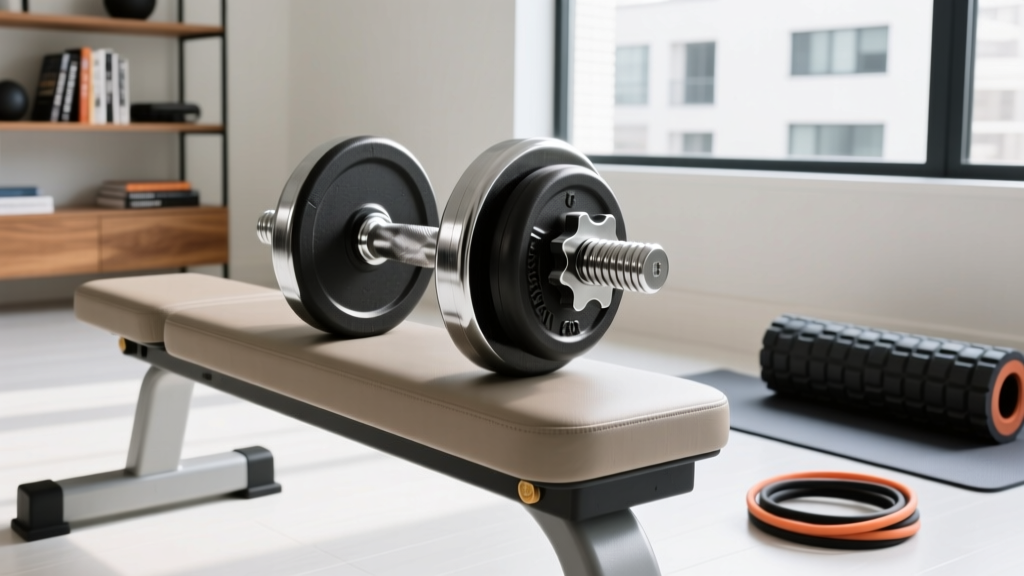
However, when transitioning from fixed hex dumbbells to adjustable dumbbells, lifters frequently encounter a massive structural roadblock: the bulky housing of adjustable weight heads. Unlike a compact 20-pound fixed iron hex dumbbell, adjustable models feature elongated dials, cradles, and plastic/metal casings that extend inches beyond the handle. When performing a spider curl, your arms hang perpendicular to the floor. At the bottom of the eccentric phase (full elbow extension), the oversized heads of adjustable dumbbells often collide with the floor, the bench frame, or the pad itself, artificially limiting your range of motion (ROM) and robbing you of the stretch-mediated hypertrophy that makes the spider curl so effective.
⚠️ Warning: Wrist Impingement RiskBecause adjustable dumbbells require a neutral or semi-pronated grip to safely engage the internal locking mechanisms, attempting to forcefully supinate (twist the pinky upward) at the top of a spider curl can cause the dumbbell housing to catch on the bench pad, leading to severe wrist torque. Always prioritize a controlled, neutral-glass lift when using dial-based adjustable models for this movement.
2026 Adjustable Dumbbell Comparison Matrix for Arm Isolation
Not all adjustable dumbbells are created equal when it comes to isolation movements. In 2026, the market is dominated by three primary engineering philosophies: dial-based, selector-pin, and sliding-collar. Below is a comprehensive breakdown of how the top models perform specifically for the spider curl setup.
| Model | Max Weight | Total Length | Spider Curl ROM Score | 2026 Retail Price |
|---|---|---|---|---|
| Nuobell 80lb | 80 lbs | 16.1 inches | 8.5 / 10 (Good) | $429 |
| Bowflex SelectTech 1090 | 90 lbs | 17.5 inches | 4.0 / 10 (Poor) | $499 |
| PowerBlock Elite EXP | 70 lbs (expandable) | 12.0 inches | 6.0 / 10 (Restricted) | $399 |
The Verdict on Hardware: The Nuobell 80 is the undisputed champion for spider curls. Its handle length and weight distribution mimic a traditional fixed dumbbell, and the knurled steel handle allows for a secure grip without the need for a restrictive cage. The Bowflex 1090 is simply too long; unless you are over 6'2" and using a heavily elevated bench, the plastic dials will strike the floor before your elbow reaches full extension. The PowerBlock Elite solves the length issue with its compact 12-inch profile, but its square cage design physically blocks the natural wrist supination required to peak the bicep contraction at the top of the movement.
Complete Walkthrough: Setting Up Your Spider Curl Station
To execute the spider curl with adjustable dumbbells safely and effectively, you must calibrate your environment. Follow this exact installation and setup walkthrough to eliminate the 'clunk' of plastic hitting the floor and maximize muscle fiber recruitment.
Step 1: Bench Angle and Chest Pad Calibration
Do not use a flat bench. You need an adjustable Flat/Incline/Decline (FID) bench.
- Back Pad Angle: Set the incline to exactly 45 degrees. A 60-degree angle shifts too much tension onto the anterior deltoids, while a 30-degree angle fails to induce the necessary active insufficiency in the long head.
- Seat Pan Angle: Tilt the seat pan up to 15 or 30 degrees. This creates a 'bucket' effect, preventing your glutes from sliding down the pad as you curl heavy adjustable dumbbells.
- Pad Thickness Check: Ensure the bench pad is at least 2.5 inches thick. Thinner pads will cause your sternum to press uncomfortably against the metal support frame when breathing heavily during high-rep sets.
Step 2: Floor Clearance and Bench Elevation
This is the most critical setup step for adjustable dumbbell users. Because the Nuobell and Bowflex heads add 3 to 4 inches of length on each side of the handle, standard bench height (usually 17 inches from the floor) will result in ground impact.
- Measure your arm length: From the acromion process (shoulder joint) to the base of your dumbbell head when the arm is fully extended.
- Elevate the bench: If your dumbbell head sits within 2 inches of the floor, you must elevate the bench. The safest method is to place 45lb rubber bumper plates flat on the floor under each of the bench's four feet. This raises the bench by roughly 2.5 inches, providing the necessary clearance for full eccentric extension without the adjustable dial mechanisms striking the ground.
- Verify stability: Ensure the bumper plates are perfectly aligned and the bench does not wobble laterally before loading your dumbbells.
Step 3: Weight Selection and Dialing Mechanics
Spider curls are an isolation movement; ego lifting here will result in distal bicep tendon strain. Studies published in the Journal of Strength and Conditioning Research consistently show that moderate loads taken close to failure yield equal or greater hypertrophic outcomes compared to heavy loads, especially for single-joint movements.
- Micro-loading: Set your Nuobell or Bowflex dials to a weight that allows for 12-15 strict repetitions. For most intermediate lifters, this falls between 20 lbs and 35 lbs per hand.
- Engage the Lock: Always lift the dumbbell straight up out of the cradle. Never twist the handle while the dumbbell is resting in the tray, as this will misalign the internal selector pins and cause weight plates to drop mid-rep.
Execution Mechanics & Troubleshooting Edge Cases
Even with a perfect setup, adjustable dumbbells introduce unique edge cases during the spider curl. Here is how to troubleshoot them on the fly.
💡 Pro-Tip: The 'Hammer' ModificationIf you find that the adjustable housing still grazes the bench pad at the top of the concentric phase, switch to a neutral (hammer) grip. Keep your palms facing each other throughout the entire range of motion. This not only clears the bench pad but also shifts emphasis to the brachialis, pushing the bicep peak higher.
- Failure Mode 1: Forearm Fatigue Precedes Bicep Failure. Cause: The thick, aggressive knurling on adjustable handles combined with a tight grip restricts blood flow. Fix: Use lifting straps. While controversial for pulling movements, straps on spider curls remove grip from the equation, allowing you to push the bicep to true mechanical failure.
- Failure Mode 2: Asymmetrical Dial Slipping. Cause: Sweat and chalk accumulate in the dial grooves, causing the internal mechanism to slip from 25 lbs down to 20 lbs mid-set. Fix: Wipe the dials with a microfiber cloth and a light spritz of isopropyl alcohol between sets. Never use liquid chalk directly on the handle; apply it only to the palms.
- Failure Mode 3: Shoulder Swing. Cause: The chest pad is set too low, allowing the upper chest to lift off the pad. Fix: Ensure the top edge of the bench pad rests exactly at the clavicle (collarbone). Your armpits should hang just over the top edge of the pad.
Dial & Cradle Maintenance for Longevity
Adjustable dumbbells are precision instruments. The setup of your station must include a maintenance protocol to ensure the internal weight selectors do not degrade. When performing spider curls, you are often picking up and returning the dumbbells to the cradle while fatigued, leading to 'dropped' returns that can shatter the plastic base trays.
Installation of a Drop-Mat: Install a 1/2-inch thick EVA foam interlocking mat directly beneath your bench and cradle station. If you miss the cradle return slot while exhausted, the foam will absorb the kinetic energy, preventing the plastic dial housings from cracking. Furthermore, every 90 days, use a can of compressed air to blow out the cradle tracks. Dust and rubber shedding from bumper plates will accumulate in the tracks, preventing the dumbbells from seating fully, which is the number one cause of selector pin failure in dial-based adjustable dumbbells.
Final Thoughts on Your 2026 Arm Setup
The spider curl remains a staple for elite arm development, but integrating it into a home gym reliant on adjustable dumbbells requires spatial awareness and mechanical respect. By selecting a compact, handle-centric model like the Nuobell 80, elevating your FID bench to guarantee full eccentric clearance, and maintaining strict dial hygiene, you can achieve the exact same hypertrophic stimulus as a commercial gym full of fixed iron. Respect the biomechanics, calibrate your bench, and let the short head of the bicep do the work.
More gear to consider
All reviews
Rubber vs Urethane: Care Tips for Seated Dumbbell Wrist Curls

Dumbbell Weight Lifting Exercises to Kettlebells: 2026 Buyer's Guide

Colorful Dumbbells vs Adjustable: 2026 Beginner Guide

The Broken Hex Dumbbell Crisis: 2026 Kettlebell Market Trends & Buying Guide
Dumbbell Incline Floor Press: Rubber Hex vs Urethane Longevity Tips