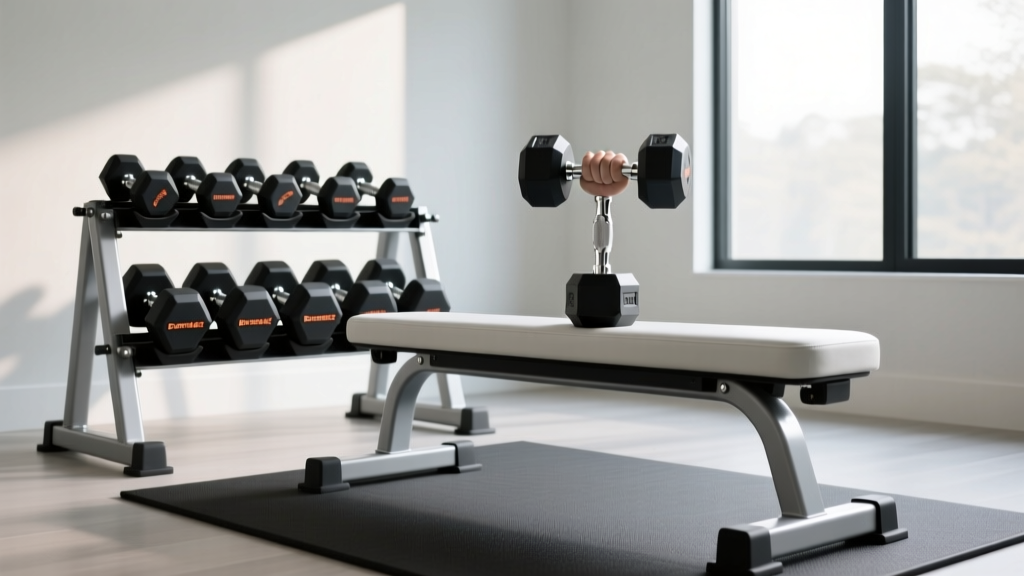
Adjustable Dumbbell Setup for Dumbbell Bench Press Hammer Grip
Compare top adjustable dumbbells and learn the exact bench and rack setup needed to safely execute the dumbbell bench press hammer grip at home.

The Intersection of Space-Saving Gear and Neutral Pressing
Building a home gym in 2026 often means balancing limited square footage with the need for versatile, heavy-duty equipment. Adjustable dumbbells have become the cornerstone of the modern garage gym, but not all selectorized systems are created equal—especially when you change your hand orientation. When you transition from a standard pronated press to the dumbbell bench press hammer grip, you fundamentally alter the kinematic chain, the range of motion, and the spatial requirements of the lift.
The hammer grip (neutral grip) places the wrists in a stacked, anatomically natural position, heavily recruiting the clavicular head of the pectoralis major, the anterior deltoids, and the triceps brachii. According to the ExRx exercise directory, this neutral variation also reduces shoulder impingement risks by allowing the elbows to tuck closer to the torso. However, this tucked elbow path and the inward-facing dumbbell heads create unique clearance issues for adjustable dumbbells, which are often bulkier than their fixed iron counterparts.
This comprehensive guide will compare the top adjustable dumbbells on the market through the specific lens of the hammer grip press, followed by a complete, step-by-step bench and power rack installation walkthrough to ensure your setup is safe, biomechanically sound, and optimized for heavy pressing.
2026 Adjustable Dumbbell Comparison for Hammer Pressing
When executing the dumbbell bench press hammer grip, the dumbbells travel closer together at the top of the concentric phase. If your adjustable dumbbells have overly bulky ends or excessive handle length, the weights will collide before your chest achieves a full contraction. Below is a comparison of the three market leaders, evaluated specifically for neutral-grip pressing mechanics and durability.
| Model | Max Weight | Handle Length & Profile | Hammer Grip Clearance | Current Pricing (2026) |
|---|---|---|---|---|
| Nuobell 80lb V2 | 80 lbs | 15.5" (Standard fixed profile) | Excellent. Tapered ends prevent mid-air collision. | $449 / pair |
| Bowflex SelectTech 552 | 52.5 lbs | 15.75" (Bulky plastic dials) | Poor. Plastic housings clash during close-grip lockout. | $399 / pair |
| PowerBlock Elite EXP | 50-90 lbs (Expandable) | 12" (Compact block cage) | Good. Short length prevents clash, but blocky shape alters wrist feel. | $379 / pair |
The Bowflex 552 is an incredible tool for lateral raises and standard pressing, but its 15.75-inch length and wide dial housings make it a poor choice for the dumbbell bench press hammer grip. Because your palms face each other, the dumbbells will physically bump into one another inches away from your chest, artificially limiting your range of motion and robbing you of the peak contraction. For neutral pressing, the Nuobell or PowerBlock systems are vastly superior.
Complete Bench and Rack Installation Walkthrough
Selecting the right dumbbell is only half the battle. To safely press heavy adjustable dumbbells—where dropping them from overhead can destroy internal selector pins or dial gears—your rack and bench setup must be meticulously calibrated. Follow this installation walkthrough to configure your station.
Step 1: Bench Selection and Pad Width Calibration
For the hammer grip, your elbows will track at roughly a 30 to 45-degree angle from your torso, rather than flaring out at 90 degrees. This requires a specific bench geometry.
- Verify Pad Width: Measure your bench pad. The ideal width for a hammer-grip press is between 10 and 11.5 inches. If your bench is wider than 12.5 inches, the pad will force your elbows to flare outward, defeating the ergonomic purpose of the neutral grip and straining the rotator cuff.
- Set the Incline Angle: While the flat bench is standard, setting an adjustable FID (Flat/Incline/Decline) bench to a micro-incline of 10 to 15 degrees is highly recommended. As noted by the ACE Fitness Exercise Library, a slight incline aligns the pressing vector perfectly with the clavicular pec fibers, which are heavily activated during the hammer grip.
- Lock the Adjustment Pins: Ensure the bench's pop-pins are fully seated. The lateral torque generated when bringing heavy adjustable dumbbells into the hammer-grip starting position can cause a poorly secured bench to shift.
Step 2: Power Rack Spotter Arm Configuration
Because adjustable dumbbells contain delicate internal mechanisms (especially dial-based systems), you cannot drop them to the floor if you fail a rep. Your spotter arms are your only safety net.
- Measure Your Bottom-Range Clearance: Lie on the bench with empty hands in the hammer-grip position, touching your chest. Have a partner measure the distance from the floor to the bottom of your wrist.
- Set Spotter Arm Height: Install the safety spotter arms exactly 1.5 to 2 inches below your measured bottom-range height. This allows you to press freely without the dumbbells scraping the steel pins, but ensures that if your triceps fail, the inner plates of the adjustable dumbbells will rest on the spotter arms before the weights crush your sternum.
- Adjust the Upright Width: If you are using a squat rack with adjustable uprights, bring them inward to roughly 42 inches apart. This narrower footprint makes it easier to safely kick the heavy adjustable dumbbells up to your shoulders without the rack's vertical posts obstructing your elbows during the initial lift-off.
Never intentionally drop a selectorized dumbbell. If you fail a rep on the dumbbell bench press hammer grip, do not attempt to toss the weights to the sides as you would with fixed hex dumbbells. The lateral impact can shatter the plastic housing, strip the internal selector gears, or bend the guide rods, rendering the $400+ equipment useless. Always lower the weights to the spotter arms, disengage your grip safely, and slide out from under them.
Execution: The Kick-Up and Lockout
Getting heavy adjustable dumbbells (e.g., 70+ lbs per hand) into the hammer-grip starting position requires a specific setup sequence to avoid damaging the equipment or injuring your wrists.
- The Knee Kick: Rest the dumbbells vertically on your thighs, just above the knee joint. As you roll backward onto the bench, drive your knees upward one at a time to momentum the weights into position.
- Establish the Neutral Wrist: Before unracking fully, ensure your wrists are stacked directly over your elbows. Adjustable dumbbell handles often feature aggressive knurling; grip tightly to prevent the handle from slipping into a 'broken wrist' position under heavy load.
- The Descent: Lower the weights under a strict 2-second eccentric tempo. Keep the dumbbell heads parallel to one another. The Nuobell and PowerBlock models will allow the inner plates to pass closely to your chest, ensuring a deep, muscle-tearing stretch in the pectorals.
Frequently Asked Questions
Can I use adjustable dumbbells for close-grip hammer flyes?
Yes, but with caution. Because adjustable dumbbells have a larger physical footprint than fixed iron dumbbells, your range of motion at the bottom of a flye will be restricted by the weights touching your torso or each other. Stick to presses for heavy loading, and use lighter fixed dumbbells or cable systems for flyes.
What is the best bench material for heavy adjustable dumbbell pressing?
Look for a bench with a high-density, diamond-stitched vinyl pad. The diamond stitching provides necessary grip. When performing the hammer grip, your back will naturally want to slide up the pad due to the triceps-dominant pressing vector; a grippy pad keeps your scapulae retracted and anchored.
Do I need to recalibrate my dumbbells if I use them for hammer-grip floor presses?
Floor presses are actually an excellent alternative if you lack a power rack with spotter arms. The floor naturally acts as a spotter, stopping your elbows a few inches above the ground. As long as you set the dumbbells down gently on a thick rubber mat (minimum 3/4-inch thickness) rather than dropping them, your selectorized mechanisms will remain perfectly calibrated.
By pairing the right compact adjustable dumbbell—like the Nuobell 80lb V2—with a meticulously measured bench and spotter arm setup, you can safely and effectively utilize the dumbbell bench press hammer grip to build massive upper-body strength without sacrificing your garage floor space.
More gear to consider
All reviews
Budget Racks for Your Dumbbell Pullover Chest Workout Weights

Dead Lift Dumbbells Setup: Neoprene Home Gym Guide

Olympic Barbell Guide: Knurling vs. 15 Minute Dumbbell Arm Workout

Comparing Neoprene Dumbbell Dimensions (cm) for Home Gyms
Kettlebell Care: Cast Iron vs Competition & Dumbbell Reverse Crunch