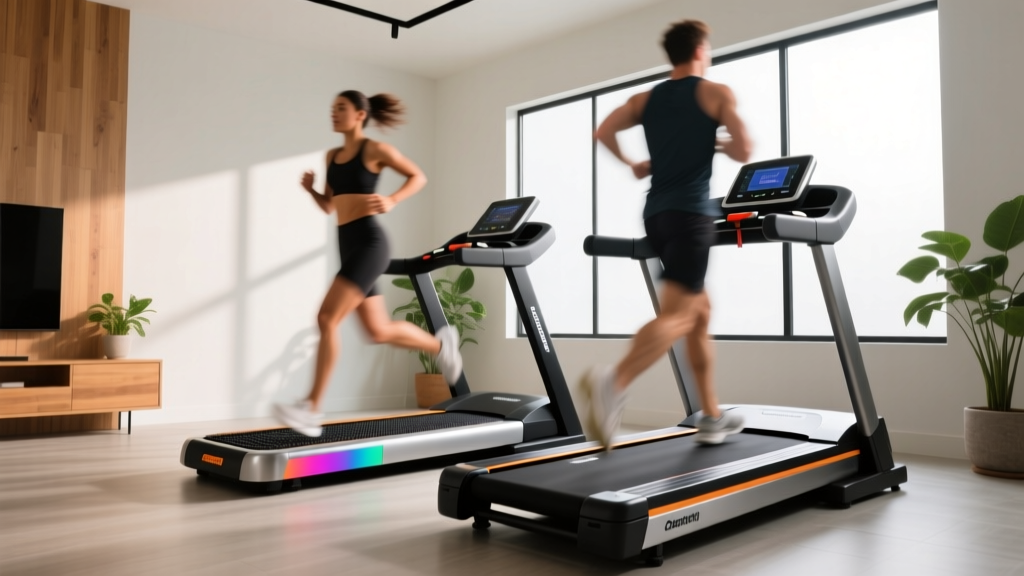
400m is Equivalent to How Many Min on the Treadmill? Folding Reviews
Discover the 2026 folding treadmill market for small spaces. We answer how many minutes a 400m sprint takes and review top compact models for HIIT.

The Micro-Cardio Trend: Why Urban Runners are Obsessed with 400m Sprints
The fitness landscape in 2026 has shifted dramatically away from hour-long steady-state jogging toward high-intensity 'micro-dosing' cardio. Urban dwellers and apartment renters are increasingly adopting track-style interval workouts—specifically 400-meter repeats—because they deliver maximum cardiovascular adaptation in minimal time. According to the American College of Sports Medicine (ACSM), short, vigorous interval bouts significantly improve VO2 max and insulin sensitivity compared to moderate continuous training.
However, translating track workouts to small-space home equipment creates a unique engineering and logistical challenge. This brings us to one of the most highly searched queries in our cardio equipment forums: 400m is equivalent to how many min on the treadmill? Answering this requires precise mathematical conversion, but executing it safely requires a folding treadmill built for rapid acceleration and long stride lengths, not a flimsy under-desk walking pad.
The Math: 400m Conversion Chart
A standard 400-meter dash equals exactly 0.2485 miles. The time it takes on a treadmill depends entirely on your belt speed (pace). Here is the exact breakdown for programming your console:
- 6.0 MPH (10:00/mi pace): 2.48 minutes (2 mins 29 secs)
- 7.5 MPH (8:00/mi pace): 1.99 minutes (1 min 59 secs)
- 8.5 MPH (7:00/mi pace): 1.75 minutes (1 min 45 secs)
- 10.0 MPH (6:00/mi pace): 1.49 minutes (1 min 29 secs)
- 12.0 MPH (5:00/mi pace): 1.24 minutes (1 min 14 secs)
Pro Tip: Most treadmill consoles allow you to set 'Distance' intervals. Set your target to 0.25 miles to closely mimic a 400m track sprint without doing mid-sprint mental math.
The 2026 Small-Space Treadmill Market: The 'Walking Pad' Trap
When consumers search for a folding treadmill for small spaces, they are often funneled toward cheap, 1.5 HP 'walking pads' that fold flat under a sofa. While excellent for low-intensity stepping, these machines are catastrophic for 400m sprint intervals. A study published in the National Institutes of Health (NIH) highlights that HIIT requires rapid acceleration and deceleration phases to trigger the desired anaerobic adaptations.
Walking pads fail on three critical fronts for sprint intervals:
- Motor Thermal Limits: A 1.5 HP motor will trip its thermal breaker when asked to rapidly accelerate a 180 lb runner from 3 MPH to 9 MPH repeatedly.
- Belt Length Physics: At 8 MPH or faster, a runner's stride extends significantly. The standard 45-inch belt on compact walking pads forces an unnatural, choppy stride, leading to severe Achilles and hamstring strain.
- Deck Flex: High-impact sprinting on thin, unsupported MDF decks transfers shock directly to the knees and shins.
To safely execute 400m repeats in a small apartment, you need a true folding treadmill—one with a vertical hydraulic fold, a minimum 60-inch belt length, and a 3.0+ Continuous Horsepower (CHP) motor.
Top Folding Treadmills for High-Intensity Micro-Workouts
We analyzed the 2026 compact fitness market to find heavy-duty folding treadmills that can handle the torque and impact of 400m sprints while still collapsing to fit in a small bedroom or living room corner.
| Model | Motor (CHP) | Belt Size | Folded Footprint | Max Speed | 2026 Price |
|---|---|---|---|---|---|
| Horizon 7.4 AT | 3.5 CHP | 22' x 60' | 37' x 35' x 76' | 12 MPH | $1,499 |
| Sole F63 | 3.0 CHP | 20' x 60' | 34' x 35' x 82' | 10 MPH | $1,199 |
| XTERRA TRX4500 | 3.25 CHP | 20' x 60' | 32' x 34' x 78' | 12 MPH | $899 |
1. Horizon 7.4 AT: The Interval King
The Horizon 7.4 AT is the undisputed leader for small-space sprinters. Its 3.5 CHP motor is overbuilt for its class, meaning it handles the rapid amp-draw of accelerating to 10 MPH for a 1.49-minute 400m sprint without overheating. The 22-inch width provides crucial lateral margin for error when fatigue sets in during the final 100 meters. Crucially, it features Bluetooth FTMS connectivity, allowing you to pair it with third-party apps like Zwift or Kinomap to automate your work/rest ratios.
2. Sole F63: The Reliable Workhorse
Sole's F63 remains a staple in the 2026 market due to its heavy-duty steel frame and Cushion Flex deck. While its 10 MPH top speed caps your 400m time at roughly 1:29 (a 6:00/mile pace), this is more than sufficient for 90% of recreational runners. The 60-inch belt length ensures your heel won't clip the rear plastic shroud during full stride extension. Its hydraulic folding mechanism is smooth, though its 82-inch folded height means it won't fit under low-slope ceilings.
3. XTERRA TRX4500: The Budget Sprint Option
For under $1,000, the XTERRA TRX4500 offers a rare 12 MPH top speed and a 3.25 CHP motor. The trade-off is a slightly narrower footprint and a less sophisticated shock absorption system. If you are running 400m repeats at high speeds, you must invest in high-stack running shoes to offset the firmer deck feel.
Engineering Constraints: Belt Length vs. Stride Mechanics
Why do we insist on a 60-inch belt for a workout that only lasts 1.5 to 2.5 minutes? The answer lies in biomechanics. As the American Council on Exercise (ACE) notes, sprinting alters a runner's kinematic chain. At 4 MPH, the average runner's stride length is roughly 40 inches. At 10 MPH, that stride length extends to 65 inches or more.
'If your treadmill belt is shorter than your maximum stride length plus a 15-inch safety buffer, your brain will subconsciously shorten your stride to prevent falling off the rear roller. This unnatural braking mechanism places immense eccentric load on the patellar tendon and hamstring insertions, drastically increasing injury risk during high-speed intervals.'
Therefore, a 50-inch or 55-inch belt—common on mid-tier folding models—is fundamentally incompatible with true 400m sprint mechanics. The 60-inch minimum is non-negotiable for high-intensity interval training (HIIT).
Buyer’s Framework: Programming the 400m Console Workout
Once you have secured a heavy-duty folding treadmill with adequate belt length and motor torque, you need to program the intervals correctly to avoid fumbling with buttons while breathing heavily. Here is the optimal framework for a standard 8x400m workout:
The 'Distance Interval' Console Hack
Do not use the 'Time' setting for 400m repeats. Because treadmill acceleration takes 3 to 6 seconds, your time-to-distance ratio will be skewed. Instead, use the Custom Interval or Distance Goal setting on your machine.
- Work Phase: Set distance to 0.25 miles. Set target speed to your sprint pace (e.g., 8.5 MPH).
- Rest Phase: Set distance to 0.10 miles (or time to 90 seconds). Set target speed to 3.0 MPH (active recovery walk).
- Repeat: 8 cycles.
This allows the machine to handle the acceleration ramp-up automatically, keeping your hands free to pump naturally.
Final Verdict: Small Space Doesn't Mean Compromised Performance
The days of sacrificing serious cardiovascular training for the sake of apartment square footage are over. The 2026 folding treadmill market has matured, offering robust, vertical-folding machines that rival commercial gym equipment. By understanding exactly how long a 400m sprint takes at various speeds, and respecting the engineering limits of motor horsepower and belt length, you can safely execute elite-level track workouts right in your living room. Ditch the walking pad, invest in a 3.0+ CHP vertical folder, and start crushing your intervals.
More gear to consider
All reviews
Building Abs on a Treadmill: Top Folding Picks for Small Spaces

Stair Climber vs Treadmill: Can I Buy a Treadmill With My HSA?
Deer Run Treadmill Z10 & Motor Size Guide: What HP Do You Need?

Curved vs Motorized: Best Treadmill Workout Apps Guide
Air Bike vs Assault Bike: Value & Deer Run Z10 Treadmill Reviews