
Small Space Home Gym Storage Ideas: Mistakes & Fixes
Discover smart small space home gym storage ideas, avoid common organization mistakes, and troubleshoot your layout with our expert guide.

The Small Space Dilemma: Why Most Setups Fail
Designing a functional fitness area in a spare bedroom, corner of the garage, or basement alcove (typically under 150 square feet) requires a radically different approach than outfitting a dedicated two-car garage. When exploring home gym storage ideas, most lifters focus on floor footprint but completely ignore volumetric space and dynamic structural loads. As of 2026, the shift toward modular micro-gyms has exposed a massive gap in consumer knowledge: buying compact equipment is only half the battle; storing it safely without compromising your drywall or your shins is the real challenge.
This troubleshooting guide dissects the most common mistakes lifters make when implementing small space equipment storage solutions, providing exact measurements, structural fixes, and high-density configurations that actually work.
4 Fatal Mistakes in Small Space Storage
Mistake 1: Overloading Drywall with Standard Pegboards
The most ubiquitous failure in small gym spaces is the use of standard 1/8-inch masonite pegboards for storing resistance bands, kettlebells, and weight plates. Masonite has a sheer failure point of roughly 15 to 20 pounds per hook when mounted to drywall. When you hang a 35-pound kettlebell or stack multiple 10-pound plate hangers, the board bows, the hooks tear through the fiberboard, and the gear crashes to the floor.
The Fix: Upgrade to 1/4-inch steel pegboard (such as the Triton Products Heavy Duty line) and bypass drywall anchors entirely. You must lag the steel board directly into 16-inch-on-center wall studs using 3/8-inch x 3-inch structural screws. If you must mount between studs, use heavy-duty steel backing plates.
Mistake 2: The 'A-Frame' Dumbbell Rack Trap
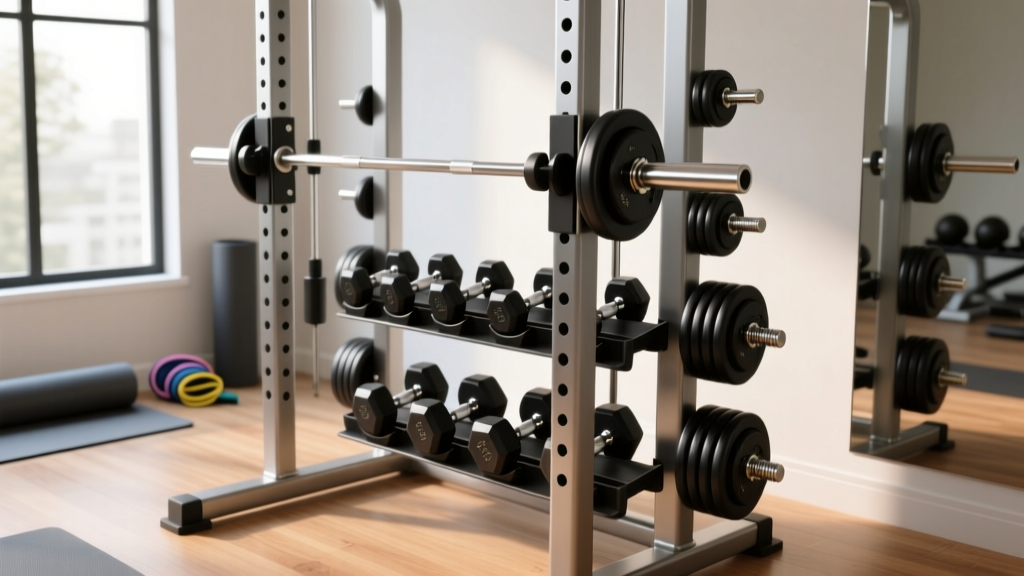
Commercial gyms use A-frame dumbbell racks because they have the floor space to spare. In a 100-square-foot home gym, a standard 3-tier A-frame rack (like the CAP Barbell A-Frame) consumes a 24x24-inch footprint—nearly 4 square feet of prime workout real estate. Furthermore, the wide base creates a severe shin-stubbing hazard during tight-space lunges or dumbbell floor presses.
The Fix: Transition to vertical wall-mounted dumbbell ladders. The Rogue Dumbbell Storage Ladder, for example, projects only 6 inches from the wall and holds up to 150 pounds per tier, reclaiming 100% of your floor space while keeping the weights at eye level for easy selection.
Mistake 3: Ignoring Dynamic Loading on Fold-Down Racks
Fold-down squat racks are the holy grail of small space equipment storage solutions. However, a common installation mistake is treating the rack's static weight rating as its dynamic rating. When you rack a 300-pound barbell aggressively, the kinetic force multiplies the static load by 1.5x to 2x. Relying on standard toggle bolts in drywall for a folding rack stringer will result in catastrophic wall failure.
⚠️ Structural Warning: According to structural guidelines highlighted by Bob Vila's expert contractors, drywall anchors are designed for static, vertical shear loads. Home gym equipment introduces lateral and dynamic kinetic forces. Always use a stud finder to locate 2x4 or 2x6 framing members, as detailed in Family Handyman's structural guides, and secure all heavy wall mounts with structural lag screws.Mistake 4: Floor-Stacking Mats and Bands
Stacking folding mats or tossing resistance bands in a corner bin seems harmless until you factor in small-space airflow. In unclimate-controlled garages or basements, floor-stacked EVA foam mats trap ambient moisture against the concrete, leading to mold growth and material degradation within months. Bands left on the floor develop flat spots and lose their elastomeric memory.
The Fix: Install a ceiling-mounted hoist system or high-wall bungee retention cords (mounted at least 7 feet high) to suspend bands and mats, allowing 360-degree air circulation and eliminating trip hazards.
Troubleshooting Matrix: Diagnosing Your Layout
If your current small space setup feels cramped or unsafe, use this diagnostic matrix to identify the root cause and apply the correct spatial fix.
| Symptom / Problem | Root Cause | Small-Space Fix |
|---|---|---|
| Barbell sleeves scraping the wall during squats | Rack J-cups positioned too close to the wall; lack of lateral clearance. | Offset the rack 4 inches from the wall using high-density rubber spacer blocks behind the uprights. |
| Kettlebells keep rolling or clanking together | Using flat shelving instead of contoured cradles. | Install angled wall-mount kettlebell shelves with UHMW plastic lining to prevent coating chips. |
| Fold-down rack hits the ceiling fan when stored | Failure to measure the folded vertical clearance arc. | Replace the ceiling fan with a flush-mount LED light, or lower the rack stringers by 6 inches. |
| Weight plates rusting rapidly | Storing plates directly on concrete floors which wick moisture. | Use a vertical wall-mounted plate tree or elevated wooden pallet risers to break the concrete contact. |
Proven High-Density Storage Configurations
When executing home gym storage ideas for micro-environments, you must think in terms of 'zones' rather than individual pieces of furniture. Here are two advanced configurations utilized by urban apartment lifters and garage-gym minimalists in 2026.
Configuration A: The 'Zero-Footprint' Wall Matrix
This setup eliminates all floor-standing storage units.
- Level 1 (Floor to 18"): Heavy-duty wall-mounted plate pegs (lagged into studs) holding bumper plates. The bottom plate rests 2 inches off the floor for easy mopping.
- Level 2 (18" to 48"): A fold-down power rack (such as the Rogue R-3 Folding Monster Lite Rack) which protrudes only 21.5 inches when folded flat against the wall.
- Level 3 (48" to Ceiling): Magnetic hooks and high-tension bungee cords securing resistance bands, lifting belts, and jump ropes directly to the metal uprights of the folded rack.
Configuration B: The Under-Bench Vault
If you use an adjustable FID (Flat/Incline/Decline) bench, the space beneath it is often dead space. Custom-fabricated slide-out wooden drawers or heavy-duty canvas sling hammocks can be tension-mounted between the bench's rear stabilizer feet. This is the ideal micro-storage solution for ankle straps, tricep ropes, chalk balls, and grip strengtheners, keeping them entirely out of the walking path.
Exact Clearances & Dimensional Requirements
To avoid purchasing gear that simply won't fit your spatial envelope, adhere to these non-negotiable minimum clearances when planning your layout:
- Folding Rack Arc: You need a minimum of 84 inches of vertical clearance to safely unfold a standard 82-inch power rack without scraping the ceiling.
- Kettlebell Wall Hooks: Hooks must project at least 8 inches from the wall to accommodate the wide handles of competition-grade kettlebells (up to 32kg) without the bell scraping the paint.
- Barbell Wall Holders: Vertical barbell holders require a minimum ceiling height of 88 inches (7'4") to allow for a 2-inch lift-off before clearing the top bracket.
- Plate Tree Aisles: If you must use a freestanding plate tree, maintain a strict 24-inch walking clearance on the loading side to prevent lumbar torque when bending to load heavy 45-pound plates.
Climate & Material Degradation in Small Spaces
Small spaces, particularly garages and sheds, suffer from rapid temperature fluctuations and poor ventilation. When selecting storage hardware, avoid cheap zinc-plated steel hooks which will oxidize and seize within a single humid summer. Opt for storage solutions featuring electrostatic powder-coat finishes (minimum 2-mil thickness) or marine-grade stainless steel hardware. Investing an extra $40 in stainless steel lag screws and carabiner clips ensures your small space storage remains safe and functional for decades, rather than requiring a full teardown and replacement due to rust jacking.
Expert Takeaway: Small space equipment storage is not about cramming as much gear as possible into a closet; it is about engineering a high-density, structurally sound ecosystem. By respecting dynamic load limits, utilizing vertical wall matrices, and adhering to strict clearance metrics, you can build a world-class training environment in less than 100 square feet.
More gear to consider
All reviews
Home Gym Weight Storage: Dumbbell Rack Setup & Installation Guide

Cold Safety Tips: Protecting Your Home Gym, Equipment, and Body in Sub-Freezing Conditions

Best Dumbbell Weight Holder Racks: 2026 Comparison
Beginner Guide to Power Rack Dumbbell Holders & Storage

The Ultimate Hex Dumbbell Rack Buying Guide & 2026 Comparison
