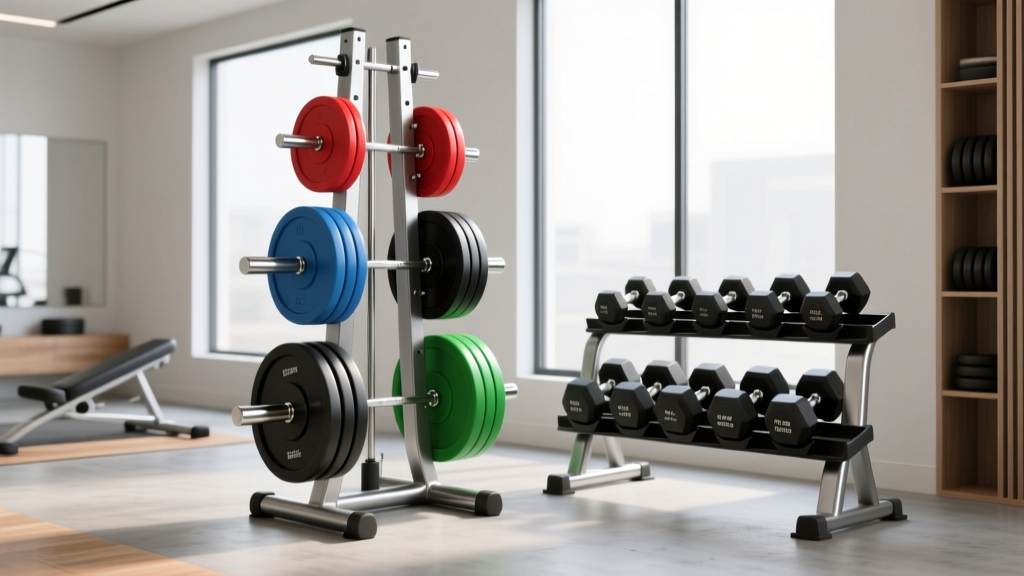
Weight Plate Trees & Dumbbell Rack Saddles: 2026 Storage Guide
Compare the best weight plate storage trees and dumbbell rack saddles for 2026. Maximize home gym space with our modular combo rack buying guide.

The Spatial Dilemma: Standalone Trees vs. Modular Combo Racks
As home gym footprints shrink and equipment arsenals grow, the debate between standalone storage units and modular rack attachments has reached a tipping point in 2026. Historically, lifters relied on a freestanding weight plate storage tree in one corner and a separate three-tier dumbbell rack in another. While functional, this approach bleeds valuable floor space and disrupts the flow of high-intensity circuits. Today, the gold standard for equipment organization lies in modular combo systems that integrate heavy-duty plate pegs and ergonomic dumbbell rack saddles directly into your power rack or rig.
Space Reclamation Metric: Replacing a standalone 5-peg A-frame weight plate tree (typically requiring a 30x30 inch base footprint for stability) and a standalone 3-tier dumbbell rack with a single rack-mounted combo system reclaims an average of 14.5 square feet of usable lifting space.Whether you are outfitting a two-car garage gym or optimizing a tight apartment workout space, understanding the structural nuances of plate horns, saddle cradles, and steel gauges is critical. This guide breaks down the engineering, safety protocols, and top-tier configurations for integrating weight plate storage trees and dumbbell rack saddles into your setup.
Anatomy of Modern Storage: Pegs, Horns, and Saddles
Before evaluating specific brands, it is essential to understand the mechanical requirements of storing dense, awkwardly shaped iron. Not all storage attachments are created equal, and mismatching your equipment to the storage mechanism is a primary cause of gear degradation and safety hazards.
Weight Plate Storage Trees and Horns
A traditional weight plate storage tree utilizes a vertical spine with protruding horns. When adapting this to a modular rack, these become 'plate storage pegs' that bolt into the uprights. The critical metric here is the horn diameter and length. Olympic plates require a 2-inch (50mm) diameter horn. However, the length of the horn dictates capacity. A standard 10-inch horn can hold roughly three 45lb bumper plates or four 45lb cast iron plates. If you own calibrated steel plates (which are thinner), you must seek out extended 14-inch or 17-inch horns to prevent plates from sliding off the tip during aggressive unloading.
Dumbbell Rack Saddles: Cradle vs. Shelf
The evolution of dumbbell storage has moved away from flat, rubber-matted shelves toward contoured dumbbell rack saddles. Saddles feature a V-shape or U-shape cradle, typically angled at 15 to 20 degrees. This incline serves two purposes: it prevents round or hex dumbbells from rolling off the rack during vibrations (like dropping a barbell nearby), and it aligns the handle ergonomically for the lifter's grip, reducing wrist extension strain during the pickup phase. Premium saddles in 2026 are lined with UHMW (Ultra-High Molecular Weight) polyethylene rather than cheap rubber, which prevents the saddle from tearing and protects the knurling or urethane coating on your dumbbells.
2026 Comparison Matrix: Top Modular Storage Ecosystems
When shopping for rack-integrated storage, you must match the attachment to your rack's upright profile (e.g., 2x2, 2x3, or 3x3 inch tubing) and hole pattern (standard 1-inch or Westside 5/8-inch spacing). Below is a comparison of the leading modular ecosystems that support both plate storage and dumbbell rack saddles.
| Brand & Ecosystem | Upring Profile | Plate Peg Specs | Dumbbell Saddle Type | Est. Combo Price (2026) |
|---|---|---|---|---|
| Rogue Monster Series | 3x3 inch (11-gauge) | 17" Extended Horns (2" dia) | UHMW-Lined Cradle Saddles | $450 - $520 |
| Rep Fitness PR-4000/5000 | 3x3 inch (11-gauge) | 12" Standard Pegs (2" dia) | Angled Rubber-Grip Saddles | $280 - $340 |
| Titan Fitness T-3 Series | 2x3 inch (11-gauge) | 10" Pegs (2" dia) | Flat Shelf w/ Lip (Non-Saddle) | $160 - $210 |
| Bells of Steel Residential | 3x3 inch (14-gauge) | 12" Pegs (2" dia) | Contoured Plastic Saddles | $220 - $270 |
According to equipment testing data from Garage Gym Reviews, the Rogue Monster and Rep Fitness ecosystems currently offer the most secure attachment mechanisms for heavy dumbbell loads, utilizing sandwich-bracket bolting rather than single-pin friction locks, which can sheer under dynamic loading.
Standalone Weight Plate Trees: When to Avoid the Rack
While rack-mounted pegs are ideal, there are scenarios where a standalone weight plate storage tree remains the superior choice. If your power rack is positioned flush against a wall, or if you utilize a squat stand setup rather than a full cage, rack-mounted storage is impossible. In these cases, an A-frame or vertical spine tree is mandatory.
⚠️ The Asymmetrical Tipping Hazard: The most common failure mode of budget-friendly, standalone weight plate trees (often priced between $60 and $90 on big-box retail sites) is base weld failure or tipping. If a tree features a 20x20 inch base and you load three 45lb bumpers on the top-left horn while the right side is empty, the center of gravity shifts outside the base footprint. Always look for trees with a minimum 28x28 inch base or those that allow for bolt-down floor anchoring.For standalone trees, the CAP Barbell 5-Tree A-Frame remains a legacy budget option, but for serious lifters hoisting 500+ lbs of iron, the Rogue RM-4000 or equivalent heavy-duty vertical trees with 3x3 upright spines and gusseted bases are the only safe investments. Expect to pay between $250 and $350 for a commercial-grade standalone tree that will not wobble when you aggressively slide a 45lb plate onto the top horn.
Dumbbell Rack Saddles: Ergonomics and Material Science
The transition from flat shelves to dumbbell rack saddles is not merely aesthetic; it is rooted in biomechanics and material longevity. When evaluating saddle attachments for your rack, pay close attention to the following specifications:
- Cradle Width and Hex Compatibility: Heavy hex dumbbells (50lbs to 100lbs) feature massive, wide heads. A standard 8-inch wide saddle will not accommodate a 90lb hex dumbbell, forcing the iron head to rest on the saddle's lip, which damages the urethane and creates a rolling hazard. Ensure your chosen saddles offer at least a 10-inch to 12-inch internal cradle width.
- Incline Angle: A 15-degree to 20-degree upward tilt is optimal. Angles steeper than 25 degrees cause smaller dumbbells to slide backward into the uprights, scraping the rack's powder coat.
- Lining Material: As noted by engineers at Rogue Fitness, UHMW plastic is vastly superior to vulcanized rubber for saddle linings. Rubber degrades, tears, and eventually exposes the bare steel bracket underneath, which will instantly destroy the knurling on your dumbbell handles. UHMW is self-lubricating, highly impact-resistant, and preserves your equipment.
Integration Strategy: The 'Sandwich' Bracket
When mounting dumbbell rack saddles to a power rack, avoid systems that rely on a single top pin resting in a hole. The repetitive lifting and replacing of 50lb+ dumbbells creates a downward sheer force that will eventually elongate the hole in your upright, causing the saddle to droop. Instead, demand a 'sandwich' or 'clam-shell' bracket system. This design uses a front plate and a rear plate that bolt tightly together through the upright hole, distributing the sheer force across the entire thickness of the steel tubing.
Expert Loading Protocols and Center of Gravity Management
Even the most robust weight plate storage tree and dumbbell rack saddle configuration can become dangerous if loaded improperly. The integration of heavy storage onto a power rack alters the rack's overall center of gravity, particularly if the rack is not bolted to a concrete floor.
"A standard 4-post power rack weighs between 250 and 350 pounds. If you mount plate pegs and dumbbell saddles exclusively on the rear uprights and load them with 600 pounds of iron, you are creating a massive rearward moment arm. During a failed pull-up or aggressive kipping motion, the rack can tip backward. Always distribute storage attachments across lateral uprights or ensure the rack is heavily bolted to the floor."
— Biomechanics and Gym Infrastructure Safety Guidelines, Rep Fitness Engineering Blog
The 4-Step Loading Hierarchy
- Bottom Tier (Ground to 12 inches): Reserve the lowest pegs and bottom-most dumbbell rack saddles for your heaviest implements (45lb/25kg plates and 70lb+ dumbbells). This anchors the center of gravity.
- Mid Tier (12 to 36 inches): Store fractional plates, change plates, and mid-weight dumbbells (30lb to 60lb) in the ergonomic 'strike zone' to minimize spinal flexion during pickup.
- Top Tier (Above 36 inches): Strictly for lightweight accessories, resistance bands, or 10lb/5lb technique plates. Never store heavy hex dumbbells at eye level; a slipped grip during re-racking can result in catastrophic facial or clavicle injuries.
- Lateral Balancing: If using a standalone tree, always load symmetrically. If you add two 45lb plates to the left horn, immediately add two to the right horn before moving to the next tier.
Final Verdict: Building Your 2026 Storage Ecosystem
The era of cluttered, space-inefficient home gyms is over. By prioritizing modular rack attachments that feature extended weight plate pegs and UHMW-lined dumbbell rack saddles, you protect your flooring, preserve your equipment's coating, and reclaim vital square footage for your actual training. If your rack profile supports it, the Rep Fitness PR-4000 or Rogue Monster ecosystems offer the most future-proof, structurally sound storage solutions on the market today. For those requiring standalone weight plate storage trees, invest heavily in base footprint and gusseted steel to mitigate tipping hazards. Treat your storage infrastructure with the same scrutiny as your barbell and plates, and your home gym will remain a safe, optimized environment for years to come.
More gear to consider
All reviews
Small Space Gym Mistakes: Troubleshooting the DBR 86 Dumbbell Rack

Wall Mounted Dumbbell Rack & Weight Plate Tree Setup

Cap Barbell A-Frame Dumbbell Rack vs Kettlebell Racks: 2026 Guide

Cold Safety Tips: Protecting Your Home Gym, Equipment, and Body in Sub-Freezing Conditions

The 2026 Market Shift to Wall Mounted Compact Dumbbell Racks
