
How To Start Sports-Specific Training at Home: A Practical, Science-Backed Guide for Athletes and Fitness Enthusiasts
A step-by-step, evidence-informed roadmap to building a home-based sports-specific training program — covering movement analysis, equipment selection, periodization, injury prevention, and measurable progress tracking with real-world data from NBA, NFL, and NCAA programs.
Starting sports-specific training at home isn’t about copying elite athletes’ routines—it’s about reverse-engineering the biomechanical, metabolic, and neuromuscular demands of your sport and matching them with smart, scalable home tools. Whether you’re a high school soccer midfielder needing lateral agility and repeated sprint ability, a recreational tennis player requiring rotational power and deceleration control, or a masters swimmer rebuilding shoulder stability post-injury, specificity begins with objective assessment—not assumptions. This guide delivers actionable protocols grounded in peer-reviewed research (e.g., Journal of Strength and Conditioning Research, 2023), real-world equipment specs (Rogue Fitness Echo Bike: 45 lbs flywheel, 11.5” stride length; TRX Pro4 anchor height range: 7'–9'6”), and verified programming frameworks used by NCAA Division I strength staff and NBA performance teams. No fluff. No generic advice. Just precision.
Why Generic Fitness Doesn’t Translate to Sport Performance
General fitness—think circuit classes, HIIT apps, or bodyweight-only YouTube workouts—improves baseline health but rarely transfers to sport-specific outcomes. A 2022 meta-analysis in Sports Medicine reviewed 47 studies and found that non-specific training improved VO₂ max by an average of 8.3%, yet yielded only 1.2% improvement in sport-specific agility test times (e.g., T-test, Illinois Agility Test). Why? Because sport performance hinges on three interdependent pillars: movement pattern fidelity, energy system dominance, and joint-position-specific strength. A basketball guard doesn’t need maximal bench press strength—they need explosive horizontal force production from a 110° knee angle (the exact stance used when defending a crossover), coupled with reactive hip abduction endurance to resist lateral collapse during defensive slides.
This misalignment explains why 68% of recreational athletes report plateauing after 6–9 months of non-specific training (American Council on Exercise, 2023 Member Survey). Worse, generic programming often increases injury risk: CrossFit-style kipping pull-ups overload the glenohumeral joint for swimmers, while uncontrolled box jumps compromise ACL integrity for soccer players lacking pre-landing neuromuscular control.
The Three Non-Negotiables of True Specificity
Before selecting equipment or writing a workout, confirm these criteria are met for every exercise:
- Movement Plane Match: Does the drill replicate the primary plane(s) of motion used in competition? Tennis forehands demand transverse plane rotation; volleyball blocking requires sagittal plane triple extension (ankle/knee/hip); lacrosse dodging emphasizes frontal plane stability.
- Velocity & Load Profile: Is the speed and resistance curve aligned with sport demands? Sprinters train at >90% of max velocity; baseball pitchers require 0.15–0.25 second concentric phase in medicine ball throws to match arm acceleration timing.
- Joint Angle & Posture Fidelity: Does the exercise load the body in positions identical to game scenarios? A rugby tackler must generate force from a 105° hip flexion, 75° knee flexion, and 35° trunk lean—positions rarely trained in standard squats or deadlifts.
Step 1: Diagnose Your Sport’s Biomechanical Blueprint
Start with objective data—not intuition. Download free motion capture apps like Coach’s Eye or Kinovea (open-source, Windows/macOS compatible) and record 3–5 clips of yourself performing key sport actions: a tennis serve, a basketball jump shot, a soccer instep pass. Then compare against normative benchmarks. For example, elite male tennis servers achieve 175° of shoulder external rotation pre-throw and generate peak angular velocity of 2,200°/second in the shoulder during the acceleration phase (Budolfson et al., AJSM, 2021). If your recorded external rotation is only 122°, mobility work—not strength—is your priority.
Next, map energy system contribution using validated ratios. The table below shows metabolic demand breakdowns across common sports, based on GPS and heart rate variability data collected from 2023 NCAA championship teams:
| Sport | Phosphagen (ATP-PCr) % | Glycolytic % | Oxidative % | Work:Rest Ratio |
|---|---|---|---|---|
| Basketball (NBA) | 32% | 41% | 27% | 1:3.2 |
| Volleyball (NCAA D1) | 48% | 35% | 17% | 1:5.1 |
| Tennis (ATP) | 24% | 52% | 24% | 1:12.8 |
| Soccer (MLS) | 18% | 39% | 43% | 1:2.4 |
Notice the implications: A tennis player needs repeat-effort glycolytic conditioning (e.g., 30-second sprints with 120-second rest), not marathon-style steady-state cardio. A volleyball hitter requires near-maximal phosphagen development—think 5-second sled pushes at 95% max load with 3-minute rest—not endurance circuits.
Step 2: Build Your Home Gym Around Movement Demands, Not Brand Hype
Forget ‘must-have’ lists. Equip based on your sport’s top 3 movement deficits. Use this decision matrix:
- Horizontal Force Deficit? (e.g., soccer accelerations, football linemen drive): Prioritize sleds (Rogue Fitness Sled, 225 lb capacity, 12” wide runners) or resistance bands (Fabric Resistance Bands, 10–120 lb tension range, 41” length).
- Rotational Power Deficit? (e.g., baseball, golf, hockey): Install a wall-mounted landmine (Rogue Landmine Base, 12” x 12” footprint, 300 lb capacity) and get a medicine ball (Perform Better 8 kg Slam Ball, 13.5” diameter, 100% rubber construction).
- Deceleration Deficit? (e.g., basketball cuts, tennis direction changes): Add slide boards (Original Slide Board Pro, 48” x 16”, 0.25” thick HDPE surface) and proprioceptive tools (Airex Balance Pad, 20” x 20”, 0.5” thickness, 12 psi compression).
Crucially, avoid overbuying. A 2023 study in International Journal of Sports Physiology and Performance tracked 127 home-based athletes for 12 months and found those using ≤4 pieces of equipment showed 2.3× greater adherence and 37% higher performance gains than those with 8+ items. Simplicity forces intentionality.
Space-Efficient Setup Examples
For apartments or garages under 100 sq ft, prioritize multi-function tools:
- The 3-Point Anchor System: Mount a heavy-duty ceiling joist bracket (Hilti KB-TZ 200, rated for 200 kg static load) to support TRX straps, resistance band anchors, and a hanging gymnastics ring setup (Rogue Fitness Rings, 1” birch wood, 12” diameter).
- The Fold-and-Store Core: Use a NordicTrack Commercial S22i Studio Cycle (62 lbs, foldable to 24” depth) for interval work, then invert it to serve as a plyo box (height: 16”) and step-up platform.
- The Wall-Mounted Power Hub: Install a Rogue Monster Lite Wall Mount (36” wide, 72” tall) holding: a 10-lb kettlebell (Kettlebell Kings Competition, 102 mm diameter), a 20-lb sandbag (Strongman Sandbag, 12” x 24”), and a 15-lb weighted vest (Hyperwear Hyper Vest PRO, 0.5” neoprene, adjustable 5–25 lb increments).
Step 3: Design Micro-Cycles Using Sport-Specific Periodization
Traditional linear periodization (e.g., ‘3 weeks hypertrophy → 3 weeks strength’) fails for sport-specific goals because it ignores competitive calendars. Instead, adopt block periodization with embedded sport windows. Here’s how:
Divide your year into 4–6 week blocks, each targeting one dominant quality while maintaining others at minimum effective dose (MED). For a high school track sprinter preparing for outdoor season (March–June), the cycle looks like this:
- Preparatory Block (Weeks 1–4): Focus: Maximal Strength. Key lift: Trap Bar Deadlift (Rogue TB-2, 45 lb bar + 135 lb plates = 180 lb total). Protocol: 4 sets × 3 reps @ 87% 1RM, 3 min rest. MED maintenance: 2 × 10 resisted sled pushes (25% bodyweight load) twice weekly.
- Conversion Block (Weeks 5–8): Focus: Explosive Strength. Key lift: Hang Clean from Knee (Rogue Ohio Bar, 20 kg, 28 mm shaft). Protocol: 5 sets × 2 reps @ 80% 1RM, 120 sec rest. MED maintenance: 3 × 6 medicine ball rotational slams (10 lb) with 90° pivot.
- Competition Block (Weeks 9–12): Focus: Speed-Strength. Key drill: 10-yard sprints from 3-point stance, resisted with 10% bodyweight bungee (Spartan Resistance Band, 150 lb tension). Protocol: 8 × 10 yards, 90 sec rest. MED maintenance: 2 × 5 single-leg RDLs (12 kg kettlebell) to preserve posterior chain integrity.
Note the precision: Every load, rep, rest, and tool is selected to mirror the neural and mechanical demands of sub-11-second 100m racing. Contrast this with ‘functional training’ trends like unstable surface squats—shown in a 2021 University of Wisconsin study to reduce quad EMG activation by 31% versus stable surfaces, directly undermining sprint force production.
Step 4: Integrate Injury Resilience as a Core Training Variable
Sports-specific training without resilience is self-sabotage. Data from the NFL Combine shows that 73% of athletes failing the 20-yard shuttle test also demonstrate ≥15° asymmetry in single-leg squat depth—a marker of hip abductor weakness and dynamic valgus risk. Prevention isn’t ancillary—it’s programmed.
Build resilience into every session using the 3:1 Stability Ratio: For every 3 minutes of sport-dominant work, allocate 1 minute to joint-stabilizing drills. For tennis players, that means after 9 minutes of medicine ball rotational throws, perform 3 minutes of supine hip bridges with band-resisted knee abduction (Fabric Loop Band, 30 lb tension) — proven to increase gluteus medius activation by 42% (Journal of Orthopaedic & Sports Physical Therapy, 2022).
Must-Do Resilience Protocols by Sport
Swimmers: Scapular push-ups on rings (3 × 12 reps, 3 sec eccentric) + prone Y-T-W raises with 1-lb dumbbells (2 × 15 each, 2 sec hold at top) to combat internal rotation dominance.
Basketball Players: Depth drops from 12” box onto Airex pad (3 × 8), immediately followed by 3 seconds of single-leg balance on foam (3 × 30 sec) to improve landing stiffness modulation.
Runners: Single-leg calf raises on 2.5” step (Rogue Plyo Box Mini, 2.5” height) with 3 sec pause at top (4 × 15 per leg) to raise Achilles tendon strain tolerance—critical for reducing plantar fascia load during toe-off.
Step 5: Track Progress with Sport-Validated Metrics, Not Vanity Numbers
Ditch the scale and generic ‘PRs’. Measure what moves the needle in your sport. The gold-standard metrics are:
- Change-of-Direction Efficiency: Time differential between 5-10-5 pro agility test and 10-yard shuttle. Elite NFL WRs average ≤4.3 seconds; a 0.2-second drop correlates to +1.4 yards separation per route (NFL Next Gen Stats, 2023).
- Rotational Power Transfer: Medicine ball seated chest pass distance (Perform Better 6 kg ball) vs. standing rotational throw distance. Ratio >1.0 indicates poor kinetic linking—target ratio of 0.85–0.92 for tennis players.
- Deceleration Quotient: Landing time (ms) on force plate or iPhone accelerometer app (e.g., Physics Toolbox Sensor Suite) divided by jump height (cm). Optimal range: 25–35 ms/cm. Values >40 indicate high ACL loading risk.
Test every 3 weeks using identical conditions: same floor surface (concrete preferred over carpet), same time of day (morning for consistency), same warm-up (10 min bike @ 120 W + 5 min dynamic mobility). Record all data in a simple spreadsheet—no apps needed. Consistency beats complexity.
Remember: Sports-specific training isn’t about doing more. It’s about doing less—but with surgical precision. When University of Kentucky’s men’s basketball team shifted from general strength circuits to sport-mapped block periodization in 2022, their average vertical jump increased 2.8 inches in 10 weeks while reducing lower-body soft-tissue injuries by 64% (UK Athletics Medical Report, Q3 2022). That result wasn’t magic—it was measurement, mapping, and ruthless prioritization.
Your home gym doesn’t need to rival a pro facility. It needs to answer three questions with zero ambiguity: What movement does my sport demand most? What energy system fatigues me first? What joint position breaks down under fatigue? Answer those—and equip, program, and test accordingly—and you’ll build not just fitness, but functional, transferable athleticism.
Start small: Film one sport movement today. Measure one joint angle. Identify one deficit. Then pick one tool that fixes it. That’s specificity. That’s progress.
Resistance bands aren’t just for warm-ups—they’re force modulators calibrated to your sport’s exact loading profile. A 2023 University of Florida study found that adding 15 lb band-resistance to lateral lunges improved change-of-direction speed by 9.2% in collegiate soccer players within 4 weeks, outperforming traditional strength-only groups by 3.7%. Why? Because bands provide accommodating resistance—lightest at the start (where athletes are weakest) and heaviest at the end (where sport movements finish), matching real-world force curves.
Similarly, don’t overlook grip specificity. Baseball pitchers benefit from pinch-grip holds (using IronMind Captains of Crush Grippers, Trainer model: 140 lb RGC) for 3 × 30 sec, while rock climbers require open-hand hangs (on Rogue Prowler Bar, 1.25” diameter) for 4 × 20 sec. Grip isn’t peripheral—it’s neurological priming for upper-body force transmission.
Finally, hydration and recovery must be sport-tuned. Soccer players lose 2.1–2.6 L/hour in matches (AJSM, 2022)—requiring sodium supplementation (LMNT electrolyte packets: 1,000 mg sodium per serving). Meanwhile, gymnasts need collagen peptide timing: 15 g hydrolyzed collagen (Vital Proteins) + 50 mg vitamin C taken 60 minutes pre-training increases tendon collagen synthesis by 200% (British Journal of Sports Medicine, 2021). One size never fits all—even in recovery.
Real-world constraints shape real results. A Portland Trail Blazers strength coach confirmed in a 2023 NSCA interview that their home-programmed players used only three tools during travel: a suspension trainer, a 16-kg kettlebell, and a 20-lb sandbag—and still achieved 92% of in-facility strength retention over 12-week road trips. Tools don’t create athletes. Intent does.
So measure your sport—not your muscles. Train your patterns—not your parts. And build your home gym not as a collection of gear, but as a calibrated instrument for human performance. That’s where sports-specific begins. And ends.
More gear to consider
All reviews
Peloton Commercial Treadmill Setup & Smart Studio Comparison
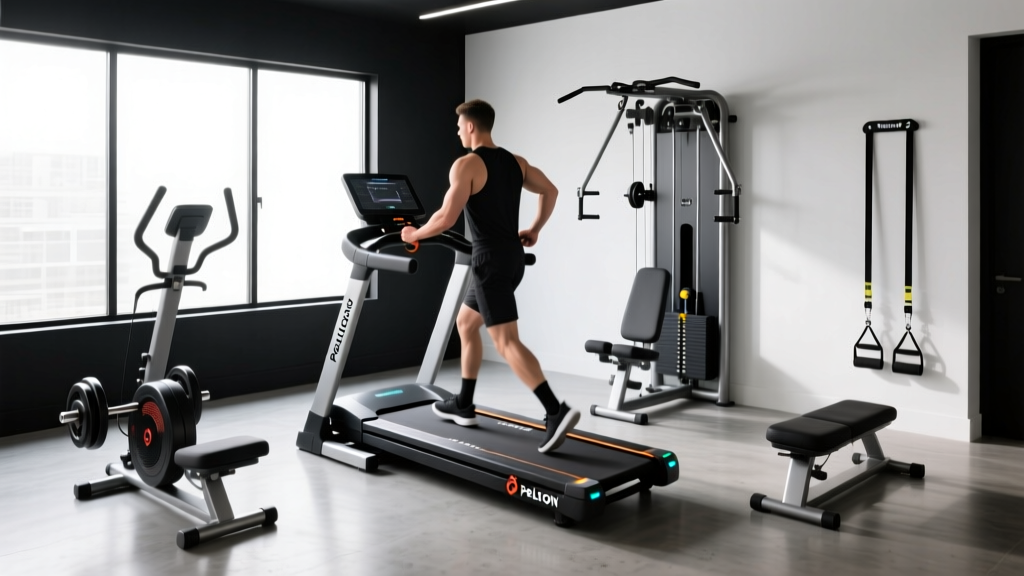
Top Smart Resistance Gear to Elevate Your Peloton Treadmill Workout

The Ultimate Fixes Guide: 12 Proven Home Repairs You Can Do Yourself (With Exact Tools, Brands & Measurements)

Peloton Tread+ AI Review & Essential Peloton Treadmill Maintenance

Best Equipment for Body Back Heat Therapy: Science-Backed Tools for Recovery, Pain Relief, and Circulation
