
Beginner Starter Kit: Space Layout for Weider XRS 50 Home Gym
Discover how to design a space-saving beginner home gym around the Weider XRS 50. Get exact layouts, clearance specs, and essential add-on gear.

The Geometry of a Beginner Home Gym
Designing a home gym in a limited space is less about interior decorating and more about applied geometry. For beginners, the goal is to maximize exercise variety without turning a spare bedroom or garage corner into an obstacle course. The Weider XRS 50 home gym is a popular anchor for new lifters because it consolidates a cable tower, weight stack, and pressing station into a single footprint. However, simply pushing it against a wall and calling it a day is a recipe for frustration, cable rub, and restricted movement.
As of 2026, building a comprehensive beginner starter kit around this machine requires a strategic approach to spatial optimization. This guide breaks down the exact operational clearances, space-saving complementary equipment, and layout blueprints you need to build a highly functional, compact home gym.
Quick Space Rule: According to the American Council on Exercise (ACE), you must always calculate the 'operational footprint' of a machine, not just its static dimensions. This includes the swing zone for cables, the extension path for moving parts, and your own body length when lying on the bench.Deconstructing the Weider XRS 50 Footprint
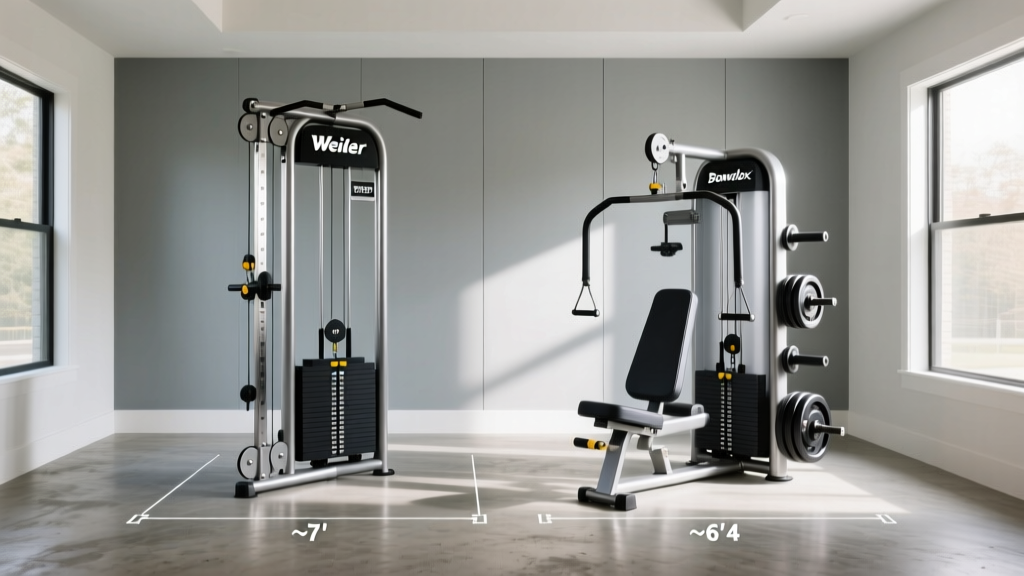
Before buying complementary gear, you must understand the spatial demands of your anchor machine. The Weider XRS 50 features a 112-pound weight stack and a multi-angle bench. Here are the critical measurements you need for your floor plan:
- Static Dimensions: Approximately 71.5' H x 41' W x 55.5' D.
- Rear Clearance (Maintenance Zone): You need a minimum of 12 inches behind the weight stack. If you flush this against a wall, you will not be able to access the cable pulleys for lubrication or replacement when they inevitably fray.
- Front Clearance (User Zone): The leg extension/curl pivot arm extends outward. Add 30 inches to the front of the machine's static depth to account for the user's legs and the bench slide.
- Lateral Clearance (Swing Zone): The lat pulldown bar is wide. You need at least 24 inches of clear space on both the left and right sides to prevent the bar from striking walls or furniture during eccentric pulls.
- Vertical Clearance (Ceiling Strike): The machine stands at 71.5 inches. When seated and pulling the lat bar down, your head and hands require an additional 12 to 15 inches of vertical space. Edge Case Warning: If you are building in a basement with drop ceilings or exposed HVAC ducts, ensure you have at least 88 inches (7 feet 4 inches) of unobstructed vertical clearance above the seat.
The Space-Optimized Beginner Add-On Kit
The XRS 50 covers basic cable movements and guided pressing, but a complete beginner starter kit requires free weights to build stabilizer muscles and correct imbalances. To maintain our space-optimization mandate, we avoid traditional dumbbell racks and fixed barbells.
1. Adjustable Dumbbells (The Space Savers)
Instead of a 15-pair dumbbell rack that consumes 20 square feet of wall space, invest in a pair of premium adjustable dumbbells. Models like the Bowflex SelectTech 552 or the Nuobell 552 range from $300 to $400 per pair. They replace up to 30 individual dumbbells, shrinking your free-weight footprint to less than 2 square feet. Store them on a compact, dual-tier cradle directly adjacent to the XRS 50 bench for seamless transitions during supersets.
2. Collapsible Kettlebell or Competition Bells
Kettlebell swings and goblet squats are essential for posterior chain development. Rather than buying a full set, purchase one or two competition-style kettlebells (e.g., 16kg and 24kg) or an adjustable kettlebell handle. Tuck these under the XRS 50 bench when not in use.
3. High-Tension Loop Resistance Bands
A set of heavy-duty loop bands (ranging from 15 lbs to 120 lbs of resistance) costs under $40 and hangs on a single wall hook. They are invaluable for warming up, adding accommodating resistance to the XRS 50 cable stack, and performing mobility work in the center of the room.
Layout Blueprints: 3 Small-Space Configurations
How you orient the Weider XRS 50 home gym dictates the flow of your workouts. Below are three optimized layouts based on common residential spaces.
| Layout Type | Ideal Room | Machine Orientation | Total Required Footprint |
|---|---|---|---|
| The Corner Anchor | Spare Bedroom / Office | 45-degree angle into the corner, facing outward. | 8' x 8' (64 sq ft) |
| The Alcove Slide | Wide Hallway / Den Nook | Flush against the back wall, centered laterally. | 10' x 6' (60 sq ft) |
| The Garage Perimeter | Single-Car Garage | Against the side wall, leaving the car bay clear. | 8' x 10' (80 sq ft) |
Pro-Tip: The 'Triangle Flow' Method
Arrange your equipment in a triangle. Place the XRS 50 at the top point, your adjustable dumbbells on a small bench at the bottom left, and your stretching/band area at the bottom right. This minimizes walking distance and keeps the center of the room open for dynamic movements.
Flooring, Mirrors, and Spatial Illusions
Space optimization isn't just about physical measurements; it's about visual and acoustic management. A cramped gym feels suffocating, which kills workout consistency.
Strategic Flooring
Avoid cheap, interlocking EVA foam puzzle mats. They compress unevenly under the point-loads of a weight stack and degrade quickly. Instead, purchase 3/4-inch thick vulcanized rubber horse stall mats (typically 4' x 6'). Cut them to fit your specific layout using a utility knife and a straight edge. Rubber absorbs the acoustic shock of dropping adjustable dumbbells, which is critical if your gym is on a second floor or shares a wall with living spaces.
Mirrors for Spatial Expansion
Mounting a large, shatterproof acrylic gym mirror on the wall directly opposite the XRS 50 bench serves two purposes. First, it allows you to monitor your pressing form and spinal alignment. Second, it visually doubles the depth of the room, reducing the claustrophobia often associated with basement or closet gyms. The Centers for Disease Control and Prevention (CDC) notes that environmental cues and pleasant spaces significantly increase adherence to regular physical activity routines.
Critical Failure Modes in Home Gym Layouts
When designing your layout, avoid these common beginner mistakes that compromise safety and equipment longevity:
- Cable Rub and Fraying: If you place the XRS 50 too close to a side wall, the lat pulldown cable will rub against the metal frame at an acute angle when you pull the bar to the opposite side. This will slice through the nylon cable coating within months, leading to dangerous snaps. Maintain the 24-inch lateral rule.
- Ignoring the Weight Stack Pin Drop: The selector pin on the XRS 50 can occasionally vibrate loose or be dropped during weight changes. If your machine is placed on a thick, plush carpet without a rigid rubber mat underneath, dropped pins will disappear into the fibers, causing frustrating workout interruptions.
- Ventilation Blindspots: Beginners often push equipment into corners where air becomes stagnant. Position a smart oscillating fan on a wall mount or high shelf to create a cross-breeze. Do not place the fan on the floor where it will blow dust into the machine's cable pulleys.
Expert Insight: 'The most common mistake I see in small home gyms is treating the space as static. Your layout must accommodate the dynamic envelope of the human body in motion. A machine might fit in a 6x6 space on paper, but a human performing a lat pulldown requires an 8x8 operational envelope to move safely and effectively.'
Finalizing Your Starter Kit Budget
Building a space-optimized home gym around the Weider XRS 50 is highly cost-effective compared to commercial gym memberships over a multi-year horizon. Here is a realistic 2026 budget breakdown for your complete, space-saving setup:
- Weider XRS 50 Home Gym: $350 - $450
- Adjustable Dumbbells (Pair): $300 - $400
- 3/4' Rubber Stall Mat (4x6): $50 - $70
- Heavy-Duty Loop Bands & Door Anchor: $35
- Shatterproof Acrylic Mirror: $80 - $120
- Total Estimated Investment: $815 - $1,075
By prioritizing operational clearances, investing in space-shifting adjustable equipment, and managing the visual environment, your Weider XRS 50 home gym will transform from a cramped corner of clutter into a highly efficient, professional-grade training facility.
More gear to consider
All reviews
Building a Modern Home Gym in Small Apartments: Full Walkthrough
Weider 8530 Home Gym vs Bowflex PR1000: Remodel Guide

Building DIY Home Gyms: The Essential Starter Kit Guide

Is the Trump Home Gym Tax Break Real? Building a Setup Under $500

Tax Deductible Home Gyms: December 2025 Rules & Mirror Placement Guide
