
Remodeling for a Marcy Home Gym Workout Routine: Budget Guide
Analyze remodeling costs, spatial requirements, and structural upgrades needed to optimize your space for a Marcy home gym workout routine.

The Spatial Reality: Designing Around the Machine
When committing to a multi-station setup like the Marcy Pro Dual Function Home Gym (PM-5788) or the Marcy Smith Cage Workout Machine (SM-4903), the physical footprint of the equipment is only half the battle. Executing a comprehensive Marcy home gym workout routine requires dynamic clearance that most standard unfinished garages or cramped basements simply do not accommodate out of the box. The SM-4903, for instance, measures roughly 86 inches long by 70 inches wide by 86 inches high. However, the biomechanics of a standard Marcy home gym workout routine involving cable crossovers, free-weight dumbbell lunges, and lat pulldowns demand an additional 36 to 48 inches of clearance on all sides.
Clearance Requirements and Spatial Budgeting
Before swinging a hammer, you must map the "swing zone." If your Marcy routine includes seated rows and standing cable triceps pushdowns, the user's body extends up to 4 feet beyond the machine's base. Remodeling a 10x10 foot alcove is insufficient. You must budget for a minimum 12x14 foot (168 square feet) dedicated zone. This spatial requirement directly impacts your remodeling budget, as it dictates the square footage for flooring, insulation, and drywall finishing.
2026 Remodeling Budget Breakdown: From Concrete to Ceiling
Transforming an unfinished space into a climate-controlled, structurally sound fitness environment requires a strategic allocation of capital. Below is a value-analysis breakdown for a standard 200-square-foot garage or basement conversion, specifically optimized for heavy multi-station equipment.
| Remodeling Phase | Material Cost (per sq ft) | Labor Cost (per sq ft) | Value & ROI Analysis |
|---|---|---|---|
| Insulation (R-19 Batts) | $0.85 - $1.20 | $1.50 - $2.50 | High ROI. Reduces HVAC load by up to 15%, paying for itself in 3-4 years. |
| Wall Reinforcement (OSB Backing) | $1.10 - $1.50 | $2.00 - $3.00 | Critical for gyms. Prevents drywall shattering from dropped dumbbells. |
| 5/8" Drywall & Finish | $0.60 - $0.90 | $1.50 - $2.50 | Medium ROI. 5/8" offers superior impact resistance over standard 1/2". |
| 3/8" Vulcanized Rubber Flooring | $2.10 - $2.80 | $0.00 (DIY Drop-in) | Essential. Protects concrete from spalling and dampens acoustic vibration. |
| LED High-Lumen Lighting | $4.00 - $6.00 (per fixture) | $150 - $300 (per room) | High ROI. 5000K daylight bulbs reduce eye strain during floor routines. |
According to industry data tracked by Angi's garage conversion guides, a full garage conversion can range from $6,000 to $25,000. However, by keeping the space as a dedicated gym rather than a permitted living space, you bypass the need for egress windows, HVAC ducting extensions, and plumbing, keeping the budget closer to the $3,500–$5,500 range for a 200-square-foot shell.
The Hidden Cost: Wall Reinforcement and Subfloor Integrity
The most common failure mode in home gym remodels is treating the space like a standard bedroom. A vigorous Marcy home gym workout routine involves dropping deadlifts, racking heavy Smith machine bars, and swinging kettlebells. Standard 1/2-inch drywall over wooden studs will dent and shatter upon impact.
Expert Warning: The OSB Backing TrickBefore hanging drywall, install 1/2-inch Oriented Strand Board (OSB) or plywood directly over the studs in the lower 48 inches of the wall. This costs roughly $35 per 4x8 sheet but provides a structural backstop that absorbs the kinetic energy of stray dumbbells, saving you hundreds of dollars in annual drywall patching and repainting.
Evaluating Subfloor Point Loads
If you are remodeling a basement or a room over a crawlspace, you must evaluate the joist system. A loaded Marcy Smith Cage, combined with a 200-pound user and 300 pounds of Olympic plates, creates a concentrated point load exceeding 800 pounds over a 4-square-foot area. While poured concrete slabs handle this effortlessly, wooden floor joists spaced at 16 inches on-center may experience long-term deflection. If your routine includes heavy, dropped free-weight movements, budget $800–$1,200 to have a contractor "sister" the existing joists with additional lumber to double the load-bearing capacity.
Climate, Lighting, and Electrical Value Analysis
A multi-station gym generates significant ambient heat and requires specific environmental controls to keep equipment from rusting and users from overheating. The EPA's guidelines on indoor air quality emphasize that enclosed spaces with high human occupancy require active ventilation to manage humidity and CO2 buildup.
- Insulation Value: Upgrading your exterior walls to R-19 or R-21 fiberglass batts is non-negotiable for garage gyms. As noted by the Department of Energy's insulation standards, proper thermal barriers prevent the "sweat-and-rust" cycle that destroys cable pulleys and weight stacks in uninsulated metal buildings.
- Electrical Circuits: Do not rely on a single 15-amp shared circuit. Budget $400–$600 for an electrician to run a dedicated 20-amp circuit. This prevents tripped breakers when running a space heater, a high-velocity fan, and a treadmill simultaneously.
- Lighting Layout: Overhead fluorescent tubes cast harsh shadows and flicker. Invest in 4000K to 5000K LED shop lights. Position them perpendicular to the Smith machine tracks to ensure even illumination during squats and bench presses, eliminating dangerous blind spots.
DIY vs. Contractor: Where to Spend and Where to Save
To maximize your remodeling budget, you must strategically divide labor between professional contractors and DIY sweat equity. Here is a value-driven framework for your remodel:
Hire a Professional For:
- Electrical Upgrades: Pulling new 20-amp circuits and installing GFCI outlets near potential sweat zones is a fire hazard if done incorrectly. Professional labor ensures code compliance and insurance validity.
- Concrete Leveling: If your garage floor has a slope greater than 1 inch over 10 feet (common for drainage), a multi-station Marcy gym will sit unevenly, causing cable tracking issues and premature wear on pulley bearings. Self-leveling concrete compound requires professional prep and pouring.
DIY to Save Capital:
- Flooring Installation: Interlocking 3/8-inch vulcanized rubber tiles require only a utility knife and a straight edge. Paying a contractor $1.50/sq ft for this is a waste of budget.
- Drywall Finishing and Painting: Mudding, taping, and painting the OSB-backed walls is time-consuming but requires no specialized licensing. Doing this yourself saves roughly $1,200 on a 200-square-foot room.
- Baseboard and Trim: Skip traditional wood baseboards, which will be destroyed by rolling weight plates. Instead, use a heavy-duty rubber cove base or simply leave a 1/2-inch expansion gap covered by the rubber floor mats.
"The ultimate value in a home gym remodel isn't found in luxury finishes like custom cabinetry or smart mirrors. It is found in structural resilience—reinforced walls, impact-absorbent flooring, and dedicated climate control that allows you to execute your Marcy home gym workout routine safely, 365 days a year, without degrading the home's envelope."
Future-Proofing Your Investment
Finally, as your strength increases, your equipment needs will evolve. When framing your walls, install 2x6 blocking between the studs at 48 inches and 72 inches off the floor. This hidden lumber backing allows you to securely mount heavy wall-ball targets, medicine ball racks, or heavy-duty storage hooks in the future without having to tear open the drywall to find a stud. By front-loading these structural considerations into your initial remodeling budget, you ensure that your space remains a high-value, functional asset that perfectly supports your fitness journey for decades to come.
More gear to consider
All reviews
2026 Budget Breakdown: Home Gym Configuration Under $500

Pmax 5600 Home Gym Smith Machine Integrated Weight System Care

Strength Training Setups: Protecting Home Gym Wallpaper
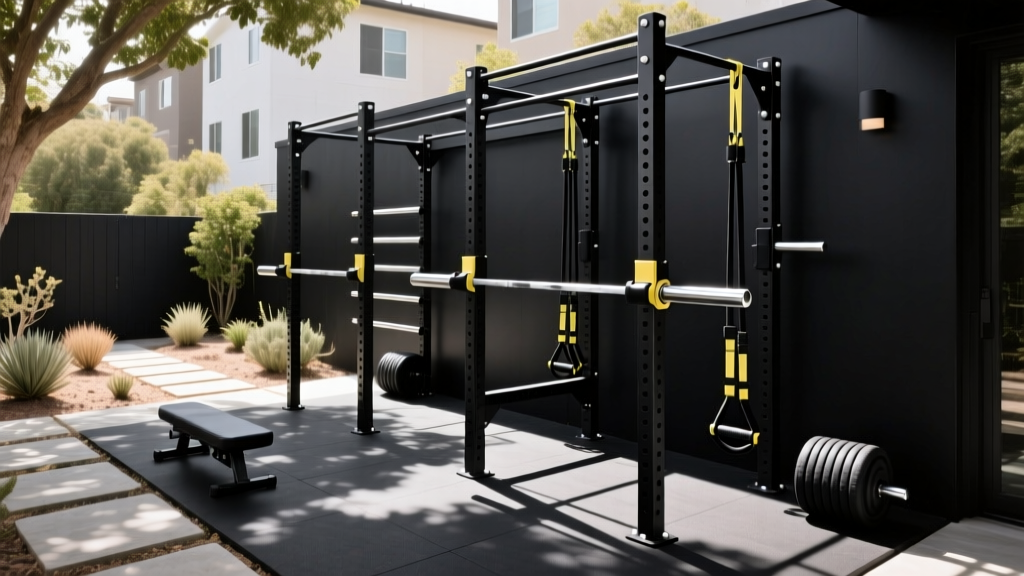
Weatherproofing Your Outdoor All Black Home Gym Setup

Weatherproofing Your Outdoor Home Gym Wall: Longevity Tips
