
Inspire M3 Home Gym Weight Guide: How Much Resistance Do You Need?
Discover how much weight you really need for your home gym. We analyze the Inspire M3 home gym, pulley ratios, and space-optimized layout strategies.

The Space-vs-Resistance Dilemma in Modern Home Gyms
When designing a home gym from scratch, the most common point of failure isn't a lack of motivation; it's a miscalculation of spatial geometry versus resistance requirements. Every lifter wants the 300-pound weight stack of a commercial cable crossover, but very few have the 60 square feet of dedicated floor space required to house it safely. This brings us to a critical question in home gym weight selection: how much weight do you actually need?
Answering this requires shifting your perspective from "total pounds" to "resistance per movement pattern." By analyzing space-optimized equipment like the Inspire M3 home gym, we can decode the mathematics of pulley ratios, isolate your true weight requirements, and design a layout that maximizes functionality without turning your garage into an obstacle course.
Calculating Your True Weight Requirements
To determine how much weight you need, you must divide your training into two distinct categories: compound free-weight movements and cable-based isolation movements. The Mayo Clinic's strength training guidelines emphasize that muscle hypertrophy and strength gains require progressive overload, but the absolute load varies wildly depending on the biomechanics of the exercise.
The 80/20 Rule of Cable Resistance:Approximately 80% of all cable-based exercises (tricep pushdowns, lateral raises, face pulls, bicep curls, and woodchoppers) rarely require more than 50 to 75 pounds of resistance per hand, even for advanced lifters. Only 20% of cable movements (heavy seated rows, cable squats, and lat pulldowns) demand loads exceeding 100 pounds.
If you are optimizing for space, you do not need a 300-pound commercial stack. You need a machine that perfectly services the 80% of isolation movements while leaving room in your layout for a compact free-weight zone to handle the heavy 20%.
Case Study in Space Optimization: The Inspire M3 Home Gym
To understand how modern engineering solves the space-to-weight ratio, let's examine the Inspire M3 home gym. The M3 is a compact, wall-mounted or corner functional trainer that has become a staple in space-restricted home gyms, apartments, and narrow garage bays.
Decoding the Specs and Pulley Ratios
The Inspire M3 features a single 165-pound weight stack. On paper, 165 pounds sounds inadequate for a serious lifter. However, the M3 utilizes a 2:1 pulley ratio. According to the principles of mechanical advantage documented in the ExRx biomechanics database, a 2:1 ratio means the weight travels twice as far as the handle, effectively halving the perceived resistance at the point of contact.
- Total Stack Weight: 165 lbs
- Pulley Ratio: 2:1
- Max Resistance Per Handle: 82.5 lbs
- Max Resistance (Dual Handles on Single Attachment): 165 lbs
For the 80% of isolation exercises mentioned earlier, 82.5 pounds per hand is exceptionally close to the ceiling of what most natural lifters will ever need for a strict, controlled lateral raise or tricep extension. By accepting this mechanical trade-off, the Inspire M3 home gym reduces its physical footprint to an astonishing 39" W x 23" D x 83" H.
Spatial Footprint Matrix: Stacks vs. Plates
How does a compact functional trainer compare to traditional weight selection methods when we factor in the "hidden space" required for safe operation? The table below illustrates the true spatial cost of different resistance modalities.
| Equipment Modality | Max Resistance | Physical Footprint | Required Operational Clearance | Est. Cost (2026) |
|---|---|---|---|---|
| Inspire M3 Functional Trainer | 82.5 lbs / hand | 6.2 sq ft (Wall/Corner) | 36" frontal clearance | $1,699 |
| Standard Olympic Plate Tree (500 lbs) | 500 lbs (Plates) | 9 sq ft (Base) | 48" radial clearance for loading | $350 (Tree) + $900 (Plates) |
| Commercial Dual-Stack Crossover | 200 lbs / side (1:1) | 45 sq ft | 72" frontal clearance | $3,500+ |
As the data reveals, the Inspire M3 home gym eliminates the 48-inch radial clearance required to load and unload Olympic plates, effectively saving you roughly 25 to 30 square feet of prime gym real estate.
Layout Design: Clearances and Traffic Flow
Selecting the right weight stack is only half the battle; integrating it into your room's layout is where space optimization truly happens. When placing a compact cable machine like the M3, you must adhere to strict clearance metrics to ensure full range of motion (ROM) and safety.
The 36-Inch Rule for Cable Machines
For wall-mounted or shallow-depth functional trainers, the National Strength and Conditioning Association (NSCA) recommends a minimum of 36 inches of unobstructed space in front of the machine. However, for exercises that require backward stepping—such as cable lunges, face pulls, or standing tricep extensions—48 to 60 inches of clearance is optimal.
"A common layout failure in home gyms is placing a cable machine directly facing a squat rack. If the clearance between the two stations is less than 5 feet, you will physically clash with the barbell sleeves during cable crossovers or lateral walks, rendering both stations unusable simultaneously."
Strategic Mirror Placement
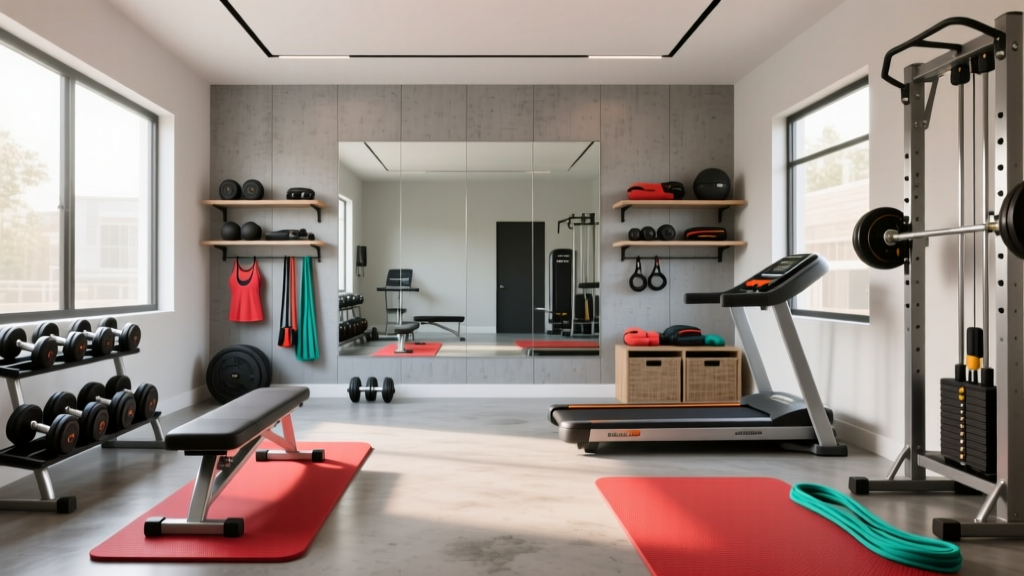
To enhance the perception of space and allow for form-checking without requiring extra floor depth, install a wall of mirrors on the adjacent perpendicular wall rather than directly behind the machine. This allows you to monitor your cable alignment while keeping the rear clearance flush against the drywall.
Bridging the Gap: Supplementing Your Weight Selection
The primary limitation of the Inspire M3's 2:1 pulley ratio is that it cannot replace heavy compound lifting. You cannot perform a 225-pound seated cable row or a heavy cable squat with an 82.5-pound per-hand limit. Therefore, a space-optimized home gym layout must pair the M3 with a secondary, high-load, low-footprint free-weight solution.
The Ideal Space-Saving Pairing:
- The Cable Zone (Inspire M3): Dedicated to all isolation work, core rotations, rehab, and high-rep hypertrophy. Mounted in a corner to utilize dead space.
- The Compound Zone (Folding Wall Rack + Adjustable Dumbbells): A wall-folding squat rack (which folds down to 4 inches of depth) paired with a set of adjustable dumbbells (e.g., Nuobell or PowerBlock, ranging from 5 to 80 lbs). This covers heavy squats, bench presses, and rows without requiring a permanent 4x4 foot power cage or a massive plate tree.
Future-Proofing Your Resistance Without Expanding Your Footprint
As you grow stronger, you may eventually max out the 165-pound stack on certain bilateral movements. Before considering an upgrade to a larger machine, utilize resistance band integration. By choking a heavy loop band (providing 40-80 lbs of variable tension) around the base of the Inspire M3 and attaching it to the cable carabiner, you can artificially increase the peak resistance at the end of the concentric phase without adding a single square inch to your gym's layout.
Ultimately, deciding how much weight you need isn't about buying the heaviest stack available; it's about understanding the biomechanics of your exercises and selecting equipment that respects the physical boundaries of your home. The Inspire M3 home gym proves that with intelligent pulley ratios and strategic layout planning, premium resistance training is possible in even the most severely space-constrained environments.
More gear to consider
All reviews
Space-Saving Body Craft Home Gym Setup for Apartments
Top Home Gym Tips and Hacks for Budget Renovations

Weatherproofing Your BodyBoss Home Gym 2.0 Outdoor Setup

How to Design a Home Gymnastics Gym: Floor Plans & Setup Guide

Vectra 1400 Home Gym vs Essential Starter Kit (2026)
