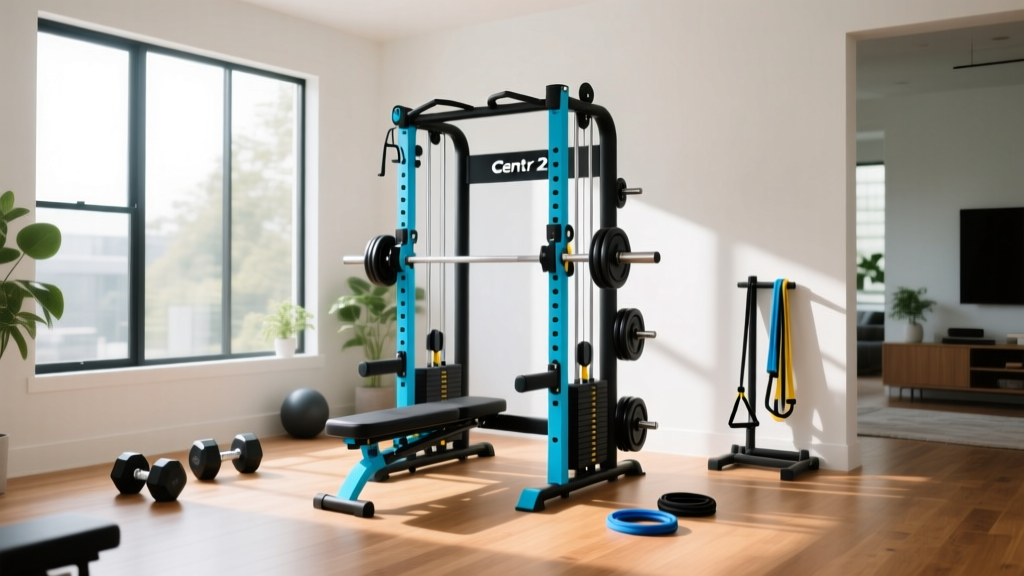
Inspire M3 Home Gym Review: Space-Optimized Weight Guide
Discover how much weight you actually need with our Inspire M3 home gym review. Master space optimization and layout design for compact home gyms.

The Space vs. Resistance Dilemma in Modern Home Gyms
As home fitness evolves in 2026, the era of the sprawling, 400-square-foot garage gym is being rapidly replaced by high-density, space-optimized workout rooms. Whether you are converting a 10x10 spare bedroom or carving out a corner of your basement, the primary bottleneck is no longer just budget—it is floor space. This spatial constraint forces a critical question for every home gym builder: How much weight do you actually need?
Traditional free-weight setups demand massive spatial sacrifices. A standard power rack requires a minimum footprint of 4x4 feet, but when you factor in the 86-inch width of an Olympic barbell, plate storage trees, and the necessary clearance for loading and unloading bumpers, you are easily consuming 60 to 80 square feet of usable floor space. For compact layouts, this is mathematically unfeasible. This is where all-in-one functional trainers enter the conversation, promising high resistance in a fraction of the footprint. To understand how to balance spatial efficiency with adequate resistance, we are using the Inspire M3 Home Gym as our core case study.
Inspire M3 Home Gym Review: A Masterclass in Spatial Efficiency
The Inspire M3 Functional Trainer is a staple in the premium home gym market, retailing between $2,799 and $2,999 in 2026. It is designed specifically to eliminate the 'dead space' associated with plate-loaded machines. Let us break down the exact spatial and mechanical specifications that make it a benchmark for layout optimization.
Core Specifications & Footprint
- Dimensions: 54 inches (W) x 54 inches (D) x 84 inches (H)
- Total Footprint: 20.25 square feet
- Weight Stacks: Dual 165 lb selectorized stacks (330 lbs total)
- Pulley System: 20 adjustable positions, 2:1 pulley ratio
- Loading Clearance Required: 0 inches (eliminates plate-loading zones)
By housing the resistance internally, the M3 allows you to push the unit flush against a wall or into a corner. Unlike a squat rack that requires 24 to 36 inches of lateral clearance for a user to slide plates onto the barbell sleeves, the M3 requires zero lateral loading space. This single feature recovers up to 15 square feet of floor space in a standard room layout, allowing room for an adjustable bench, a compact cardio unit, or dedicated stretching zones.
The 2:1 Pulley Ratio Edge Case (Critical Warning for Heavy Lifters)
While the M3 is a triumph of space optimization, it presents a specific biomechanical edge case that buyers must understand. The machine utilizes a 2:1 pulley ratio. This means that for every two feet of cable pulled, the weight stack moves one foot. Consequently, the resistance felt at the handle is exactly half of the selected stack weight.
Selecting the maximum 165 lbs on a single stack yields only 82.5 lbs of actual resistance per handle. For upper-body isolation movements, cable crossovers, and rehabilitation work, this is more than sufficient. However, if your training protocol relies on heavy, low-pulley compound movements like squats or deadlifts, the M3's 165 lb stack will max out quickly. According to guidelines from the National Strength and Conditioning Association (NSCA), advanced lifters require progressive overload that frequently exceeds 200 lbs for lower-body compound lifts. To mitigate this in a space-constrained setup, you must utilize the M3's included leg press board accessory, which alters the leverage and allows you to safely push the stack to its mechanical limit without relying on a barbell.
How Much Weight Do You Actually Need? (The Biomechanics Breakdown)
To optimize your layout, you must decouple the idea of heavy weight from the reality of your training needs. Many home gym owners purchase 500 lbs of Olympic plates out of a fear of 'stalling' their progress, only to realize that 80% of their accessory work requires less than 50 lbs per limb. The Mayo Clinic emphasizes that muscle hypertrophy and strength gains can be achieved through varied resistance modalities, provided the muscle is taken close to failure.
Below is a spatial cost analysis comparing traditional plate requirements against the M3's selectorized stacks for common movement patterns.
| Movement Category | Avg. Advanced Load (Per Limb/Side) | M3 Stack Equivalence | Space Required (Plates vs. M3) |
|---|---|---|---|
| Bicep Curls / Tricep Pushdowns | 30 - 60 lbs | Adequate (Stack feels like 82.5 lbs max) | Plates: 12 sq ft / M3: 0 sq ft |
| Lat Pulldowns / Seated Rows | 120 - 180 lbs (Total) | Adequate (Dual stack linkage = 165 lbs) | Plates: 25 sq ft / M3: 0 sq ft |
| Cable Crossovers (Chest) | 40 - 75 lbs per hand | Borderline (Maxes out at 82.5 lbs/hand) | Plates: 30 sq ft / M3: 0 sq ft |
| Heavy Squats / Deadlifts | 225 - 400+ lbs (Total) | Inadequate via handles (Requires Leg Press Board) | Plates: 60+ sq ft / M3: 0 sq ft |
Traditional Free Weights vs. Selectorized Stacks: A Spatial Cost Analysis
When deciding how much weight to integrate into your layout, consider the 'hidden' spatial costs of traditional iron. The American Council on Exercise (ACE Fitness) notes that functional cable machines provide constant tension throughout the entire range of motion, a biomechanical advantage that free weights cannot offer due to gravity's vertical pull. This constant tension means you often require less absolute weight on a cable stack to achieve the same muscular fatigue as a dumbbell or barbell.
Layout Decision Framework
- Choose Plates If: You are a powerlifter or Olympic weightlifter whose primary metric of progress is the absolute 1-rep max on the squat, bench, and deadlift. You must allocate a minimum 12x12 foot space for safety and plate maneuverability.
- Choose the Inspire M3 If: Your goals are hypertrophy, athletic conditioning, general fitness, or joint-friendly rehabilitation. You want to maintain a 10x10 room footprint while retaining access to over 100 distinct cable-pull angles.
Layout Blueprint: Integrating the M3 into a 10x10 Room
To visualize the space optimization, let us map out a precise layout for a standard 10x10 foot spare bedroom (100 square feet) utilizing the Inspire M3.
Step 1: The Anchor Point
Place the M3 in the far corner of the room. Because it requires no lateral loading space, you can push the 54-inch sides directly into the corner, leaving the 84-inch height to clear standard 8-foot or 9-foot ceilings. Pro Tip: Leave a 2-inch gap from the wall to prevent the weight stacks from vibrating against the drywall during heavy drops.
Step 2: The Active Zone
The cables on the M3 extend up to 6 feet. To utilize the full range of motion for lunges and crossovers, you need a clear 'Active Zone' of 6x6 feet directly in front of the machine. In a 10x10 room, placing the unit in the corner naturally creates this 6x6 foot diagonal clearance without blocking the room's entryway.
Step 3: Flooring and Accessories
Skip the expensive interlocking tiles. Purchase four 3/4-inch thick rubber horse stall mats (typically 4x6 feet each). Cut two of them to create an 8x8 foot shock-absorbent platform in the Active Zone. Place a compact, adjustable FID (Flat/Incline/Decline) bench in the center of this zone. Because the M3 replaces the need for a dumbbell rack (which normally consumes 15-20 sq ft), your 10x10 room will feel remarkably open, leaving enough perimeter space for a yoga mat and a compact folding treadmill.
Final Verdict on Space-Optimized Weight Selection
Answering the question of 'how much weight you need' is entirely dependent on your spatial reality and training methodology. If you are restricted to a compact room, buying 400 lbs of iron plates is a logistical error that will choke your layout and limit your movement options. The Inspire M3 proves that with intelligent pulley engineering and a 20-square-foot footprint, a dual 165 lb stack is more than sufficient for 90% of the population's hypertrophy and functional fitness needs. By prioritizing spatial efficiency and understanding the biomechanics of cable ratios, you can build a world-class home gym that enhances your living space rather than consuming it.
More gear to consider
All reviews
Old Weider Home Gym Models: Space-Saving Beginner Starter Kit Guide

Home Gym Equipment Assembly in Philadelphia: Apartment Setup Guide
Maintaining Your Bedroom Home Gym: Longevity Tips for Small Spaces
Clever Home Gym Ideas for Small Apartments: Full Setup Guide

What Thickness Rubber Flooring for Home Gym in Small Spaces