
Expert Home Gym Floor Ideas & Complete Layout Plans
Discover top home gym floor ideas and complete layout plans. Our expert hands-on review covers rubber mats, interlocking tiles, and 3D floor plans.

The Foundation: Why Your Flooring Dictates Your Floor Plan
When designing a training space, most lifters obsess over power racks and cable machines, treating the ground beneath them as an afterthought. But as any seasoned strength coach will tell you, your physical flooring material and your spatial floor plan are inextricably linked. The right surface protects your subfloor, dampens acoustic shock, and provides the necessary friction for heavy compound lifts. More importantly, exploring practical home gym floor ideas is the very first step in zoning your layout for optimal traffic flow and safety.
In this hands-on review, we are breaking down the best flooring materials on the market in 2026, followed by three complete, dimensionally accurate floor plans for garages, basements, and spare rooms. We will also cover the hidden failure modes that ruin expensive setups.
Hands-On Review: Top Flooring Materials Tested
After spending the last decade testing everything from cheap EVA foam puzzle mats to commercial-grade rolled rubber, we have narrowed the field to the only three options worth your money. According to facility guidelines referenced by strength and conditioning professionals, a proper lifting surface must have a Shore A durometer rating between 60 and 75 to balance shock absorption with stability.
1. The Gold Standard: 3/4" Vulcanized Horse Stall Mats
Specifically, the Rogue Fitness RM-6 Mats. These 4'x6' behemoths weigh roughly 105 lbs each and are made from vulcanized rubber. Unlike standard crumb rubber, vulcanization creates a non-porous surface that won't absorb sweat or harbor bacteria.
Hands-On Verdict: Unmatched durability. You can drop a 500-lb barbell from overhead, and the mat won't flinch. The trade-off? They are incredibly heavy to move, and the initial off-gassing smell requires about two weeks of garage ventilation to dissipate.
2. The Precision Fit: Interlocking Rubber Tiles
The Rep Fitness 3/4" Interlocking Tiles are the go-to for spaces where wall-to-wall coverage is required without cutting massive rolls. Priced around $3.50 per square foot, they offer a tighter, more aesthetic seam than stall mats.
Hands-On Verdict: Excellent for dedicated home gyms. However, under extreme lateral shear forces (like heavy sled pushes), the interlocking teeth can stretch and separate over time if not secured with double-sided carpet tape.
3. The Budget Trap: EVA Foam Puzzle Mats
Often sold in 5/8" or 3/4" thicknesses for under $1.50 per square foot.
Hands-On Verdict: Avoid these for heavy lifting. EVA foam compresses under heavy loads, creating an unstable base for squats and deadlifts. They are strictly for yoga, light bodyweight work, or kids' play areas.
Flooring Comparison Matrix
| Material | Est. Cost (2026) | Best Use Case | Primary Drawback |
|---|---|---|---|
| 3/4" Vulcanized Mats | $2.10 - $2.50 / sq ft | Olympic lifting, heavy drops | Heavy, requires seam taping |
| 3/4" Interlocking Tiles | $3.25 - $4.00 / sq ft | Wall-to-wall aesthetic setups | Seam separation under sleds |
| 1/2" Rolled Rubber | $2.00 - $2.80 / sq ft | Commercial feel, cardio zones | Too thin for heavy deadlift drops |
| EVA Foam Tiles | $0.80 - $1.50 / sq ft | Yoga, mobility, stretching | Dangerous instability for heavy loads |
Designing the Layout: 3 Complete Home Gym Floor Plans
Once you have selected your surface, it is time to map the space. A proper floor plan zones equipment by biomechanical function, ensuring you never have to walk through a loaded barbell's path to reach the dumbbell rack.
Plan A: The 2-Car Garage Powerhouse (400 Sq Ft / 20'x20')
The 2-car garage is the holy grail of home gym real estate. Here is how to zone a 20x20 foot space for maximum efficiency:
- Zone 1: The Heavy Lifting Platform (Center-Left). Dedicate a 4'x8' raised deadlift platform flush with the surrounding 3/4" rubber mats. This centralizes the heaviest loads and protects the concrete from repetitive impact.
- Zone 2: The Power Rack & Cable Hub (Back Wall). Mount your rack against the rear wall, leaving 36 inches of clearance behind it for plate storage and lat pulldown attachments. This anchors the room and keeps long barbells from protruding into walkways.
- Zone 3: Dumbbell & Accessory Alley (Right Wall). Place a 3-tier dumbbell rack (5-50 lbs) and an adjustable bench along the right wall. This creates a dedicated hypertrophy zone away from the Olympic barbell path.
- Zone 4: Cardio & Conditioning (Front-Left). Position an air bike or rower near the garage door. This allows for easy ventilation during high-output metabolic conditioning.
Plan B: The Basement Functional Fitness Zone (250 Sq Ft / 15'x16')
Basements offer great temperature control but present severe overhead clearance challenges. If your basement ceiling is 8 feet high, subtract 12 inches for HVAC ducts and joists, leaving you with 7 feet of clearance.
Expert Warning: A standard pull-up bar on an 84" power rack requires the user's head to clear the bar. In a low-ceiling basement, opt for a 72" or 80" short rack, and avoid overhead pressing inside the rack. Instead, designate a specific 'overhead zone' away from ductwork.
Layout Strategy: Use interlocking rubber tiles wall-to-wall to maximize usable square footage. Push all tall storage (plate trees, dumbbell racks) into the corners where ceiling height is typically highest. Keep the center completely open for kettlebell swings, sled work, and gymnastics movements.
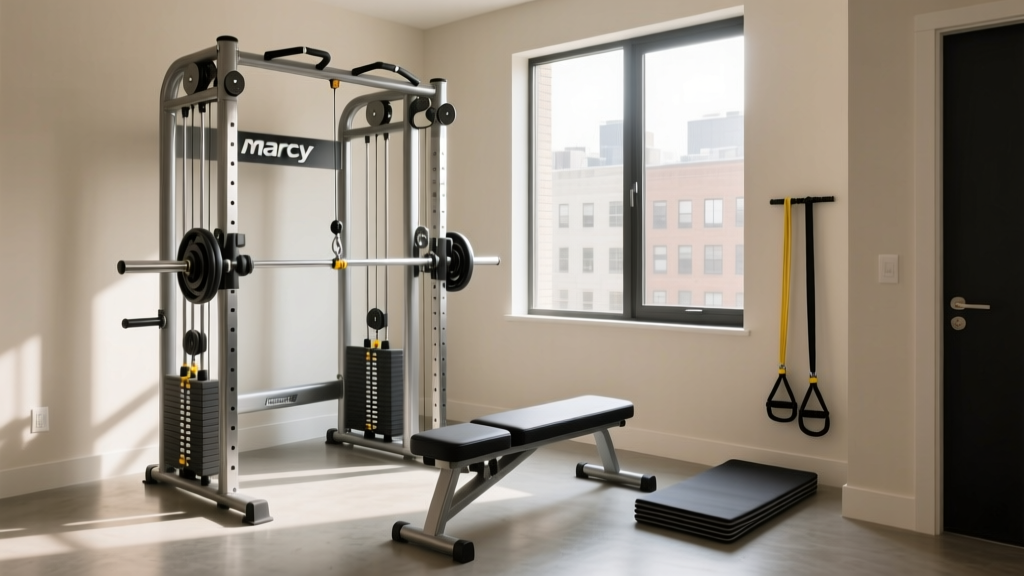
Plan C: The Apartment Spare Room (120 Sq Ft / 10'x12')
When space is at a premium, every inch of your floor plan must serve a dual purpose.
- The Perimeter: Use a foldable wall-mounted rack (like the PRx Profile) that folds flat to 4 inches when not in use.
- The Flooring: Lay down a 6'x8' heavy-duty rubber mat strictly in the center of the room to protect the hardwood or carpet, leaving a 2-foot border of original flooring to maintain the room's residential aesthetic.
- Storage: Utilize vertical wall space for resistance bands, suspension trainers, and adjustable dumbbells to keep the 10x12 footprint clear for movement.
Expert Installation & Hidden Failure Modes
Even the best home gym floor ideas will fail if the installation ignores basic building science. Here are the three most common failure modes we see in the field, and how to prevent them:
- Concrete Efflorescence and Moisture Trapping: Concrete is porous. If you lay rubber directly on a basement slab without a vapor barrier, ground moisture will wick up, get trapped under the impermeable rubber, and cause mold or degrade the concrete into a chalky powder (efflorescence). The Fix: Always lay down a 6-mil polyethylene vapor barrier before installing rubber flooring in below-grade spaces.
- Lateral Seam Separation: When performing sled drags or heavy lateral lunges, the friction pulls interlocking tiles apart. The Fix: Apply high-quality double-sided carpet tape (like XFasten) to every seam, or switch to vulcanized mats secured with Gorilla Tape on the perimeter.
- Acoustic Transfer in Multi-Family Homes: If you are building a gym on a second floor or in a condo, 3/4" rubber will stop the barbell from breaking the floor, but it won't stop the low-frequency bass vibration from angering your neighbors. The Fix: Build a decoupled deadlift platform using layers of 3/4" plywood alternating with acoustic damping mats (like SoundProof Cow's Impact Sound Isolation).
Final Verdict & Budget Breakdown
Building a complete home gym setup requires viewing the floor not just as a surface, but as the foundational grid of your entire training environment. For a standard 2-car garage (approx. 400 sq ft), budget between $850 and $1,200 for high-quality 3/4" vulcanized rubber mats. It is a one-time investment that will outlast the equipment you place on it.
By matching the correct flooring material to your specific spatial layout, you ensure a safe, durable, and highly functional training space for years to come. For further reading on commercial-grade facility standards, refer to the equipment and flooring guidelines published by Rogue Fitness and independent testing labs like Garage Gym Reviews.
More gear to consider
All reviews
Home Gym Weights & Tools Checklist: What You Actually Need (and What You Don’t)

Common Mistakes With Basic Home Gym Equipment in Rental Apartments

Building a Will Tennyson Home Gym: Compact Foldable Solutions

Tax Deductible Home Gyms: December 2025 Rules & Mirror Placement Guide
Maintaining Marcy Home Gym Exercise Equipment in Small Spaces
