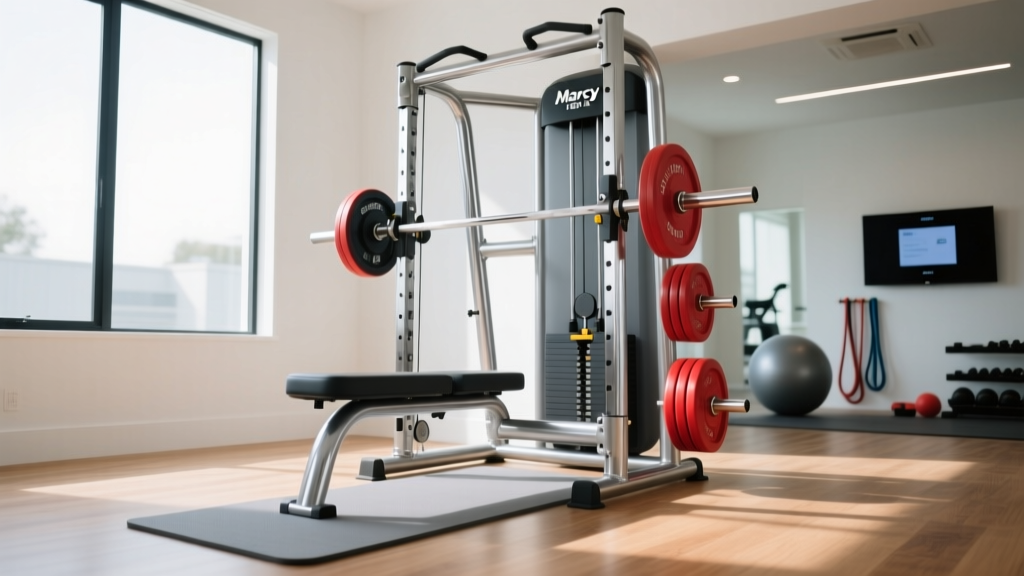
Commercial vs Residential: Marcy 150-Lb. Stack Home Gym Guide
Is a commercial rig necessary? We compare commercial gym machines against the Marcy 150-lb. stack home gym to help you choose the right tier for 2026.

The Great Divide: Commercial vs. Residential Fitness Equipment
The home fitness landscape in 2026 is sharply bifurcated. On one end of the spectrum, you have budget-friendly, space-conscious residential units designed for casual use. On the other, you have commercial-grade behemoths engineered to withstand the relentless abuse of a 24-hour fitness facility. For home gym builders, navigating this divide is the single most critical financial decision you will make. Over-investing in commercial gear for a light-use garage gym leads to diminishing returns, while under-investing in residential gear for heavy, daily lifting results in premature equipment failure and potential safety hazards.
To illustrate this divide, we are using a highly popular residential baseline: the Marcy 150-lb. stack home gym. By dissecting its engineering, limitations, and real-world performance, and then contrasting it against light-commercial and full-commercial multi-station systems, this guide will provide a definitive decision framework for your next equipment purchase.
Baseline Analysis: The Marcy 150-lb. Stack Home Gym
When evaluating the entry-level to mid-tier market, the Marcy 150-lb. stack home gym frequently emerges as the default choice for budget-conscious buyers. Typically retailing between $550 and $800, these all-in-one units (such as the popular MWM-series) offer a compelling value proposition: a compact footprint, a built-in weight stack, and multiple cable attachment points for lat pulldowns, triceps pushdowns, and chest presses.
Specifications and Real-World Limitations
The 150-pound stack is generally sufficient for beginners and intermediate lifters focusing on isolation movements and high-repetition hypertrophy work. However, the physics of cable machines dictate that the resistance felt at the handle is often multiplied by the pulley ratio. A 2:1 ratio means 150 lbs on the stack translates to roughly 75 lbs of actual resistance at the grip. For advanced lifters, this ceiling is reached quickly, particularly on compound movements like heavy seated rows or leg extensions.
💡 The Pulley Ratio Factor: Many residential buyers misunderstand weight stack ratings. Always check the machine's mechanical advantage. A Marcy 150-lb. stack home gym with a 2:1 ratio will max out at 75 lbs of lifting resistance, whereas a commercial 1:1 ratio machine delivers the full 150 lbs to the user.Engineering Discrepancies: Where the Money Actually Goes
Why does a commercial multi-station from Hoist or Life Fitness cost upwards of $5,000 to $8,000, while a residential Marcy unit costs under $1,000? The price gap is not merely a brand tax; it reflects fundamental differences in metallurgy, tolerances, and fatigue resistance.
Steel Framing and Welding Tolerances
Residential units typically utilize 14-gauge or 16-gauge steel tubing, often measuring 2x2 inches. While adequate for static loads, dynamic movements (like explosive lat pulldowns) introduce lateral torque that can cause thinner frames to flex or wobble over time. Commercial rigs mandate 11-gauge or 7-gauge steel, frequently in 3x3-inch or 2x4-inch profiles, with robotic MIG welding that ensures uniform penetration and zero structural weak points.
Cable and Pulley Systems
According to equipment maintenance and safety guidelines outlined by the National Strength and Conditioning Association (NSCA), cable integrity is the primary safety concern in resistance machines. Residential gyms like the Marcy 150-lb. stack home gym typically use 3/16-inch aircraft cables rated for 1,000 to 1,500 lbs of tensile strength, routed through nylon or stamped-steel pulleys with basic bushing bearings. Commercial systems use 5/32-inch or 3/8-inch steel cables rated for over 3,000 lbs, gliding over solid aluminum or machined steel pulleys equipped with sealed, precision ball bearings.
Weight Stack Guide Rods and Friction
Biomechanical consistency is paramount for muscle stimulation. The American College of Sports Medicine (ACSM) emphasizes that variable resistance machines must maintain a smooth, predictable force curve throughout the entire range of motion. Residential guide rods are often hollow, thinly chrome-plated steel that can pit, rust, or bend, causing the weight stack to bind and stick. Commercial guide rods are solid, precision-machined, and coated in industrial nickel or hard-chrome, ensuring zero friction even after millions of cycles.
Head-to-Head Comparison Matrix
To visualize the jump in quality and engineering, we have mapped the residential Marcy against a light-commercial staple (Bodycraft) and a full-commercial powerhouse (Hoist).
| Feature | Residential (Marcy 150-lb.) | Light Commercial (Bodycraft GL) | Full Commercial (Hoist ROC-IT) |
|---|---|---|---|
| Steel Gauge | 14 to 16-Gauge | 11-Gauge | 7 to 11-Gauge |
| Cable Diameter | 3/16" (Nylon Coated) | 5/32" (Military Spec) | 3/8" (Steel Core) |
| Pulley Type | Nylon / Bushing | Aluminum / Sealed Bearing | Machined Steel / Precision |
| Weight Stack Pin | Spring-Loaded Steel | Magnetic Locking | Heavy-Duty Selectorized |
| Warranty (Frame) | 1 to 5 Years | Lifetime | Lifetime (Commercial) |
| Est. 2026 Price | $550 - $800 | $2,800 - $3,500 | $6,000 - $8,500+ |
Real-World Failure Modes and Edge Cases
Understanding how equipment actually breaks down in a home environment is crucial for making an informed investment. Based on years of field testing and user reports, here are the most common failure modes associated with residential weight stack systems:
- Weight Stack Pin Shearing: The spring-loaded pins on residential units are prone to bending if dropped into the stack at an angle. Under heavy, dynamic drop-sets, these pins can shear entirely, causing the top half of the weight stack to drop unexpectedly.
- Cable Crimp Slippage: The point where the cable loops back on itself and is secured by a metal crimp (ferrule) is a major weak point. On budget units, repeated tension cycles cause the crimp to slowly slip, resulting in a sudden loss of tension or complete cable detachment.
- Upholstery Delamination: Residential vinyl pads are typically stapled directly into particleboard or thin plywood backings. Sweat intrusion and repeated friction cause the vinyl to tear and the backing to crumble within 2 to 3 years of heavy use.
- Pulley Warping: Nylon pulleys, while quiet, can warp or develop flat spots if the cable is subjected to extreme lateral tension, leading to a grinding sensation and accelerated cable fraying.
The 500-Hour Decision Framework
How do you decide which tier is right for your garage? We utilize the 500-Hour Annual Usage Rule to guide our readers.
Tier 1: The Casual User (Under 150 Hours/Year)
If you plan to use the machine 2-3 times a week for 30-45 minutes, primarily for general health, mobility, and light hypertrophy, the Marcy 150-lb. stack home gym is a highly rational purchase. The lower weight ceiling is perfectly adequate, and the cost-per-use remains exceptionally low. Just be diligent about wiping down the guide rods and inspecting the cable crimps every six months.
Tier 2: The Dedicated Lifter (150 - 400 Hours/Year)
If you are training 4-5 days a week, utilizing progressive overload, and pushing the machine to its mechanical limits, residential units will frustrate you. The 150-lb stack will become a bottleneck for your lat and row movements within 12 months. Stepping up to a light-commercial unit like the Bodycraft GL or a functional trainer with dual 200-lb stacks is mandatory to ensure the equipment scales with your strength gains.
Tier 3: The Multi-User / Heavy Athlete (400+ Hours/Year)
If your home gym serves multiple adult users, includes heavy athletic training (explosive movements, sports-specific conditioning), or if you simply demand a zero-maintenance, gym-quality feel, full-commercial gear is non-negotiable. The initial capital expenditure is high, but the total cost of ownership over a 15-year lifespan is actually lower than replacing two or three residential units.
"The biggest mistake home gym owners make is buying for the lifter they are today, rather than the lifter they will be in two years. A 150-pound stack feels like plenty of resistance on day one, but progressive overload is the fundamental law of muscle growth. Buy the machine that your future self won't outgrow."
Final Verdict: Aligning Budget with Biomechanics
The commercial vs. residential debate ultimately boils down to aligning your budget with your biomechanical needs and usage volume. The Marcy 150-lb. stack home gym remains a formidable entry-point for beginners, offering an accessible, all-in-one solution that eliminates the need for free-weight spotters. However, it is fundamentally a consumer-grade appliance, not an industrial tool.
If your training ambitions extend beyond basic circuit work and into serious strength development, bypass the residential tier. Invest in the heavier steel, thicker cables, and precision bearings of a commercial or light-commercial multi-station. Your joints, your safety, and your long-term strength gains will thank you.
More gear to consider
All reviews
Marcy 150 Home Gym Assembly: Expert Installation Tips & Review

Marcy 100 lb Stack Home Gym Review: Beginner Setup & Guide

How To Start Homegym Machines: A Practical, Space-Smart Guide for Beginners

Cheap vs Premium Safety in Home Gym Machines: What Your Joints, Wallet, and Long-Term Health Really Pay For
