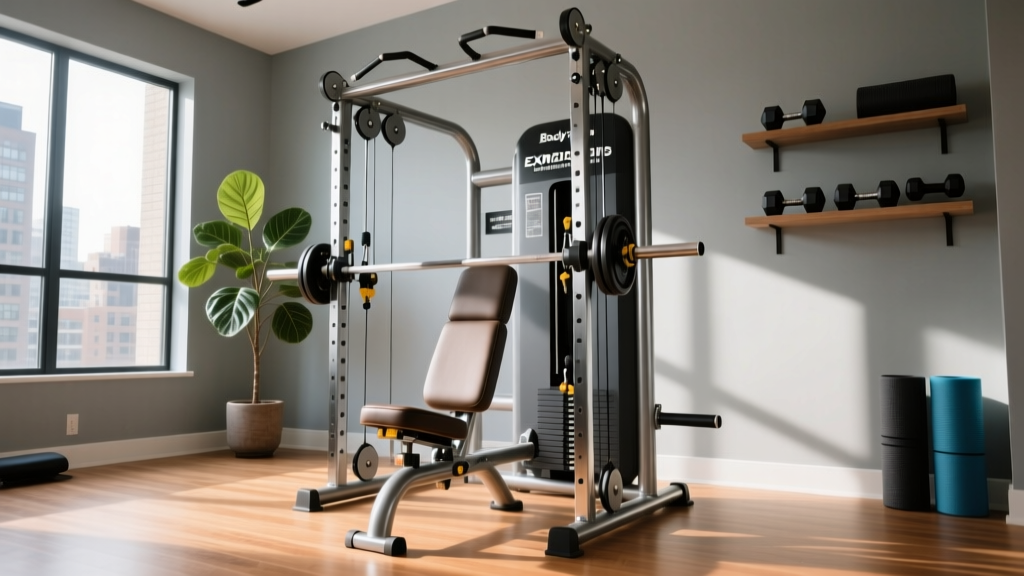
Best Home Gym Machine Workout Setups: All-In-One Reviews 2026
Discover the best all-in-one systems for your home gym machine workout. Our 2026 reviews compare top multi-station gyms, cable rigs, and smart trainers.

The Evolution of the All-In-One Home Gym Machine Workout
Designing the perfect home gym machine workout in 2026 requires navigating a deeply bifurcated market. On one side, we have traditional, heavy-duty weight stack systems and modular functional trainers built from 12-gauge steel. On the other, we have AI-driven, servo-motor smart gyms that replace physical iron with digital resistance. Whether you are outfitting a two-car garage or a compact spare bedroom, the goal remains the same: maximizing muscle hypertrophy, strength gains, and biomechanical safety within a single footprint.
According to the National Strength and Conditioning Association (NSCA), variable resistance and constant-tension cable systems are highly effective for both muscular endurance and hypertrophy, provided the equipment allows for proper load progression and multi-planar movement. This guide cuts through the marketing fluff to provide an in-depth, expert-level analysis of the best all-in-one home gym machines available this year, complete with exact specifications, failure modes, and actionable programming advice.
The Anatomy of a High-Performance Cable System
Before diving into specific models, it is critical to understand the mechanical differences that dictate the quality of your home gym machine workout. The most vital specification is the cable pulley ratio.
- 1:1 Ratio: The weight you select is the exact weight you lift. Ideal for heavy compound movements (squats, shrugs, heavy rows). However, the cable tension is higher, leading to faster wear on nylon pulleys.
- 2:1 Ratio: A 200 lb stack feels like 100 lbs at the handle. This halves the cable tension, drastically increasing the lifespan of the cables and bearings while allowing for smoother, faster movements essential for athletic functional training and rehabilitation.
Never purchase an all-in-one machine without measuring your ceiling height against the machine's pull-up bar clearance. A standard 84-inch tall machine requires at least 96 inches of ceiling height to allow for proper pull-up execution without head strikes. Furthermore, ensure your floor can support a minimum of 50 lbs per square foot when combining the machine's base weight, the weight stack, and the user.
2026 All-In-One Machine Comparison Matrix
Below is a side-by-side comparison of three distinct categories of all-in-one machines dominating the 2026 market: the heavy-duty modular rig, the functional training purist, and the smart digital system.
| Model | Category | Max Resistance | Pulley Ratio | Footprint | Est. Price (2026) |
|---|---|---|---|---|---|
| Force USA G12 | Modular Heavy-Duty | 400 lbs (Stack) | 2:1 & 1:1 | 53' x 53' | $4,599 |
| Bodycraft Elite FT | Functional Trainer | 200 lbs (Stack) | 2:1 | 36' x 72' | $3,299 |
| AEKE K1 | Smart Digital System | 132 lbs (Digital) | N/A (Servo) | 18' x 18' (Wall) | $2,899 |
Deep-Dive Reviews: Top Contenders for Every Budget & Space
1. Force USA G12 All-In-One Trainer (The Heavy-Duty Standard)
The Force USA G12 remains the gold standard for garage gym owners who refuse to compromise on load capacity. It integrates a power rack, Smith machine, functional trainer, and chin-up station into a single 12-gauge steel frame.
- Pros: Unmatched versatility. The dual 200 lb weight stacks (upgradable to 400 lbs) allow for heavy 1:1 lifting via the Smith machine and smooth 2:1 functional cable work simultaneously. Includes band pegs and a leg press attachment.
- Cons: The sheer footprint (53x53 inches) requires a dedicated space. Assembly is notoriously complex, often taking 8-12 hours for two people.
- Failure Modes & Edge Cases: The selector pins on the 400 lb upgraded stacks can experience shear stress if dropped violently. Additionally, the 1:1 cable routing requires bi-annual silicone lubrication to prevent the braided steel cables from fraying at the pulley contact points.
2. Bodycraft Elite FT (The Functional Training Purist)
For athletes focused on rotational power, sports-specific movements, and rehabilitation, the Bodycraft Elite FT is a masterpiece of biomechanical engineering. It features dual 200 lb stacks with a strict 2:1 ratio.
- Pros: The 20-position adjustable pulleys slide seamlessly along the uprights, allowing for precise vector targeting. The 2:1 ratio ensures the weight stack never 'slams' during explosive concentric movements, protecting the internal guide rods.
- Cons: The 2:1 ratio means a 200 lb stack only yields 100 lbs of resistance per handle. Heavy powerlifters will max out the stack on exercises like heavy cable rows or squats.
- Expert Insight: According to rehabilitation protocols outlined by the American Council on Exercise (ACE), the smooth, constant tension provided by 2:1 functional trainers is superior to free weights for late-stage joint rehab, as it eliminates the 'sticking point' inherent in gravity-dependent dumbbell movements.
3. AEKE K1 Smart Fitness System (The Compact Tech Choice)
The AEKE K1 represents the cutting edge of the 2026 smart home gym market. Instead of physical weight stacks, it utilizes advanced servo-motors to generate digital resistance, controlled via a built-in 32-inch HD touchscreen.
- Pros: Requires less than 4 square feet of floor space when folded. Offers 0.5 kg micro-increments for precise progressive overload. Features 'Eccentric Overload' modes, where the machine automatically increases resistance during the lowering phase of a rep to maximize muscle damage and hypertrophy.
- Cons: Requires a subscription for premium live and on-demand classes. The 132 lb maximum digital resistance is insufficient for advanced lower-body training (e.g., heavy squats or deadlifts).
- Failure Modes & Edge Cases: Servo-motor overheating can occur during high-rep, low-rest drop sets lasting longer than 4 minutes. Ensure the wall-mount bracket is secured directly into wooden studs or masonry; drywall anchors will fail under the dynamic torque generated during heavy lat pulldowns.
Programming Your Home Gym Machine Workout
Having the equipment is only half the battle. Structuring an effective home gym machine workout requires leveraging the unique properties of cable resistance. Below is a highly effective 4-day Upper/Lower split optimized for a dual-stack functional trainer like the Bodycraft Elite or Force USA G12.
'Because cables provide continuous tension throughout the entire range of motion, you can achieve high levels of muscle fatigue with significantly less absolute weight than free weights. Focus on the eccentric (lowering) phase for 2-3 seconds on every rep.'
Day 1 & 3: Upper Body (Cable & Smith Machine Focus)
- Smith Machine Incline Press: 4 sets x 8-10 reps (Focus on deep stretch at the bottom).
- Dual-Cable Chest Fly (Low to High): 3 sets x 12-15 reps (Utilize the 2:1 ratio for smooth, controlled adduction).
- Seated Cable Rows (V-Bar): 4 sets x 10-12 reps (Hold the peak contraction for 1 second).
- Single-Arm Lat Pulldown: 3 sets x 12 reps per arm (Allows for spinal rotation and deeper lat engagement).
- Cable Rope Triceps Pushdowns: 3 sets to failure.
Day 2 & 4: Lower Body & Core (Functional & Stability)
- Smith Machine Bulgarian Split Squats: 3 sets x 8-10 reps per leg.
- Cable Pull-Throughs: 4 sets x 12-15 reps (Excellent for glute and hamstring hypertrophy without spinal loading).
- Cable Woodchoppers: 3 sets x 12 reps per side (Core rotational power).
- Weighted Cable Crunches: 4 sets x 15 reps.
Installation, Maintenance, and Edge Cases
To ensure your investment lasts a decade or more, rigorous maintenance is non-negotiable. Industry testing by equipment reviewers at Garage Gym Reviews highlights that the number one cause of all-in-one machine failure is neglected cable and guide rod maintenance.
- Guide Rod Lubrication: Wipe down the linear guide rods with a microfiber cloth and apply a light coat of synthetic lubricant (like Super Lube) every 60 days. Never use WD-40, as it attracts dust and creates an abrasive paste that destroys the stack bushings.
- Cable Tensioning: Over the first 6 months, braided steel cables will stretch by up to 1/4 inch. Use the turnbuckles located at the top pulleys to re-tension the cables. A properly tensioned cable should not sag when the weight stack is fully resting at the bottom.
- Pulley Bearing Seizure: If your pulleys begin to squeak or stutter, the sealed bearings are likely compromised by dust ingress. Most high-end machines use standard 608ZZ or 6202RS bearings, which can be replaced for under $5 each, saving you from buying a $150 OEM pulley assembly.
Frequently Asked Questions
Can I build significant muscle mass using only an all-in-one cable machine?
Yes. Hypertrophy is driven by mechanical tension, metabolic stress, and muscle damage, not the type of equipment used. As long as you are applying progressive overload (increasing weight, reps, or time under tension) and training close to muscular failure, a cable machine is highly effective for building muscle. The constant tension provided by cables often induces greater metabolic stress than free weights.
Is a 2:1 or 1:1 pulley ratio better for a beginner?
A 2:1 ratio is generally better for beginners. It allows for smaller, more precise weight increments (e.g., moving up 10 lbs on the stack only increases the resistance by 5 lbs at the handle). It also promotes smoother movement patterns, which helps beginners learn proper biomechanics without the stabilizing demands of heavy 1:1 loads.
Do smart digital gyms like the AEKE or Tonal feel like real weight?
Modern 2026 servo-motor systems have largely eliminated the 'robotic' feel of early digital gyms. They simulate the inertia and eccentric overload of physical iron exceptionally well. However, they lack the physical 'clank' and spatial feedback of moving physical plates, which some powerlifters find psychologically necessary for heavy 1-rep max attempts.
More gear to consider
All reviews
Cheap vs Premium Foam: What Home Gym Owners *Really* Need to Know About Density, Durability, and Safety
Top Cable Machines for a Fit Home Gym Setup (2026)

Marcy 150lb Home Gym Weight Stack Upgrade: Value Guide

Marcy 150 lbs. Stack Home Gym Upgrade Guide: Space & Layout Tips

Therapy and Mistakes Compared: How Home Gym Machines Support Recovery While Avoiding Common Setup Errors