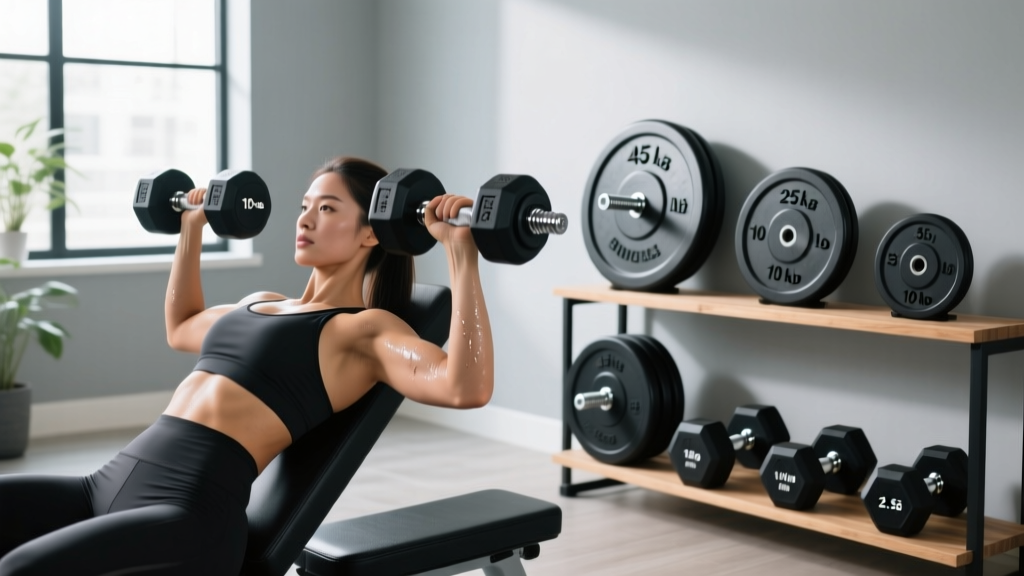
What Size Dumbbells for Women? Plus Olympic vs Standard Plates Guide
Discover what size dumbbells for women to start with, then scale your home gym with our in-depth comparison of Olympic vs standard weight plates.

Building a home gym is a journey of progressive overload. You start with the basics, master your form, and eventually hit a ceiling where your initial equipment can no longer support your strength gains. For many women entering the fitness space, the journey begins with a simple but critical question regarding free weights, before eventually graduating to barbell work. This comprehensive guide will first address the foundational dumbbell sizing, and then dive deep into the ultimate home gym scaling decision: weight plate types Olympic vs standard.
Answering the Core Question: What Size Dumbbells for Women?
When outfitting a home gym, the most frequent question we receive is: what size dumbbells for women is the ideal starting point? The answer is not a single number, but rather a tiered approach based on your current fitness level and the specific muscle groups you are targeting. According to the CDC's physical activity recommendations, adults should engage in muscle-strengthening activities of moderate or greater intensity at least two days a week, making proper weight selection vital for joint health and hypertrophy.
The Tiered Sizing Framework
- Beginner (0-6 Months): For upper body movements (lateral raises, bicep curls), start with 5 to 12 lbs. For lower body movements (goblet squats, Romanian deadlifts), you will need 15 to 25 lbs. Women often underestimate their lower body strength; a 10 lb dumbbell will not provide enough stimulus for glute and hamstring adaptation.
- Intermediate (6-18 Months): Upper body requirements jump to 15 to 25 lbs, while lower body movements require 30 to 50 lbs. This is the stage where buying individual fixed-weight dumbbells becomes financially and spatially inefficient.
- Advanced (1.5+ Years): Upper body presses and rows will demand 30 to 50+ lbs, and lower body work will exceed 60 lbs per hand. At this stage, you are likely transitioning to barbell work, which brings us to weight plates.
The Progressive Overload Ceiling: When to Add Plates
Eventually, goblet squats with a 50 lb dumbbell will no longer stimulate leg growth. As noted by the Mayo Clinic's guidelines on strength training, muscles require progressive overload—gradually increasing the weight, frequency, or number of repetitions—to continue growing. This is the exact moment you must transition to barbell training and purchase a squat rack, a barbell, and weight plates.
This transition introduces one of the most confusing purchasing decisions for new home gym owners: choosing between Olympic and Standard weight plates. Making the wrong choice here can result in incompatible gear, bent bars, and wasted money.
Olympic vs Standard Weight Plates: The Core Differences
The distinction between Olympic and standard plates comes down to the center hole diameter and the barbell sleeves they are designed to fit. While the names suggest a difference in quality, they actually denote specific dimensional standards.
Standard Plates (1-Inch Hole)
Standard plates feature a center hole of approximately 1 inch (25mm). They are designed to slide onto standard barbells, which typically have 1-inch diameter shafts and sleeves. These are commonly found in big-box sporting goods stores and are often sold in beginner kits with a hollow-core or cheap solid steel bar. The Failure Mode: Standard bars and plates are generally not rated for heavy loads. A standard barbell will often begin to permanently bend (plastic deformation) when loaded past 200 to 250 lbs. Furthermore, standard plates are almost exclusively made of cheap cast iron or plastic-filled concrete, which can crack if dropped.
Olympic Plates (2-Inch Hole)
Olympic plates feature a center hole of exactly 50mm (roughly 1.97 inches, universally referred to as 2 inches). They are designed for Olympic barbells, which have a 28-29mm shaft for grip but feature machined 50mm rotating sleeves at the ends. The Industry Standard: Every commercial gym, powerlifting federation, and serious home gym uses Olympic plates. They accommodate heavier loads, allow for the use of bumper plates (for dropping), and offer vastly superior weight accuracy.
Warning: The 'Standard Olympic' TrapBeware of cheap online listings advertising 'Standard Olympic Bars.' This is a manufacturing oxymoron. Some budget brands sell bars with a 1-inch shaft (to use cheap standard collars) but 2-inch sleeves (to hold Olympic plates). Always verify the shaft diameter and sleeve diameter separately before purchasing.
Comparison Matrix: Olympic vs Standard Plates
| Feature | Standard Plates | Olympic Plates |
|---|---|---|
| Center Hole | 1 inch (25mm) | 2 inches (50mm) |
| Bar Compatibility | Standard 1-inch bars | Olympic bars with 50mm sleeves |
| Max Safe Load | ~200 - 300 lbs (bar dependent) | 700 - 1,500+ lbs |
| Material Options | Cast iron, vinyl-concrete | Cast iron, Urethane, Crumb Rubber |
| Avg. Price per Pound | $1.00 - $1.50 / lb | $2.00 - $3.50 / lb |
| Drop Safety | Low (will crack/floor damage) | High (if using bumper plates) |
Material Science: Cast Iron vs. Urethane vs. Bumper Plates
Once you commit to the Olympic standard (which we highly recommend for any serious home gym), you must choose your plate material. This decision impacts noise, floor safety, and budget.
1. Machined Cast Iron
Cast iron is the traditional choice. The Rogue Deep Dish Cast Iron Plates are a benchmark in the industry, featuring a classic deep-dish profile, machined faces for flat stacking, and an e-coat finish to prevent rust. Pricing: Expect to pay around $2.15 to $2.50 per pound. Best For: Lifters with dedicated rubber matting who primarily do powerlifting (squats, bench, deadlifts) and do not drop the bar from overhead.
2. Virgin Rubber / Urethane
Urethane plates are encased in a highly durable, odorless synthetic rubber. They are the standard in commercial gyms because they resist scratching, do not smell like cheap tire rubber, and absorb minor impacts. Pricing: Premium tier, usually $3.00 to $4.00+ per pound. Best For: Garage gyms attached to living spaces where noise dampening and aesthetics are a priority.
3. Crumb Rubber Bumper Plates
Bumper plates all share the same exact diameter (450mm / 17.7 inches), regardless of whether they weigh 10 lbs or 45 lbs. This allows you to safely drop the barbell from a height (such as during Olympic lifts or deadlifts) because the rubber absorbs the shock, protecting both the barbell sleeves and your floor. Pricing: Budget-friendly bumpers like the Fringe Sport Echo series hover around $2.25 per pound. Best For: CrossFit athletes, Olympic weightlifters, and anyone deadlifting on a residential garage floor.
Sleeve Math: How Many Plates Actually Fit?
A common edge-case failure for home gym buyers is purchasing a barbell with short sleeves and realizing they cannot load enough plates to reach their target weight.
The Math: A standard 45 lb Olympic bumper plate is roughly 3.1 inches thick. A typical Olympic barbell features a loadable sleeve length of 16.3 inches.
16.3 inches ÷ 3.1 inches = 5.25 plates per side.
This means you can fit five 45 lb plates per side, plus the collar.
Total Capacity: (5 x 45 x 2) + 45 lb bar = 495 lbs.
If your strength goals will eventually exceed a 450 lb deadlift or squat, you must ensure you buy a bar with extended 19-inch sleeves, or purchase thinner, high-density calibrated steel plates (which are roughly 1.2 inches thick for a 45 lb plate).
3-Step Framework for Building Your Plate Collection
- Step 1: Buy the Barbell First. Never buy plates before your bar. Ensure your bar has 50mm sleeves and a tensile strength rating of at least 190,000 PSI to prevent bending.
- Step 2: The 'Change Plate' Priority. Do not just buy 45 lb plates. Progressive overload requires micro-jumps. Your first purchase should include pairs of 2.5 lb and 5 lb fractional plates. Adding 5 lbs to a bench press is a massive jump; adding 2.5 lbs ensures sustainable progress.
- Step 3: Fill Out the 45s and 25s. Once you have your change plates and a pair of 45s, buy pairs of 25 lb plates. Having 25s allows you to easily load 135 lbs (one 45 and one 25 per side) without stacking too many small plates, keeping the barbell balanced and the sleeves clear.
Expert Troubleshooting & Edge Cases
Calibrated vs. Uncalibrated: If you are competing in powerlifting, you need calibrated steel plates. These are machined to a strict tolerance of +/- 10 grams. Uncalibrated cast iron plates can vary by 1 to 2 lbs per plate, meaning a 225 lb lift on a cheap set might actually be 221 lbs or 229 lbs. For 95% of home gym users, uncalibrated plates are perfectly fine, but be aware of the variance if you are tracking strict 1-rep max data.
Rust Prevention: If you opt for bare cast iron or zinc-plated Olympic plates in a non-climate-controlled garage, humidity will cause surface rust within weeks. Keep a wire brush and a light coat of 3-in-One oil or mineral oil on hand. Avoid WD-40, as it strips existing protective coatings and attracts dust.
By starting with the correct dumbbell sizing and strategically investing in the Olympic plate ecosystem, you build a home gym that will never limit your physical potential.
More gear to consider
All reviews
EZ Curl Bar vs Straight Bar Care & Dumbbell vs Resistance Band Life
Beginner Guide: Dumbbell Toe Touch Crunch with Neoprene Weights

Stop the Dumbbell Drag: Budget Rack & Storage Guide

Collar Guide: Secure Your Full Chest Workout with Dumbbells & Bars

EZ vs Straight Bar Value: Plus Different Workouts with Dumbbells
