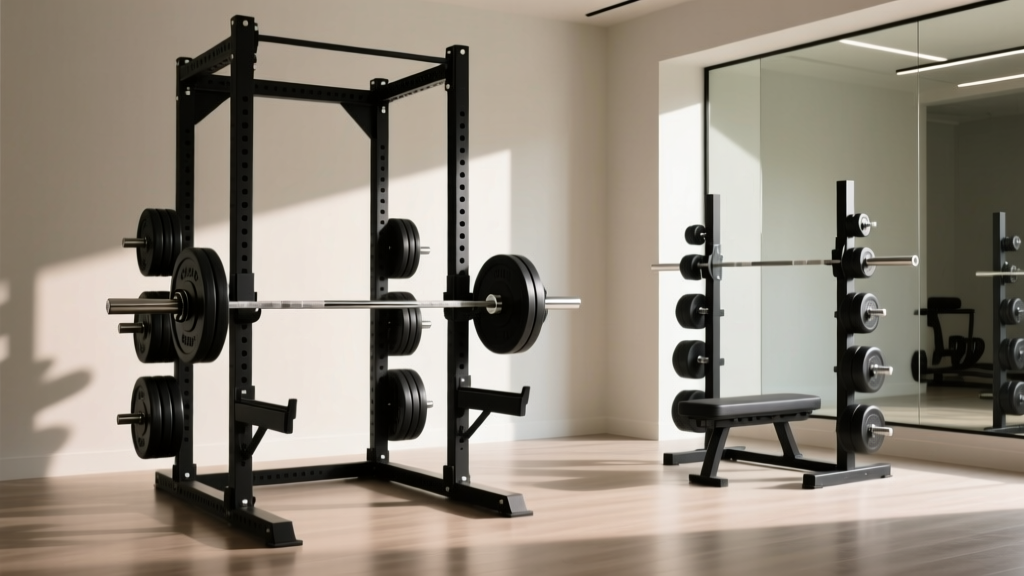
Troubleshooting Barbell or Dumbbell Deadlifts: Power Rack vs Squat Stand
Fix common setup mistakes for barbell or dumbbell deadlifts. Compare power racks, squat racks, and stands to optimize clearance, safety, and variations.

The Hidden Biomechanics of Rack-Assisted Pulls
Most lifters view the deadlift as a strictly floor-based movement, assuming the rack is only necessary for squats or bench presses. However, when programming advanced variations—such as deficit pulls, rack pulls, block pulls, or unilateral dumbbell Romanian deadlifts (RDLs)—your equipment footprint becomes a critical variable. Troubleshooting setup errors for barbell or dumbbell deadlifts requires a deep understanding of spatial clearance, shear forces, and hardware tolerances.
Choosing between a full power rack, a half squat rack, and a standalone squat stand is not just a matter of budget; it dictates which deadlift variations you can safely execute. A miscalculated setup can result in barbell sleeve jamming, UHMW plastic degradation, or catastrophic hardware failure under heavy loads. Below, we break down the exact mechanical failures that occur when lifters use the wrong rack configuration for their pulling mechanics.
Clearance Matrix: Power Rack vs. Squat Rack vs. Squat Stand
Before troubleshooting specific mistakes, we must establish the spatial realities of standard Olympic barbells and rack dimensions. A standard 7-foot Olympic barbell features a 51.5-inch inner shaft and two 16.3-inch sleeves. When placed on a 48-inch wide squat stand, your lateral margin of error is dangerously slim.
| Equipment Type | Typical Footprint (W x D) | Best Deadlift Variation | Primary Failure Mode | 2026 Avg. Cost |
|---|---|---|---|---|
| Full Power Rack (e.g., Rogue R-3) | 49' x 34' | Deficit Deadlifts, Rack Pulls | Bar path restriction if pulling inside the cage | $1,250 - $1,450 |
| Half Squat Rack (e.g., REP PR-1100) | 48' x 24' | Block Pulls, Banded Deadlifts | Forward tipping during heavy eccentric loads | $450 - $600 |
| Squat Stand (e.g., Titan T-2) | 48' x 18' | Floor Pulls, Dumbbell RDLs | Sleeve collar jamming on uprights | $399 - $450 |
4 Critical Setup Mistakes (And How to Fix Them)
1. The Lateral Shift Jam on Squat Stands
When performing sumo deadlifts or setting up for wide-grip snatch-grip rack pulls, the barbell naturally shifts laterally. If you are using a standard squat stand with 2x3-inch steel uprights set at 48 inches outside-to-outside, a 7-foot barbell leaves only 1.25 inches of clearance per side. If the bar shifts during a heavy grind, the sleeve collar will jam against the upright.
- The Fix: Pull the bar in front of the squat stands rather than between them. Use the stands strictly as a storage anchor for your J-cups and spotting arms, keeping the lifting zone completely unobstructed.
- Hardware Upgrade: If you must pull inside the uprights, upgrade to a 53-inch wide squat stand or a full power rack to accommodate the 51.5-inch shaft plus lateral drift.
2. Dumbbell RDL Upright Collisions
Executing dual barbell or dumbbell deadlifts (specifically RDLs or stiff-leg variations) inside a shallow 24-inch deep half rack is a common spatial error. A standard 35lb rubber hex dumbbell is approximately 15 inches long. During the eccentric hip hinge phase, the dumbbell heads will strike the front uprights, prematurely halting your range of motion and altering your center of gravity.
Expert Insight: According to the National Strength and Conditioning Association (NSCA), any premature deceleration during the eccentric phase of a hinge movement disrupts the stretch-shortening cycle and forces the lumbar erectors to compensate for the sudden shift in load vectors.
- The Fix: Perform dumbbell hinge variations outside the rack footprint, or invest in a 30-inch deep power rack to ensure the dumbbell heads clear the uprights at the bottom of the ROM.
3. Rack Pull Shear Force Failures
Using standard sandwich J-cups to set up heavy rack pulls is a severe equipment misuse. J-cups are engineered for vertical compression (squats). When you pull a 500lb barbell off the J-cups, the initial horizontal drag creates immense shear force against the J-cup mounting pin. Over time, this will bend 1-inch diameter steel pins and tear through the UHMW plastic lining.
- Stop using J-cups for rack pulls.
- Purchase dedicated Rack Pull Blocks (e.g., Rogue RM-6 Rack Pull Blocks, approx. $225) that rest on the safety spotter straps or crossmembers.
- Use Safety Spotter Arms with UHMW-lined saddle cradles designed to handle horizontal friction.
4. Deficit Deadlift Platform Instability
Lifters often attempt deficit deadlifts by standing on 45lb bumper plates placed directly on the floor. This creates a rolling hazard and an unstable base, leading to asymmetrical force production. Furthermore, if you are pulling inside a power rack, the barbell will now start 2 to 4 inches higher relative to the safety pins, altering your bailout mechanics.
- The Fix: Use interlocking high-density EVA foam mats or bolted-down wooden plyo boxes. If pulling inside a Rogue R-3 Power Rack, ensure your safety spotter straps are dropped to the lowest possible hole (Hole 1 or 2) to allow the barbell to dump safely if you fail mid-pull from the elevated deficit position.
Troubleshooting Hardware Wear and Tear
Warning: UHMW Plastic Degradation
High-quality racks use Ultra-High-Molecular-Weight (UHMW) plastic to protect barbell knurling. However, aggressive barbell deadlift variations (like touch-and-go rack pulls) can gouge this plastic. Inspect your J-cups and spotter arm saddles every 90 days. If the UHMW lining is worn down to the bare steel, you will destroy your barbell's zinc or Cerakote finish within a single training cycle. Replace 0.25-inch UHMW liners immediately (typically $15-$25 per pair).
Spatial Metrics You Must Verify Before Buying
To ensure your rack supports your specific barbell or dumbbell deadlifts programming, verify these exact measurements against your gym floor plan:
- Barbell Overhang: Ensure you have at least 18 inches of clearance on the left and right sides of your rack to accommodate plate loading and sleeve rotation without hitting a wall.
- Spotter Arm Length: If you pull inside a rack, use 18-inch spotter arms rather than 24-inch arms to prevent your shins from clipping the steel during the initial pull off the floor.
- Upright Gauge: Never buy a squat stand for heavy deadlift variations that uses less than 11-gauge steel. 14-gauge uprights will visibly deflect and vibrate when dropping heavy bumper plates nearby.
Frequently Asked Questions
Can I use a squat stand for banded deadlifts?
No. Banded deadlifts require anchoring heavy resistance bands to the base of the rack. Squat stands lack the weighted rear crossmembers or dedicated band peg holes found on full power racks. Attempting to anchor bands to a freestanding squat stand will cause the entire unit to tip forward violently.
What is the safest way to fail a rack pull?
Never use J-cups as a catch mechanism. Set up heavy-duty nylon safety spotter straps across the width of the rack, positioned exactly two inches below the barbell's starting height. As noted by biomechanics resources like ExRx, controlling the eccentric failure path is vital for lumbar safety; straps will catch the bar silently and safely without damaging the knurling.
Do hex dumbbells require a different rack setup than barbells?
Yes. Hex dumbbells do not roll, but their bulky heads require significantly more anterior-posterior (front-to-back) clearance than a barbell shaft. If your squat rack is only 18 inches deep, you will not have the physical space to execute a proper dumbbell RDL without striking the uprights. Opt for a 30-inch deep cage or pull entirely outside the rack footprint.
More gear to consider
All reviews
Decathlon Dumbbells & Weights: Bumper vs Iron Plate Comparison

Bumper vs Iron Plates: Gym Layouts & Dumbbell Deltoid Fly Space

Cast Iron vs Competition Kettlebells & Dumbbell Front Raises Muscles Worked
Best Neoprene Dumbbells for a Whole Body Dumbbell Circuit
Maintaining Loadable Dumbbells for Rear Delt Dumbbell Exercises
