Power Rack vs Squat Rack vs Stand for Sitting Dumbbell Workouts
Compare power racks, squat racks, and stands to optimize your sitting dumbbell workouts. Discover spatial clearances, safety specs, and 2026 pricing.

The Core Dilemma: Framing Your Seated Dumbbell Training
When outfitting a home gym, most lifters obsess over barbell clearances and pull-up bar heights. But if your programming heavily features sitting dumbbell workouts—such as seated shoulder presses, chest-supported rows, and heavy seated bicep curls—the geometry of your rack becomes a completely different puzzle. As of 2026, the market is saturated with modular steel, yet choosing between a full power rack, a half squat rack, and minimalist squat stands requires a deep understanding of bench placement, dumbbell arc trajectories, and spotting mechanics.
Unlike standing barbell lifts, sitting dumbbell workouts remove the lower body from the stabilization equation. This isolation places higher shear forces on the shoulder joints and lumbar spine, making safety mechanisms and spatial awareness paramount. Below, we break down how power racks, squat racks, and squat stands perform head-to-head specifically for seated dumbbell training.
Quick Decision Framework
- Choose a Power Rack if: You lift heavy dumbbells (50+ lbs per hand) overhead and need safety straps to catch failed reps without a spotter.
- Choose a Squat Rack (Half Rack) if: You want an open-front design for unrestricted lateral raises and easy bench sliding, while retaining weight storage.
- Choose Squat Stands if: You are on a strict budget, have a tiny footprint, and primarily do seated arm work (curls/extensions) rather than heavy overhead presses.
Power Racks: The Ultimate Enclosure for Heavy Seated Presses
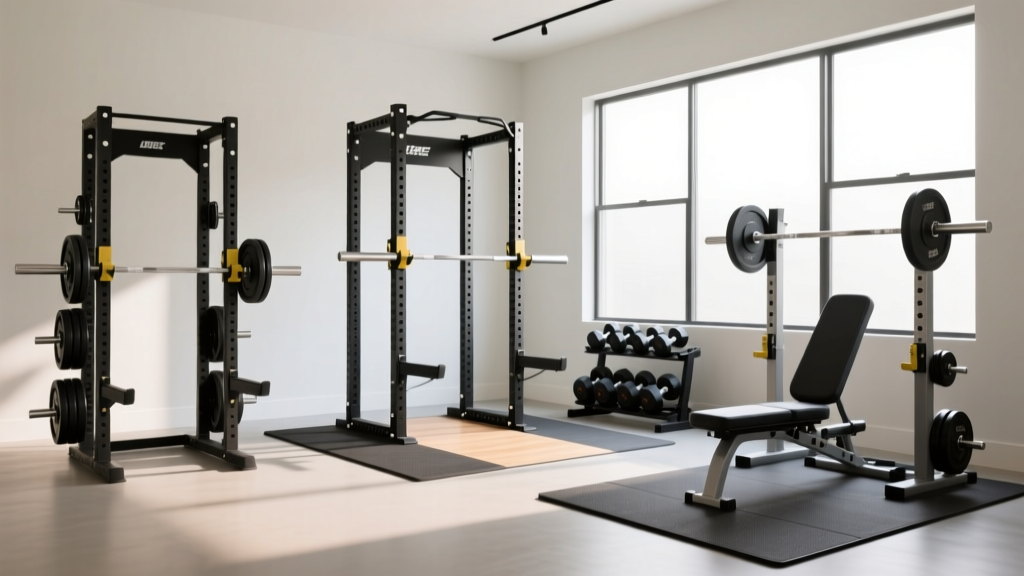
A full power rack (four uprights) is the gold standard for safety, but it introduces spatial constraints that can make or break your sitting dumbbell workouts. The primary advantage of a power rack for seated training is the ability to use safety straps or spotter arms at shoulder height. According to the National Strength and Conditioning Association (NSCA), overhead pressing requires specific spotting techniques that are nearly impossible to execute safely when a lifter is seated and pinned inside a confined space without mechanical safeties.
Real-World Model Analysis: Rogue RML-390F vs. Titan T-3
Let us look at two industry staples. The Rogue RML-390F (priced around $1,150 in 2026) features a 49-inch internal width between the uprights. This is a critical metric. When performing seated Arnold presses or standard overhead dumbbell presses, the average male lifter requires roughly 42 to 45 inches of lateral arc clearance at the bottom of the movement. The 49-inch width allows you to sit fully inside the rack, set an adjustable bench to 75 degrees, and press heavy dumbbells without scraping your knuckles or elbows against the steel uprights.
Conversely, the Titan T-3 Series power rack (approximately $850) features a narrower 47-inch internal width. While excellent for barbells, this 2-inch deficit becomes a glaring failure mode during sitting dumbbell workouts. Lifters with broader bi-acromial widths will find their elbows striking the uprights at the bottom of a seated press, forcing them to angle the bench diagonally or slide it halfway out of the rack, negating the safety benefits of the enclosure.
Squat Racks (Half Racks): The Open-Front Compromise
Half racks, characterized by two main uprights and a rear storage base, offer a compelling middle ground. The open-front design is exceptionally beneficial for sitting dumbbell workouts that require wide lateral movements, such as seated lateral raises or seated chest flies.
Advantages for Seated Training
- Unrestricted Arcs: Because there are no front uprights, you can position the bench slightly forward, allowing for infinite lateral dumbbell travel.
- Easy Bench Adjustment: Sliding an adjustable bench (like the REP AB-3100 2.0) in and out of a half rack is seamless, making supersets between seated rows and standing exercises much faster.
- Attachment Compatibility: Many 2026 half racks, such as the REP Fitness PR-4000 ($999), feature integrated lat/low-row pulley systems. This allows you to transition seamlessly from sitting dumbbell shoulder presses to seated cable rows without leaving your footprint.
The Safety Drawback
The primary drawback of the half rack for sitting dumbbell workouts is spotting. While half racks have safety spotter arms, they are designed to catch a barbell across the torso or shoulders. If you fail a heavy seated dumbbell press, the dumbbells will drop to your sides, entirely missing the horizontal safety arms. For heavy seated overhead work, a half rack requires a competent human spotter standing behind the bench.
Squat Stands: Minimalist Footprints for Basic Seated Work
Squat stands are essentially two independent uprights. They are incredibly affordable (typically $250 to $400 for a pair of Rogue SML-2C stands) and take up virtually zero floor space when not in use. However, their utility for sitting dumbbell workouts is highly restricted.
"Squat stands are phenomenal for seated bicep curls, tricep extensions, and light seated lateral raises. But attempting a 70-lb seated dumbbell shoulder press inside a pair of squat stands is a biomechanical and safety risk that no experienced lifter should take without a dedicated spotter."
Because squat stands lack crossmembers and an enclosed cage, you cannot mount safety straps at shoulder height. Furthermore, the American Council on Exercise (ACE) notes that seated dumbbell exercises remove lower-body stabilization, placing higher isolated forces on the lumbar spine. If you lose your balance laterally during a heavy seated press on a stand, there is no steel cage to lean against or catch the falling weight.
Head-to-Head Comparison Matrix
| Feature | Power Rack (4-Post) | Squat Rack (Half Rack) | Squat Stands |
|---|---|---|---|
| Avg. 2026 Price | $900 - $1,500 | $600 - $1,100 | $250 - $450 |
| Seated Overhead Safety | Excellent (with straps) | Poor (for dumbbells) | Non-Existent |
| Lateral Arc Clearance | Restricted (Requires 49"+ width) | Unrestricted | Unrestricted |
| Chest-Supported Row Utility | High (Can incline bench against crossmember) | Medium (Requires specific attachments) | Low |
| Footprint | 48" x 48" (Average) | 48" x 60" (with storage) | 24" x 24" per stand |
The Spatial Reality: Dumbbell Arcs and Upright Clearance
The most overlooked aspect of planning sitting dumbbell workouts is the dumbbell arc trajectory. When you perform a seated shoulder press, the dumbbells do not travel in a perfectly straight vertical line. They naturally arc outward at the bottom of the movement to clear the shoulders and allow for a full stretch of the anterior deltoid.
The "Knuckle-Scrape" Failure Mode
If you purchase a rack with a 43-inch or 47-inch internal width, you will inevitably experience the "knuckle-scrape" failure mode. As you lower 60-lb dumbbells to your shoulders, your elbows flare out. In a narrow rack, the steel uprights physically block this flare, forcing you to either:
- Stop the movement short, eliminating the stretch-mediated hypertrophy that makes sitting dumbbell workouts so effective (a concept heavily supported by recent studies in the Journal of Orthopaedic & Sports Physical Therapy regarding muscle length and tension).
- Tuck your elbows aggressively, shifting the biomechanical load away from the medial deltoid and onto the triceps and rotator cuff.
The 2026 Solution: If you are committed to a power rack for seated dumbbell work, you must verify the internal width, not the external footprint. Look for racks like the Bells of Steel Residential Rack or specific wide-body configurations from REP Fitness that offer 49 to 53 inches of internal clearance.
Chest-Supported Rows: The Hidden Rack Hack
One of the most effective sitting dumbbell workouts for back hypertrophy is the chest-supported row. In a full power rack, you can set the J-cups to waist height, place a barbell across them, and lean an adjustable bench (set to 30 or 45 degrees) against the barbell. This creates a rock-solid, chest-supported incline bench without needing to buy a dedicated $400 chest-supported row machine. Squat stands cannot support this setup safely, and half racks require specialized plate-loaded chest row attachments to achieve the same stability.
Pairing the Right Bench with Your Rack
Your rack is only half the equation. For sitting dumbbell workouts, the bench you slide into that rack dictates your range of motion. Standard flat benches are useless here. You need an adjustable bench with a ladder or FID (Flat/Incline/Decline) mechanism.
- Seat Pad Length: Look for a seat pad that is 12 inches or shorter. Longer seat pads will hit the crossmembers of a power rack, preventing you from sliding the bench flush into the enclosure.
- Back Pad Angle: For seated shoulder presses, a true 90-degree vertical angle can impinge the shoulder joint. Biomechanics experts recommend a 75-to-85-degree incline for seated dumbbell presses to allow proper scapular retraction and protect the rotator cuff. Ensure your bench has a micro-adjust setting in this range.
- Wheelbase and Handles: Moving a 100-lb adjustable bench in and out of a squat rack or power rack is cumbersome. Benches with rear transport wheels and front tow handles (like the Rogue Adjustable Bench 3.0) are highly recommended for lifters who frequently alternate between sitting dumbbell workouts and standing barbell lifts.
Final Verdict: Matching the Steel to Your Sitting Routine
Ultimately, the choice between a power rack, squat rack, and squat stands for sitting dumbbell workouts comes down to your specific exercise selection and spatial reality. If your routine is anchored by heavy, unspotted seated overhead presses and you have the floor space, a 49-inch+ wide Power Rack with safety straps is non-negotiable for joint longevity and safety. If your sitting dumbbell workouts focus more on isolation movements, lateral raises, and you value an open, breathable gym environment, a Half Rack provides the perfect blend of storage and unrestricted movement. Reserve the Squat Stands for budget-conscious lifters whose seated training is strictly limited to arm isolation work.
Frequently Asked Questions
Can I do sitting dumbbell workouts on a power rack with a low ceiling?
Yes. If your ceiling is under 84 inches, look for "shorty" power racks (typically 72 or 80 inches tall). For sitting dumbbell workouts, a shorter rack is actually advantageous because you can still set safety straps at shoulder height to catch dropped dumbbells, even if you cannot perform standing pull-ups.
Are squat stands safe for seated bicep curls?
Absolutely. Seated bicep curls and tricep extensions do not pose a risk of the weight falling onto your torso or neck. Squat stands provide ample space for these movements, and the lack of an enclosing cage allows for natural elbow tracking.
More gear to consider
All reviews
Protecting Your Rack: Tricep Extension Dumbbell Storage & Care
Barbell Collar Comparison: Securing the Dumbbell Row Without Bench

Beyond the All Dumbbell Workout: Barbell Buying & Setup Guide
Dumbbell Incline Floor Press: Rubber Hex vs Urethane Longevity Tips

Gold's Gym Dumbbell Set Setup: Neoprene Home Gym Walkthrough
