
Setting Up Your Home Gym for Different Arm Exercises with Dumbbells
Master your home gym setup and learn different arm exercises with dumbbells. Our complete walkthrough covers neoprene gear, space prep, and routines.

The Foundation: Selecting Neoprene Dumbbells for Home Use
When building a dedicated space for arm training at home, the choice of equipment dictates both the safety of your flooring and the quality of your grip. Neoprene-coated dumbbells have become the gold standard for residential setups in 2026, primarily because polychloroprene (neoprene) offers a Shore A hardness of around 80-85A. This makes it significantly softer than urethane, preventing scuffs on luxury vinyl plank (LVP) and hardwood floors, while being vastly more durable and sweat-resistant than cheap vinyl or PVC coatings.
For a comprehensive arm routine, you need a weight ladder that accommodates the drastic strength disparities between your biceps, triceps, and forearms. We recommend purchasing a tiered set ranging from 10 lbs to 50 lbs, in 5 lb increments. Premium brands like Yes4All and BalanceFrom currently price their neoprene hex sets between $1.50 and $2.20 per pound. A complete 10-50 lb pair set will cost approximately $350 to $450. The hexagonal head design is non-negotiable for home use; it prevents the bells from rolling away between sets, a common hazard in tight home gym spaces.
Installing Your Dedicated Arm Workout Station
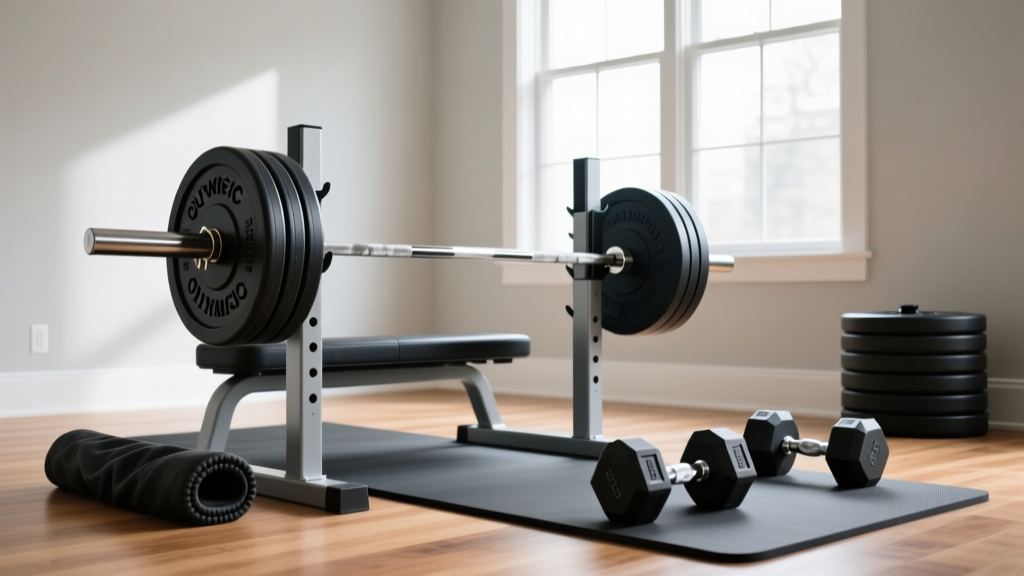
Before executing ACE Fitness approved isolation movements, you must properly install your physical workspace. Arm training requires less overall square footage than Olympic lifting, but it demands strict spatial organization to maintain high-density workout pacing.
Spatial and Flooring Requirements
- Clearance: Allocate a minimum 6x6 foot footprint. This allows for full lateral extension during movements like dumbbell flyes or wide-grip triceps extensions without striking walls or furniture.
- Subfloor Protection: While neoprene is floor-friendly, repeated dropping of 40+ lb dumbbells will eventually damage residential subfloors. Install a 4x6 foot, 3/4-inch thick vulcanized rubber horse stall mat directly under your workout zone. Avoid interlocking EVA foam tiles, as they compress unevenly under heavy loads and degrade quickly from sweat acidity.
Rack Installation and Structural Integrity
Storing 10 pairs of neoprene dumbbells requires a robust rack. If you opt for a wall-mounted horizontal rack to save floor space, you must anchor it correctly. A fully loaded 10-pair rack can weigh upwards of 600 lbs. Do not use drywall anchors. You must locate your wall studs (typically 16 inches on center) and secure the rack using 3/8-inch x 3-inch structural steel lag bolts. If your rack spans across multiple studs, use a heavy-duty plywood backing board (3/4-inch birch) to distribute the shear load evenly before mounting the steel brackets.
Pro-Tip: Handle Diameter AwarenessNeoprene dumbbells often feature a slightly thicker handle grip (typically 1.35 inches) compared to standard bare steel or urethane bells (1.1 to 1.15 inches). If you have smaller hands, this increased circumference will cause premature forearm fatigue during heavy bicep curls. Keep liquid chalk nearby to maintain a secure grip without relying on straps, which can hinder grip strength development.
Execution Walkthrough: Different Arm Exercises with Dumbbells
Programming different arm exercises with dumbbells requires an understanding of the varying strength curves and biomechanical leverage points of the upper arm. According to the kinesiology data compiled by ExRx.net, the biceps brachii, brachialis, and triceps brachii all require distinct angles of shoulder flexion and extension for maximal motor unit recruitment.
Biceps: Stretch and Contraction Focus
The biceps are heavily involved in elbow flexion and forearm supination. To maximize hypertrophy, we utilize two distinct angles:
- Incline Dumbbell Curls (Stretch Focus): Set an adjustable bench to 45 degrees. Allow your arms to hang straight down, placing the shoulder in hyperextension. Curl the neoprene dumbbells while keeping the elbows pinned back. This heavily targets the long head of the biceps. Use a 3-1-1-0 tempo (3 seconds lowering, 1 second pause at the bottom).
- Seated Hammer Curls (Brachialis Focus): Sit upright on a 90-degree bench. Keep a neutral grip (palms facing each other). Curl the weights directly toward your shoulders. This shifts the mechanical load to the brachialis and brachioradialis, adding visible thickness to the side of the arm.
Triceps: Overhead and Pressing Angles
The triceps comprise roughly 60% of your upper arm mass. As noted in Mayo Clinic guidelines on strength training, working muscles through their full range of motion is critical for joint health and growth.
- Seated Overhead Triceps Extension: Sit on a bench with back support to prevent lumbar hyperextension. Grasp a single heavy neoprene dumbbell with both hands (diamond grip). Lower the weight behind your head until your elbows reach 120 degrees of flexion, then press upward. This isolates the long head of the triceps, which crosses the shoulder joint.
- Cross-Body Dumbbell Extensions: Lie flat on a bench. Instead of pressing straight up, extend the dumbbells across your body toward the opposite shoulder. This unique angle places continuous tension on the lateral head of the triceps without the elbow strain associated with traditional skull crushers.
Structured Arm Exercise Matrix
| Muscle Target | Exercise Variation | Recommended Neoprene Weight Range | Rep Range & Rest |
|---|---|---|---|
| Biceps (Long Head) | Incline Dumbbell Curl | 15 - 30 lbs per hand | 8-12 reps (90s rest) |
| Brachialis / Forearm | Seated Hammer Curl | 20 - 40 lbs per hand | 10-15 reps (60s rest) |
| Triceps (Long Head) | Overhead Extension | 30 - 50 lbs (single bell) | 10-12 reps (90s rest) |
| Triceps (Lateral Head) | Cross-Body Extension | 10 - 25 lbs per hand | 12-15 reps (60s rest) |
Neoprene Maintenance and Failure Modes
While neoprene is highly resilient, it is not invincible. Understanding the failure modes of your equipment ensures your investment lasts for years rather than months.
Environmental Degradation
Neoprene is highly susceptible to UV degradation. If your home gym is in a sunroom or near a large south-facing window, prolonged exposure to direct sunlight will cause the synthetic rubber to chalk, fade, and eventually crack. Always store your dumbbells in a shaded area or use UV-blocking window film.
Sweat and pH Damage
Human sweat is mildly acidic (pH 4.5 to 7.0). Over time, the accumulation of salt and acids from your hands will break down the neoprene coating, leading to a sticky, peeling surface. To prevent this, wipe down the handles and heads of your dumbbells after every session with a microfiber cloth dampened with a pH-neutral cleaner. Avoid bleach or ammonia-based products, which will instantly degrade the polychloroprene matrix.
Knurling Wear and Tear
The steel handles beneath the neoprene coating are usually chrome-plated and feature medium-depth knurling. If the neoprene coating on the handle begins to peel (usually after 3-5 years of heavy use), the exposed steel can rust if your gym lacks climate control. If peeling occurs, carefully strip the remaining neoprene from the handle using a utility knife, clean the steel with WD-40, and wrap the handle with athletic tape or use neoprene grip covers to restore usability without buying a brand-new set.
By meticulously setting up your physical space and understanding the biomechanical requirements of different arm exercises with dumbbells, you transform a simple collection of neoprene weights into a highly efficient, joint-friendly hypertrophy station right in your home.
More gear to consider
All reviews
Bumper vs Iron Plates: Care for RDL Workout Dumbbell & Barbell Rigs

Barbell Collar Types & Dumbbell Bulgarian Split Squat Setup Fixes

Power Rack vs Squat Rack vs Stand: Training Forearms with Dumbbells
Olympic Barbell Setup & Plank Dumbbell Drag Muscles Worked Guide

Water Dumbbell Exercises vs Loadable Dumbbells: 2026 Trends
