Space-Saving Home Exercise With Dumbbells: Rubber Hex vs Urethane
Optimize your home gym layout. We compare rubber hex vs urethane dumbbells for space efficiency, rack footprint, off-gassing, and layout design.

The Spatial Reality of Home Exercise With Dumbbells
When designing a high-efficiency home gym in 2026, every square inch of your floor plan matters. Selecting the right free weights isn't just about aesthetics, knurling patterns, or budget; it is fundamentally an exercise in spatial geometry. For those dedicated to optimizing their layout for home exercise with dumbbells, the choice between rubber hex and urethane models will dictate your storage footprint, rack compatibility, and even your room's ventilation requirements. While both materials protect your floors from catastrophic damage, their physical densities, off-gassing profiles, and structural shapes create vastly different layout challenges. This guide breaks down the exact dimensional data, spatial ROI, and environmental constraints of rubber hex versus urethane dumbbells to help you engineer the perfect micro-gym or garage layout.
Material Density and Rack Footprint
The most critical spatial differentiator between rubber and urethane is material density. Urethane (specifically cast polyurethane) is significantly denser than standard vulcanized rubber. This means a urethane dumbbell requires less physical volume to achieve the same mass. When you are trying to fit a full 5-to-50-pound set onto a compact 3-tier rack in a cramped spare bedroom or garage corner, that density discrepancy compounds into inches of saved linear space.
The Urethane Advantage: Compact Density
Premium urethane dumbbells, such as the Rogue U-Series, boast a high-density polyurethane head. A 50 lb Rogue Urethane dumbbell features a head diameter of roughly 3.4 inches. Because the heads are smaller, you can fit more weight increments onto standard vertical saddle racks without the dumbbells overlapping or requiring wider, space-consuming horizontal tiered racks.
Rubber Hex: The Linear Space Tax
Conversely, rubber hex dumbbells are bulkier. A comparable 50 lb rubber hex dumbbell (like those from CAP Barbell or REP Fitness) spans nearly 4.2 inches across its flat edges. When stacking a 10-pair set, this extra 0.8-inch width per dumbbell forces you to purchase wider racks or deeper 3-tier horizontal shelves, eating into your gym's walkway clearance.
| Weight Increment | Rubber Hex Head Width (Approx.) | Urethane Round Head Diameter (Approx.) | Linear Rack Space Delta (Per Pair) | 2026 Avg. Price Per Pound |
|---|---|---|---|---|
| 15 lbs | 2.8 inches | 2.4 inches | 0.8 inches saved | $1.60 (Hex) / $2.85 (Urethane) |
| 30 lbs | 3.5 inches | 2.9 inches | 1.2 inches saved | $1.55 (Hex) / $2.75 (Urethane) |
| 50 lbs | 4.2 inches | 3.4 inches | 1.6 inches saved | $1.50 (Hex) / $2.65 (Urethane) |
Layout Design: Anti-Roll Geometry and Floor Storage
If your space optimization strategy involves storing dumbbells on the floor rather than on a rack, the geometric shape of the dumbbell head becomes your primary constraint.
- Rubber Hex Geometry: The hexagonal shape is explicitly designed to prevent rolling. This allows you to stack them tightly in a corner, flush against a baseboard, or leave them scattered on the floor during high-intensity interval training (HIIT) without worrying about them rolling underfoot. For floor-based layouts, hex dumbbells act as modular, stationary blocks.
- Round Urethane Geometry: Traditional round urethane dumbbells will roll on hard surfaces. If you use round urethane in a space-optimized layout, you must designate a 'containment zone'—such as a 4x6 foot horse stall mat with a raised lip, or a dedicated shallow wooden tray. Alternatively, you can opt for 12-sided urethane dumbbells (like the Titan Fitness Elite Urethane series), which offer a hybrid solution: the compact density of urethane with a faceted edge that resists rolling on flat surfaces.
The 'Spare Bedroom' Ventilation Rule: Off-Gassing and Air Quality
Space optimization often means converting small, enclosed areas into home gyms—think 10x10 spare bedrooms, windowless basements, or converted walk-in closets. In these micro-environments, the chemical properties of your equipment dictate your layout's habitability.
⚠️ Spatial Warning: Rubber Off-Gassing in Enclosed Rooms
Many budget-friendly rubber hex dumbbells are manufactured using recycled crumb rubber bound with polyurethane adhesives. This process traps volatile organic compounds (VOCs) that continuously off-gas at room temperature. According to the EPA's guidelines on indoor air quality, elevated VOC levels in poorly ventilated spaces can cause respiratory irritation and headaches. If your optimized layout lacks cross-ventilation or an active HVAC return, a full set of cheap rubber hex dumbbells will make the room smell like a tire shop, rendering the space unusable for prolonged cardio or heavy breathing exercises. Urethane, by contrast, is virtually odorless and chemically stable, making it the only viable choice for unventilated micro-gyms.
Rack Compatibility & Clearance Matrices
Your dumbbell choice must align with your racking infrastructure. Mismatched dumbbells and racks lead to wasted vertical clearance and awkward lifting mechanics.
Tiered Tray Racks (Best for Rubber Hex)
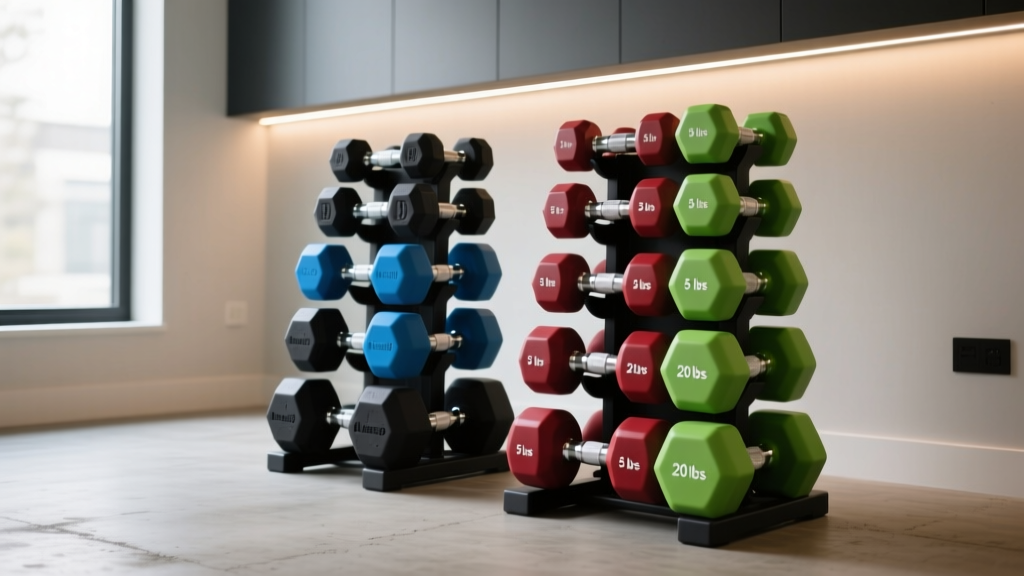
Horizontal 3-tier racks (like the REP Fitness 3-Tier Dumbbell Rack) feature flat steel shelves. Rubber hex dumbbells sit perfectly flat on these shelves. However, because hex heads are wide, a standard 3-tier rack designed for round dumbbells will often fail to accommodate a full set of hex dumbbells above 35 lbs; the handles will overlap, forcing you to buy an extended 'wide' rack that consumes an extra 12 inches of lateral wall space.
Vertical Saddle Racks (Best for Urethane)
Vertical A-frame or wall-mounted saddle racks save massive amounts of floor space by utilizing vertical clearance. Round or 12-sided urethane dumbbells slide seamlessly into standard 2.5-inch or 3-inch nylon-lined saddles. Attempting to force bulky rubber hex dumbbells into standard vertical saddles often results in the hex corners snagging on the nylon lining, eventually tearing the rack's protective coating and exposing the steel to rust.
Pro-Tip for 2026 Layouts: If you are mounting a fold-away wall rack to maximize floor space during non-workout hours, always choose urethane. The compact heads prevent the rack from protruding more than 14 inches from the wall, keeping you compliant with standard hallway clearance codes.
Floor Protection and Drop Zone Mapping
Space optimization also involves mapping out 'drop zones' for when fatigue sets in. Material hardness (measured on the Shore A durometer scale) affects how the dumbbell interacts with your flooring and mats.
Rubber hex dumbbells generally feature a harder rubber shell (around 85-90 Shore A). They absorb impact reasonably well but can crack or chip if dropped repeatedly on concrete from chest height. Urethane is softer and more elastic (typically 75-85 Shore A for the outer layer). While urethane is virtually indestructible and won't chip, its elasticity means it bounces. If you drop a 40 lb urethane dumbbell on a thin PVC floor, it will bounce and potentially roll into your drywall or nearby furniture. Therefore, if your layout places your dumbbell rack near fragile walls or glass mirrors, you must allocate space for 3/4-inch thick vulcanized rubber drop mats directly beneath the urethane rack to deaden the bounce.
The Final Layout Decision Framework
To finalize your spatial design, run your specific room parameters through this decision matrix, as recommended by equipment testing authorities like Garage Gym Reviews:
- Choose Urethane If: Your gym is in an enclosed, poorly ventilated room (spare bedroom/basement); you are utilizing vertical saddle racks or wall-mounted fold-away racks to save floor space; you need to minimize the linear footprint of a 10-pair set; and your budget allows for the $2.50+ per pound premium.
- Choose Rubber Hex If: Your gym is in a well-ventilated garage or open-concept space; you prefer floor-storing your weights in corners without rolling; you perform high volumes of floor-based renegade rows and burpees where anti-roll geometry is a safety requirement; and you are outfitting a large space where horizontal tiered racks won't impede traffic flow.
Ultimately, optimizing your space for home exercise with dumbbells requires looking past the price tag. By calculating the true spatial cost—including rack width, mat requirements, and air quality management—you can select the material that transforms your available square footage into a highly functional, frustration-free training environment.
More gear to consider
All reviews
Cast Iron vs Competition Kettlebells: Dumbbell Lateral Squats Guide

One Arm Overhead Dumbbell Extension: Neoprene Home Setup

Dumbbell Curl Weight for Beginners: A Neoprene Home Guide
Power Rack vs Squat Stand: Deltoid Muscle Dumbbell Workouts & Squats

2026 Gear Trends: Loadable Dumbbells for the Dumbbell Snatch Workout