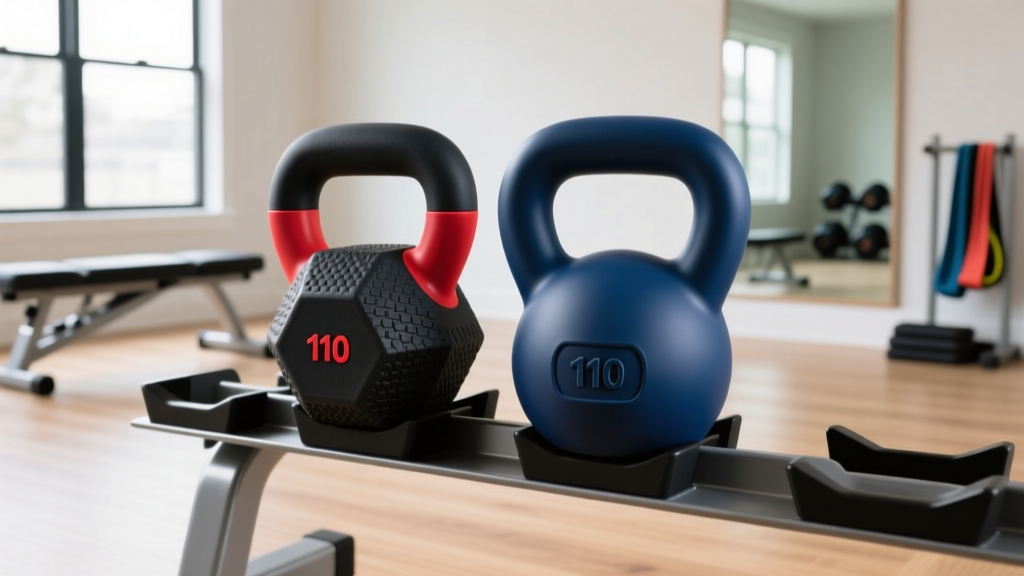
Rubber Hex vs Urethane: Best 110 lb Dumbbells for Home Gyms
Optimize your home gym layout. We compare rubber hex vs urethane 110 lb dumbbells for space efficiency, rack footprint, density, and safety.

When designing a high-performance home gym, space is often the most unforgiving constraint. As lifters progress and their strength demands increase, the equipment required to support that growth inevitably consumes more square footage. Reaching the threshold of heavy free weights—specifically the 110 lb dumbbell tier—introduces a unique spatial crisis. At this weight, the physical volume of the dumbbell head becomes massive, and the way these implements interact with your rack, flooring, and surrounding walls dictates the efficiency of your entire layout.
For advanced lifters outfitting compact garage gyms or basement studios in 2026, the debate between rubber hex dumbbells and urethane dumbbells is no longer just about durability or aesthetics. It is fundamentally a question of spatial geometry, material density, and environmental safety. In this comprehensive layout guide, we break down exactly how rubber hex and urethane 110 lb dumbbells compare regarding rack footprint, bounce radius, and overall space optimization.
The Physics of Density: Urethane vs. Rubber Hex Dimensions
To understand how dumbbells affect your gym layout, you must first understand material density. Urethane is a premium elastomer that is significantly denser than the recycled or virgin rubber used in standard hex dumbbells. This density discrepancy becomes glaringly obvious as you scale up to heavier weights.
A standard 110 lb rubber hex dumbbell features a massive head diameter, often exceeding 7.8 inches. Because rubber is less dense, the manufacturer must increase the physical volume of the head to achieve the target weight. Conversely, a 110 lb urethane dumbbell head typically measures between 6.5 and 6.9 inches in diameter. While a one-inch difference might seem negligible on a single implement, it compounds drastically across a full rack.
Spatial Impact Data: The 110 lb Threshold
Rubber Hex (110 lb): ~7.8-inch head diameter. Requires wider lateral spacing to prevent friction damage to adjacent pairs.
Urethane (110 lb): ~6.7-inch head diameter. Allows for tighter lateral grouping, maximizing rack capacity.
Layout Advantage: Upgrading to urethane can compress your heavy dumbbell rack footprint by up to 14%, a critical metric for home gyms under 300 square feet.
Rack Footprint and the 'Handle Clash' Phenomenon
When optimizing your layout, the dumbbell rack is the primary focal point. A standard commercial 3-tier dumbbell rack measures roughly 48 inches wide, 24 inches deep, and 36 inches high. In a tight home gym, this 8-square-foot footprint is a massive commitment. How your 110 lb dumbbells sit on this rack dictates your workflow and safety.
The Lateral Spacing Problem
Rubber hex dumbbells are notorious for 'handle clash' on standard 3-tier racks. Because the heads are so wide at the 110 lb mark, the thick, often straight handles (frequently 35mm or thicker to support the load) end up touching or overlapping with the adjacent 100 lb or 105 lb pairs. This forces lifters to awkwardly maneuver their hands when racking or un-racking heavy weights, increasing the risk of pinched fingers or dropped loads in a confined space.
Premium urethane dumbbells, such as the Rogue Urethane Dumbbells, mitigate this issue through superior head density and ergonomically contoured, knurled handles. The narrower head profile ensures that even at 110 lbs, there is adequate lateral clearance on a 48-inch rack, allowing for a seamless, safe lifting flow without requiring you to purchase a wider, more space-consuming 60-inch rack.
Material Comparison Matrix: Space and Safety
When planning your gym layout, consider how the material properties of your heaviest dumbbells interact with the surrounding environment. The following matrix highlights the critical spatial and environmental differences between the two materials at the 110 lb tier.
| Feature | Rubber Hex (110 lb) | Urethane (110 lb) |
|---|---|---|
| Head Diameter | ~7.8 inches (Bulky) | ~6.7 inches (Compact) |
| Bounce Profile | High lateral bounce (Requires wider drop zones) | Dead-bounce (Allows tighter equipment spacing) |
| Off-Gassing / Odor | High VOCs (Problematic in unventilated rooms) | Virtually odorless (Ideal for basements/small rooms) |
| Average Cost (Pair) | $350 - $420 | $850 - $1,050 |
Environmental Constraints: Ventilation and Drop Zones
Space optimization is not solely about physical dimensions; it also encompasses the environmental quality of the space. Many home gyms are located in garages, basements, or spare bedrooms with limited HVAC circulation. According to testing data from Garage Gym Labs, cheap rubber dumbbells release volatile organic compounds (VOCs) that can cause headaches and respiratory irritation. In a large commercial facility, this is negligible. In a 12x12 home gym, a full set of rubber hex dumbbells up to 110 lbs can make the air quality unbearable during summer months.
Urethane is chemically stable and does not off-gas, making it the undisputed champion for compact, poorly ventilated layouts. Furthermore, the 'bounce factor' dictates how closely you can place your dumbbell rack to walls, mirrors, or squat racks. A dropped 110 lb rubber hex dumbbell will aggressively bounce and roll laterally, requiring a 3-to-4-foot buffer zone around your lifting platform to protect drywall and adjacent equipment. Urethane absorbs kinetic energy and 'dead-bounces,' allowing you to compress your layout and place racks much closer together safely.
'When mapping out a home gym under 400 square feet, the dead-bounce characteristic of urethane is a non-negotiable safety feature. It allows you to position your dumbbell rack just 24 inches from your power rack uprights without risking catastrophic damage to your steel or drywall from a failed heavy set.' — Facility Layout Principles, FitGearPulse Analysis
Financial Breakdown: Cost Per Square Foot
The primary argument against urethane is the upfront cost. In 2026, the global supply chain for raw urethane remains tight, keeping prices elevated. A pair of 110 lb rubber hex dumbbells will cost approximately $1.75 to $2.00 per pound, totaling around $385 to $440. The same pair in premium urethane will cost between $4.00 and $5.00 per pound, totaling $880 to $1,100.
However, when viewed through the lens of spatial ROI (Return on Investment), urethane often justifies its premium. By utilizing urethane, you can purchase a narrower 48-inch rack instead of a 60-inch rack, saving 12 inches of valuable wall space. You also eliminate the need for extensive protective wall padding or expanded drop zones. For lifters paying high real estate or rent premiums, the space saved by denser equipment translates to tangible financial value.
Step-by-Step Layout Guide for Heavy Dumbbells
If you are integrating 110 lb dumbbells into your home gym, follow this spatial optimization checklist to ensure a safe, efficient layout:
- Anchor the Rack: Place your 3-tier dumbbell rack against a load-bearing wall. If using rubber hex, leave a minimum 36-inch clearance to the sides for lateral bounce. If using urethane, 18 inches is sufficient.
- Calculate Tier Angles: Ensure your rack features an angled top tier (usually 10 to 15 degrees). At 110 lbs, lifting from a flat horizontal tier puts excessive shear force on the lumbar spine in cramped spaces where you cannot step back properly.
- Flooring Integration: Do not place heavy dumbbell racks directly on bare concrete. The vibration from racking 110 lb weights will travel through the slab. Use 3/4-inch vulcanized rubber mats specifically under the rack footprint to isolate acoustic vibration, especially in multi-story homes.
- Clear the Drop Zone: Map out a semi-circle extending 3 feet forward from the rack. Keep kettlebells, plyo boxes, and bands outside this zone to prevent tripping hazards during heavy, fatiguing sets.
Final Verdict for Compact Home Gyms
When optimizing a home gym layout for heavy, advanced lifting, the physical and environmental footprint of your equipment is just as critical as its performance. While rubber hex dumbbells offer a budget-friendly entry point, their massive head diameter, aggressive bounce profile, and VOC off-gassing make them a liability in tight, unventilated spaces.
For lifters committed to the 110 lb tier and beyond, urethane dumbbells represent the ultimate spatial optimization tool. Their superior density compresses your rack footprint, their dead-bounce profile protects adjacent equipment, and their odorless nature preserves your indoor air quality. If your layout demands maximum efficiency and safety per square foot, investing in urethane is the definitive choice for a future-proof home gym.
More gear to consider
All reviews
Optimizing Space for the Flat Dumbbell Chest Fly: Hex vs Urethane
Collar Clamps Compared for Dumbbell Arm Workout for Beginners

Dumbbell Pullovers for Lats: EZ Curl Bar vs Straight Bar

Olympic vs Standard Plates vs Centr Dumbbell Set: Home Gym Guide

EZ Curl Bar vs Straight Bar & the 40kg Dumbbell 2026 Trends
