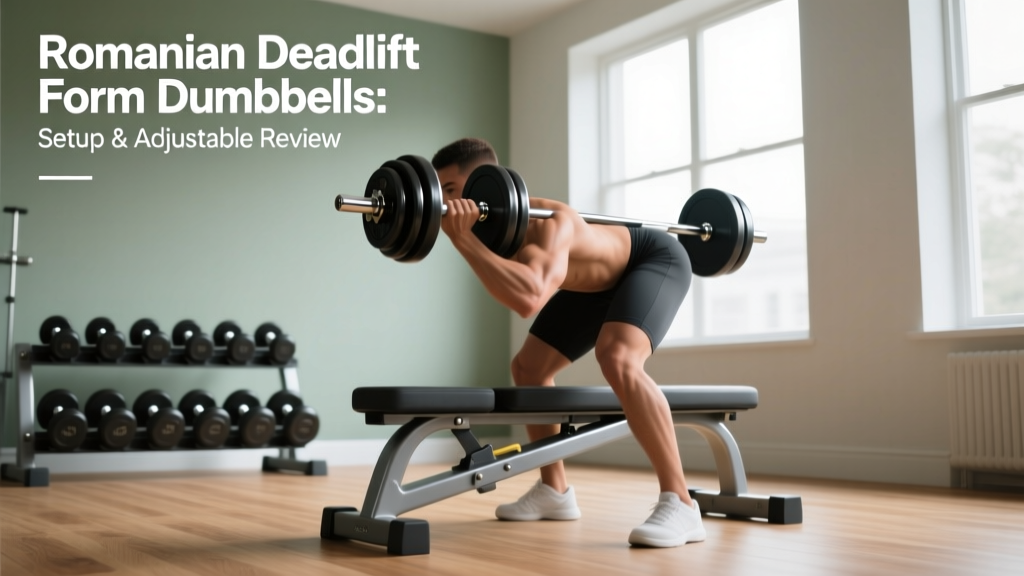
Romanian Deadlift Form Dumbbells: Setup & Adjustable Review
Master your hinge. We compare top adjustable dumbbells and walk through the exact setup and installation for perfect Romanian deadlift form.

The Biomechanical Demand of the Hinge
The Romanian Deadlift (RDL) is the undisputed king of posterior chain development, targeting the hamstrings, glutes, and spinal erectors through a deep hip hinge. While barbells are traditional, dumbbells offer superior freedom of movement, allowing for a more natural wrist position and an extended range of motion past the toes. However, when analyzing the equipment required to maintain optimal romanian deadlift form, dumbbells must act as seamless, compact extensions of your arms. If your dumbbells are too long or poorly balanced, they will clash with your thighs or knees, forcing you to widen your stance or push the weight forward, which destroys the vertical bar path and shifts dangerous shear forces onto your lumbar spine.
According to biomechanical analyses by Stronger By Science, the moment arm in a hinge movement is highly sensitive to the horizontal distance between the load and your mid-foot. Even a two-inch forward deviation caused by bulky dumbbell heads can increase lower back torque by over 15%. Therefore, selecting and setting up the right adjustable dumbbells is not just a matter of convenience; it is a critical injury-prevention protocol.
Expert Insight: 'The RDL is a lesson in tension, not just movement. If your equipment forces you to alter your natural stance width to accommodate the physical footprint of the weights, you are no longer training the posterior chain optimally.' — Physio-pedia Biomechanics GuidelinesStation Installation & Spatial Setup
Before dialing in your weights, you must install a proper RDL station. Adjustable dumbbells require a specific drop zone and floor clearance to protect both the internal mechanisms of the dumbbells and your flooring.
1. Flooring and Matting Installation
Never perform heavy RDLs on bare hardwood or standard EVA foam tiles. You need high-density vulcanized rubber. Install 3/4-inch (19mm) thick horse stall mats or commercial gym flooring. This thickness absorbs the kinetic energy of a controlled drop (or an emergency bail) without cracking the adjustable dial mechanisms inside the dumbbell cradles.
2. Spatial Clearance Calculations
Measure your lifting platform. For a standard RDL setup, you need a minimum clear floor space of 4 feet by 6 feet. When holding dumbbells at arm's length, the bottom of the weights will hover around mid-shin. Ensure your matting is perfectly level; even a 2-degree floor slope can cause adjustable dumbbells to roll or shift in their cradles when you re-rack them mid-set.
3. The Re-Racking Zone
Unlike fixed hex dumbbells, adjustable models cannot be dropped from shoulder height or tossed onto the floor. You must install a low-profile dumbbell tray or designate a specific 'safe zone' on your mat where you can squat down and manually re-rack the weights into their base plates without twisting your spine under load.
2026 Adjustable Dumbbell Comparison Matrix
Not all adjustable dumbbells are built for the hip hinge. Below is our 2026 comparison of the top three market leaders, evaluated specifically on their suitability for the RDL based on length, grip profile, and increment jumps.
| Model | Max Weight | Length | Grip Profile | RDL Suitability | 2026 Price |
|---|---|---|---|---|---|
| PowerBlock Elite | 5-50 lbs | 12.0 inches | Caged, Urethane | Excellent (Compact) | $369 |
| Nuobell 80 | 5-80 lbs | 14.5 inches | Knurled Steel | Very Good (Authentic feel) | $349 |
| Bowflex 552 | 5-52.5 lbs | 16.9 inches | Smooth Plastic/Rubber | Poor (Too long, hits thighs) | $399 |
Deep Dive: Why Length Dictates Hinge Quality
The Bowflex SelectTech 552 is a fantastic tool for presses and curls, but at 16.9 inches long, it is a biomechanical nightmare for the RDL. When held at the sides, the inner plates will physically strike your thighs or patellas during the eccentric descent. The PowerBlock Elite, with its blocky 12-inch profile, keeps the center of mass incredibly close to your body's midline. The Nuobell 80 offers the best of both worlds: a traditional barbell-like knurled handle for grip security, with a relatively compact 14.5-inch footprint that clears the legs for most lifters.
Step-by-Step Setup for the Perfect Rep
Once you have selected the right compact adjustable dumbbell (we recommend the Nuobell or PowerBlock for this movement), follow this exact installation and execution walkthrough to guarantee a flawless hinge.
- Dialing the Load: Place the dumbbells securely in their base cradles. Rotate the dials to your target weight. Crucial: Always lift the dumbbells straight up out of the cradle. Twisting them while they are still engaged with the base plate will strip the internal ABS plastic gears.
- The Stance Installation: Stand with your feet hip-width apart (roughly 10-12 inches between heels). Point your toes straight ahead or slightly outward (max 10 degrees). This narrow stance is vital to prevent the dumbbells from hitting your legs.
- The Grip Setup: Hinge at the hips to grasp the dumbbells. Use a neutral grip (palms facing your thighs). Wrap your thumbs completely around the handle. The ExRx exercise database emphasizes that a closed, neutral grip maximizes latissimus dorsi engagement, which stabilizes the thoracic spine.
- Pre-Tensioning: Before initiating the descent, pull your shoulder blades down and back ('putting them in your back pockets'). Squeeze the armpits to engage the lats. This creates a rigid torso.
- The Descent (Eccentric): Push your hips straight back toward the wall behind you. Keep the dumbbells grazing your thighs and shins. Lower the weights only until you feel a maximum stretch in your hamstrings (usually just below the knee). Do not round your back to go lower.
- The Ascent (Concentric): Drive your hips forward to return to the standing position. Squeeze the glutes hard at the top, but do not hyperextend the lumbar spine.
Troubleshooting Edge Cases & Grip Failures
Even with perfect equipment and setup, lifters frequently encounter mechanical failures during heavy RDL sets. Here is how to troubleshoot the most common issues.
Warning: Grip Fatigue vs. Muscular FailureYour hamstrings and glutes are massive muscle groups capable of moving heavy loads, but your forearm flexors are small. A common failure mode is grip giving out before the posterior chain is fully stimulated. If you find yourself dropping the dumbbells or losing neutral spine alignment because your hands are slipping, install lifting straps into your setup. Figure-8 straps are highly recommended for dumbbell RDLs as they lock the load to your wrists, completely removing grip as the limiting factor.
Edge Case: The 'Shin Strike' Problem
If you are using 14.5-inch dumbbells and still clipping your shins at the bottom of the movement, your center of gravity is shifting forward. This happens when lifters bend their knees too much, turning the RDL into a squat. The Fix: Install a physical cue. Place a 4-inch foam roller or a small yoga block about 12 inches behind your heels. During the set, focus on pushing your glutes back until they physically tap the foam roller. This forces a pure hip hinge and keeps the dumbbells traveling in a straight vertical line.
Edge Case: Asymmetrical Weight Distribution
Adjustable dumbbells rely on internal weight plates. If you do not fully seat the dumbbell into the cradle before turning the dial, you may select 40 lbs on the left side and 45 lbs on the right. A 5 lb discrepancy during a heavy hinge movement can cause immediate rotational torque on the sacroiliac (SI) joint. The Fix: Always visually verify the weight indicator window on both sides of the dumbbells before every single set, and give the handle a gentle 'shake test' to ensure no loose plates are rattling inside the housing.
Final Thoughts on Equipment Selection
Perfecting your hinge requires more than just discipline; it requires an environment and equipment that facilitate proper mechanics. By investing in compact adjustable dumbbells like the PowerBlock or Nuobell, installing proper shock-absorbing matting, and strictly adhering to a vertical bar path, you transform the RDL from a risky lower-back gamble into one of the safest, most effective muscle-building tools in your 2026 training arsenal. Respect the setup, trust the hinge, and let the posterior chain grow.
More gear to consider
All reviews
Iron vs Bumper Plate Care: Dumbbell Alt Bicep Curl & Longevity

Cast Iron vs Competition Kettlebells: Dumbbell Body Workout Layouts
Loadable Dumbbells 2026: Dumbbell Romanian Deadlift Muscles Worked
Single Arm Dumbbell Row Form: Rubber Hex vs Urethane in Small Gyms
Power Rack vs Squat Rack vs Stand: Your 5 Day Dumbbell Workout Split
