Rear Delt Pulls With Dumbbells: Adjustable Gear Review
Master rear delt pulls with dumbbells using our step-by-step beginner guide and adjustable dumbbell comparison to find the perfect grip and weight.

The Rear Delt Dilemma: Why Your Gear Matters
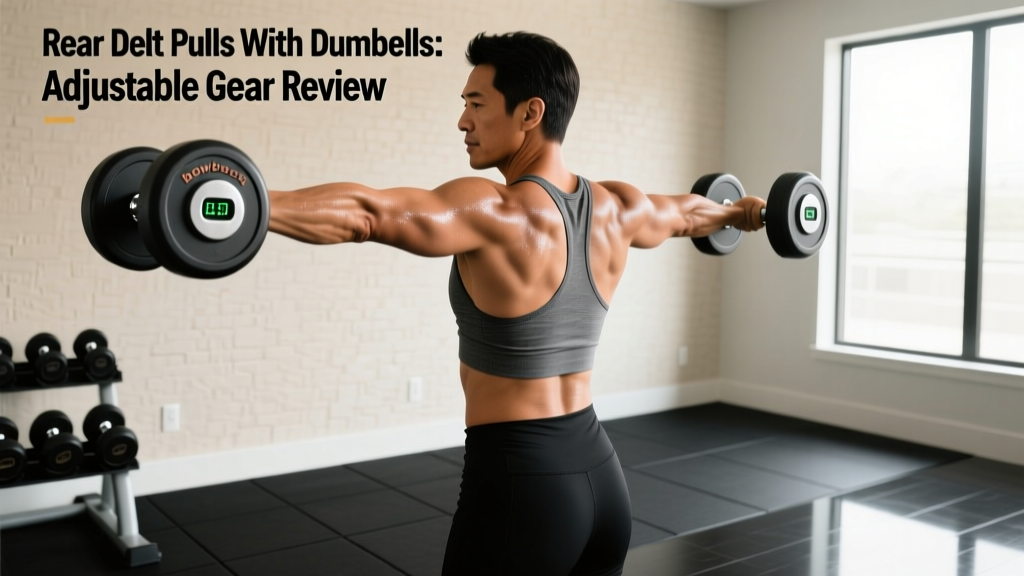
The posterior deltoid is notoriously one of the most stubborn and misunderstood muscle groups for beginners. When performing rear delt pulls with dumbbells (often called reverse flyes or bent-over lateral raises), the primary biomechanical function at play is horizontal shoulder abduction. According to the comprehensive muscle anatomy databases at ExRx, the rear delt fibers run horizontally across the back of the shoulder, meaning they require a very specific range of motion to fully activate.
Here is where most beginners fail: they grab weights that are far too heavy. The rear delts are small stabilizer muscles. While your chest might press 50-pound dumbbells, your rear delts might only need 5 to 12 pounds to reach muscular failure. This creates a massive problem when using standard adjustable dumbbells. If your adjustable set jumps from 5 lbs to 10 lbs, that is a 100% increase in load—a jump that will almost certainly force your larger trapezius and rhomboid muscles to take over the movement, robbing your rear delts of the stimulus.
In this 2026 guide, we are going to break down exactly how to execute rear delt pulls with dumbbells step-by-step, and then review the top adjustable dumbbell models on the market specifically through the lens of light-weight isolation work, grip ergonomics, and micro-loading capabilities.
Step-by-Step Guide: Executing the Perfect Rear Delt Pull
Before we evaluate the gear, we must establish the baseline movement. Proper form prevents lower back strain and ensures the posterior deltoid does the heavy lifting. The American Council on Exercise (ACE) emphasizes the importance of spinal neutrality during bent-over movements.
Phase 1: The Setup and Hinge
- The Stance: Stand with your feet shoulder-width apart, holding your adjustable dumbbells with a neutral grip (palms facing each other).
- The Hinge: Push your hips backward as if closing a car door with your glutes. Hinge forward until your torso is at a 45-degree angle. Beginner Mistake: Bending over to a full 90 degrees often causes the lower back to round. A 45-degree angle maintains a neutral spine while still aligning the pull against gravity.
- The Arm Position: Let the dumbbells hang straight down toward the floor. Maintain a slight, soft bend in your elbows (about 10 to 15 degrees). Lock this elbow angle in place; it should not change during the rep.
Phase 2: The Pull (Concentric Phase)
- Lead with the Elbows: Do not think about lifting the weight with your hands. Instead, imagine pulling your elbows up and back toward the ceiling.
- The Arc: Raise the dumbbells out to your sides in a wide arc. As the weights rise, you can slightly rotate your wrists so your pinkies point upward (pronating slightly), which can increase rear delt recruitment.
- The Peak: Stop when your upper arms are parallel to the floor. Squeeze your shoulder blades together and hold for a full 1-second isometric pause.
Phase 3: The Descent (Eccentric Phase)
- Control the Negative: Lower the dumbbells back to the starting position over a count of 3 seconds. Do not let gravity pull the weights down.
- Reset: Allow the dumbbells to come to a complete stop at the bottom before initiating the next rep to eliminate momentum.
Beginner Pro-Tip: The 'Pour the Pitcher' Cue
If you struggle to feel the rear delts firing, try the internal rotation cue. At the top of the movement, imagine you are pouring out a pitcher of water with both hands (thumbs pointing down). This internally rotates the humerus and places the posterior deltoid fibers in a direct line of pull against gravity. Use lighter weight when trying this variation!
Adjustable Dumbbell Comparison for Isolation Work
Not all adjustable dumbbells are created equal, especially when it comes to the micro-adjustments required for rear delt pulls. Below is a comparison of the top three adjustable dumbbell systems available in 2026, graded specifically on their suitability for light, isolation-based shoulder work.
| Model | Weight Increments | Handle & Head Profile | Rear Delt Suitability | Avg. Price (Pair) |
|---|---|---|---|---|
| Bowflex SelectTech 552 | 2.5 lbs (up to 25 lbs) | Bulky plastic ends, 5.5" handle | Excellent (Micro-loading) | $349 |
| Nuobell 80lb | 5.0 lbs | Traditional feel, knurled steel | Good (Ergonomic grip) | $329 |
| PowerBlock Elite USA | 2.5 lbs (with adder pins) | Caged block, restricted wrist | Fair (Cage interference) | $229 |
Deep Dive: Which Adjustable Set Wins for Rear Delts?
1. Bowflex SelectTech 552: The Micro-Loading Champion
For rear delt pulls, the Bowflex SelectTech 552 is arguably the best choice for beginners, despite its bulky physical footprint. The secret lies in its dial system, which offers 2.5-pound increments from 5 lbs all the way up to 25 lbs. When training a small muscle group like the posterior deltoid, jumping from 10 lbs to 15 lbs (a 50% increase) often leads to form breakdown and trap compensation. The ability to move from 10 lbs to 12.5 lbs allows for seamless progressive overload.
The Drawback: The wide, rounded plastic ends of the Bowflex can occasionally bump into your thighs or each other at the bottom of the movement if your stance is too narrow. You will need to take a slightly wider stance to accommodate the 16.9-inch length of the dumbbell at lower weights.
2. Nuobell 80lb: The Ergonomic Purist
If you despise the bulky feel of the Bowflex, the Nuobell system is a revelation. By twisting the knurled steel handle, the weight plates slide on and off seamlessly. The Nuobell feels exactly like a traditional hex dumbbell in your hand, making the neutral-grip setup for rear delt pulls incredibly comfortable. The handle thickness (roughly 1.3 inches) is ideal for maintaining a secure grip without over-taxing your forearms before your rear delts fatigue.
The Drawback: The Nuobell jumps in 5-pound increments (5, 10, 15, 20). For a beginner whose rear delts are currently maxing out at 10 pounds, the jump to 15 pounds might be too aggressive, forcing you to stay at 10 pounds for several months before progressing.
3. PowerBlock Elite USA: The Space-Saver with a Catch
PowerBlocks are legendary for their durability and compact, stackable footprint. The Elite USA model allows for 2.5-pound micro-loading, but only if you purchase and install the internal 'adder' weight pins. Without them, the jumps are 3 pounds. However, the major issue with PowerBlocks for rear delt pulls is the caged handle design. During the peak contraction of a rear delt pull, your wrists naturally want to extend and rotate slightly. The rigid steel cage of the PowerBlock restricts this natural wrist mechanics, which can cause the metal frame to dig into your forearm or wrist at the top of the movement.
FitGearPulse Verdict: For strict isolation work like rear delt pulls, the Bowflex SelectTech 552 wins purely on the merit of its 2.5 lb micro-increments in the lower weight ranges. Small muscles require small jumps in weight to progress safely.
Programming Your Rear Delt Pulls for Hypertrophy
Now that you have selected your gear and mastered the form, how should you program this movement? The National Strength and Conditioning Association (NSCA) guidelines for muscular hypertrophy suggest moderate to high rep ranges for smaller, fatigue-prone muscle groups.
- Frequency: 2 to 3 times per week (rear delts recover quickly and can handle high frequency).
- Volume: 3 to 4 sets per session.
- Rep Range: 12 to 20 reps. If you cannot complete at least 12 reps with strict form, the weight is too heavy.
- Rest Periods: 60 to 90 seconds. The rear delts do not require the 3-minute rest periods needed for heavy compound squats or deadlifts.
- Tempo: 1-1-3 (1 second up, 1 second pause, 3 seconds down).
Common Edge Cases and Troubleshooting
Even with the perfect adjustable dumbbells and a step-by-step guide, beginners often encounter specific failure modes. Here is how to troubleshoot them:
Edge Case 1: 'I only feel it in my upper traps.'
The Fix: You are shrugging your shoulders toward your ears during the pull. Before every single rep, actively depress your scapula (pull your shoulder blades down into your back pockets). Keep your neck long and relaxed. If the traps still take over, drop the weight by 2.5 lbs.
Edge Case 2: 'My lower back aches after the set.'
The Fix: Your hamstrings are likely tight, preventing a proper hip hinge and forcing your lumbar spine to round. If you cannot comfortably hold a 45-degree bent-over position, switch to a chest-supported rear delt pull. Set an adjustable bench to a 30 or 45-degree incline, lay face down on the pad, and perform the exact same pulling motion. This removes the lower back from the equation entirely.
Edge Case 3: 'The adjustable dumbbell plates rattle and distract me.'
The Fix: This is common with dial-based adjustables like the Bowflex when the weight is set below 15 pounds, as the unused plates rest in the cradle. Ensure you are lifting the dumbbell straight up out of the cradle, not at an angle. If the rattle persists, consider placing a thin yoga mat under the storage base to dampen the vibration resonance.
Final Thoughts on Gear and Gains
Rear delt pulls with dumbbells are a foundational movement for building 3D shoulders, improving posture, and preventing shoulder impingements. By treating the posterior deltoid with the respect it deserves—using light weights, strict tempos, and equipment that allows for micro-loading—you will see dramatic improvements in your upper back aesthetics and shoulder health. Choose your adjustable dumbbells wisely, prioritize the 2.5-pound increments, and let the elbows lead the way.
More gear to consider
All reviews
EZ Bar vs Straight Bar: Is the Close Grip Dumbbell Curl Better?
Adjustable Dumbbell Review: Exercises for Hamstrings With Dumbbells
Power Rack vs Squat Stand: Best Rig for Your Dumbbell Back Workout

Space Layouts: Bumper vs Iron & How Often to Increase Dumbbell Weight

2026 Rack Trends: Storage and One-Arm Dumbbell Row Muscles Worked