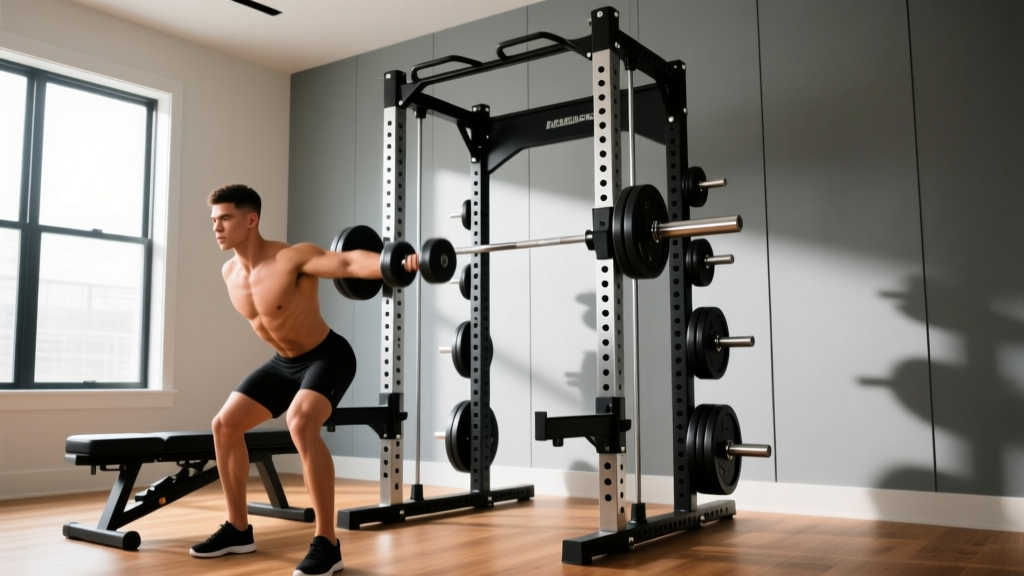
Power Rack vs Squat Stand: Single Arm Dumbbell Lateral Raise Space
Compare power racks, squat racks, and stands. We analyze internal clearance for the single arm dumbbell lateral raise and heavy compound lifts.

The Overlooked Metric: Lateral Clearance in Home Gym Racks
When outfitting a home gym in 2026, the vast majority of buyers fixate on three metrics: footprint, weight capacity, and price. You will read endless reviews about whether a rack can hold 1,000 pounds or if it fits under an 84-inch ceiling. However, as any seasoned lifter will tell you, the true test of a rack's daily usability isn't found in a heavy back squat—it is found in the spatial freedom required for isolation movements. Specifically, the single arm dumbbell lateral raise.
This unilateral shoulder movement requires significant lateral swing room. If your rack's internal clearance is too narrow, you will repeatedly smash your knuckles or the dumbbell head into the steel uprights, ruining your tempo and risking wrist strain. In this in-depth buying guide, we are evaluating power racks, half racks (squat racks), and squat stands through the lens of lateral clearance, using the single arm dumbbell lateral raise as our benchmark for spatial freedom.
The Biomechanics of Rack Clearance
To understand why rack width matters, we must look at human biomechanics. According to anthropometric data referenced by the Garage Gym Labs testing team, the average 5'10" male has a wingspan of roughly 71 inches. This means the distance from the center of the chest to the tip of the middle finger is approximately 35.5 inches.
When executing a single arm dumbbell lateral raise, the arm travels from the hip to roughly 90 degrees of abduction (parallel to the floor). Add the width of a standard rubber hex dumbbell (about 4 to 6 inches), and you need a minimum of 40 inches of unobstructed lateral space from your center line to complete the rep without hitting an obstacle.
The "Center-Line" Trap
If you stand dead-center inside a rack with 43 inches of internal width, you only have 21.5 inches of space on either side of your body. Your arm will collide with the upright before you reach parallel. To perform the single arm dumbbell lateral raise safely inside a standard power rack, you must adopt an offset stance, shifting your body 10 to 12 inches toward the non-working side.
Power Racks: Maximum Safety, Variable Clearance
Power racks are the gold standard for home gyms, offering four-point stability and integrated safety spotter arms. However, their enclosed nature creates the most significant spatial challenges for lateral movements.
Standard 49-Inch Outside Width Models
The most common footprint in the industry features a 49-inch outside width. Because the uprights are typically 3x3 inches thick, this leaves an internal clearance of exactly 43 inches.
- Rogue R-3 Power Rack: The benchmark 49-inch rack. Priced around $745 in 2026, it offers 43 inches of internal space. You must use an offset stance for single arm lateral raises. (View Rogue R-3 Specs)
- Titan Fitness T-3 Series: A highly competitive alternative at roughly $599. It shares the exact 49-inch outside / 43-inch inside dimensions, requiring the same lateral offset for dumbbell work.
The Narrow Footprint Trend
Some manufacturers have shrunk their racks to appeal to apartment dwellers. The REP Fitness PR-4000, for instance, boasts a 47-inch internal width. While this saves floor space, it reduces your lateral working zone to just 23.5 inches per side from the center line. For tall lifters performing single arm dumbbell lateral raises, this narrower cage is highly restrictive and forces a severe offset stance that can feel unbalanced.
Half Racks (Squat Racks): The Open-Air Compromise
Half racks, often referred to as squat racks, feature two main uprights with a rear storage or stabilization crossmember. Because the front is entirely open, they offer a unique advantage for the single arm dumbbell lateral raise: infinite lateral clearance, provided you step forward.
Stepping Out of the Cage
With a half rack like the Rogue S-2 Squat Rack (approx. $625) or the Titan X-2 Series (approx. $450), you simply unrack your barbell for your heavy compounds, and then step two feet in front of the uprights to perform your dumbbell isolation work.
Because you are no longer "inside" the cage, your working arm has the entire width of your garage or basement to swing freely. The single arm dumbbell lateral raise becomes completely unobstructed.
Warning: The Spotter Arm Limitation
While half racks excel at providing open space for dumbbell work, their spotter arms extend forward from the uprights. If you are bench pressing alone and fail a rep, the barbell can bounce forward off the safety arms. For heavy, unassisted bench pressing, a fully enclosed power rack remains the safer choice.
Squat Stands: Budget-Friendly but Spatially Restrictive
Squat stands consist of two independent uprights. They are the most budget-friendly option, with models like the REP Fitness PR-1100 selling for under $350 and the Rogue SML-2C hovering around $415. However, they present a unique spatial paradox.
The Illusion of Open Space
On paper, squat stands have no side walls, implying unlimited lateral space. In reality, most squat stands have an outside width of 48 to 49 inches. Because they lack the heavy rear crossmembers of a half rack or the full cage of a power rack, they are prone to lateral wobble if bumped.
If you stand between the uprights to perform a single arm dumbbell lateral raise, you are constrained by the same 42-to-43-inch internal width as a power rack. If you step outside the uprights to gain lateral room, you are now standing on the uneven base plates or weight storage horns, creating a tripping hazard and an unstable floor surface for your lift.
The Verdict for Stands: To safely perform lateral raises with squat stands, you must step at least three feet in front of the uprights, treating them purely as a barbell storage unit while you work out in the open floor space.
2026 Head-to-Head Comparison Matrix
Use the table below to compare how each rack type handles both heavy compound lifts and the spatial demands of the single arm dumbbell lateral raise.
| Rack Type | Avg. Internal Width | Lateral Raise Freedom | Safety for Solo Bench | 2026 Price Range |
|---|---|---|---|---|
| Power Rack (Standard) | 43 inches | Requires 10" offset stance | Excellent (Enclosed) | $550 - $800 |
| Power Rack (Wide) | 53+ inches | Moderate (Less offset needed) | Excellent (Enclosed) | $850 - $1,200+ |
| Half Rack | 43 inches (Open Front) | Unlimited (Step forward) | Good (Use spotter arms) | $450 - $700 |
| Squat Stand | 42-43 inches | Unlimited (Step far forward) | Poor (High tip risk) | $300 - $450 |
The FitGearPulse Decision Framework
Choosing the right rack in 2026 requires balancing your compound lifting needs with your isolation movement preferences. Follow this framework to make your final decision:
- Assess Your Floor Space: If you have less than 48 square feet dedicated to your rack zone, a standard 49-inch power rack or a pair of folding wall-mounted squat stands is mandatory. Accept that you will need to use an offset stance for your single arm dumbbell lateral raises.
- Evaluate Your Bench Press Habits: If you frequently bench press heavy without a spotter, eliminate squat stands from your list immediately. Choose an enclosed power rack with pin-pipe safeties or strap safeties.
- Prioritize Dumbbell Volume: If your programming is heavily dumbbell-focused (e.g., bodybuilding splits with high volumes of lateral raises, flyes, and arnold presses), invest in a Half Rack. The ability to step out of the cage and utilize the open floor space will drastically improve your workout flow and prevent knuckle-busting collisions with steel uprights.
- Consider the "Wide" Upgrade: If budget and space allow, look for 53-inch outside width power racks (often labeled as "Wide" models). These provide roughly 47 inches of internal clearance, significantly reducing the offset required for unilateral shoulder work.
Final Thoughts on Spatial Awareness
The single arm dumbbell lateral raise is more than just a shoulder builder; it is the ultimate stress test for your home gym's spatial layout. While power racks offer unmatched safety for heavy barbell lifts, their enclosed design demands a conscious offset stance for wide unilateral movements. Half racks provide the best of both worlds, allowing you to step into the open air for dumbbell work, while squat stands remain a budget-friendly option that requires strict floor management. By prioritizing internal clearance and lateral swing room alongside weight capacity, you will build a home gym that supports every movement in your arsenal without restriction.
More gear to consider
All reviews
Best Adjustable Dumbbells for Bicep and Tricep Workouts (2026)
2026 Dumbbell Rack Trends: Storage for Push Presses with Dumbbells

Good Morning With Dumbbells: Rubber Hex vs Urethane Layout Guide

Outgrowing Basic Dumbbell Exercises? Olympic Barbell Knurling Guide

Barbell Collar Types Compared: Securing Weights for Dumbbell Sit Ups
