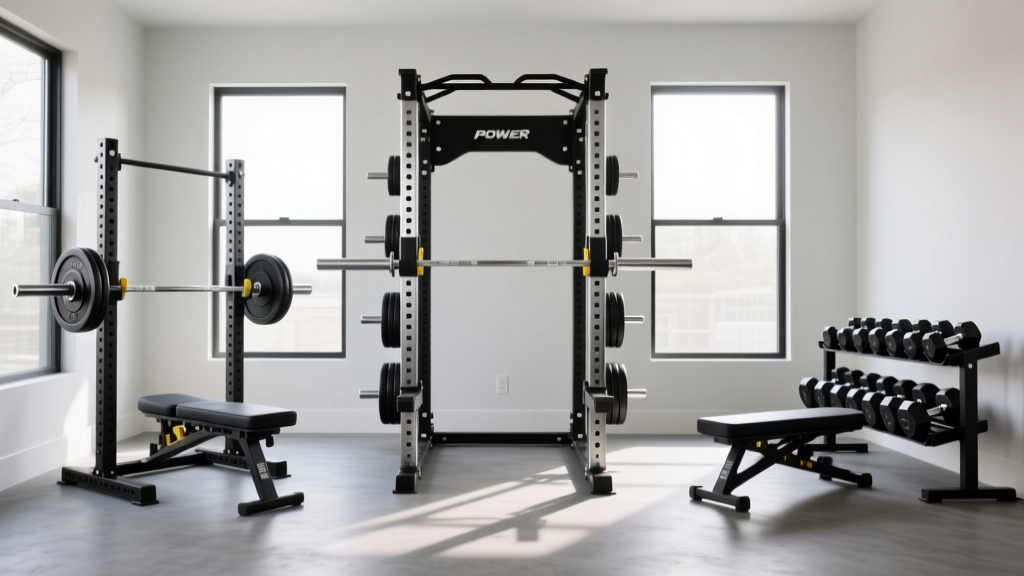
Power Rack vs Squat Rack vs Stand for Free Dumbbell Exercises
Transitioning from free dumbbell exercises to heavy lifting? Compare power racks, squat racks, and squat stands to find the best 2026 home gym setup.

Welcome to the next phase of your home gym journey. If you have built a solid foundation using free dumbbell exercises, you already understand the mechanics of progressive overload. However, as your strength increases, you will inevitably hit the ceiling of what adjustable dumbbells or a fixed dumbbell set can offer. To continue building muscle and strength safely, transitioning to barbell movements is essential—and that requires a dedicated steel structure.
But when you start shopping, the terminology can be overwhelming. What is the actual difference between a squat stand, a squat rack (half rack), and a full power rack? More importantly, how do these structures integrate with your existing dumbbell routine? This step-by-step guide will walk you through choosing the exact right equipment for your space, budget, and training style in 2026.
Step 1: Why Free Dumbbell Exercises Eventually Require a Rack
Before investing $400 to $1,000 in a steel rack, it is crucial to understand how this equipment complements your current routine. According to the World Health Organization, adults should engage in muscle-strengthening activities of moderate or greater intensity that involve all major muscle groups on two or more days a week. While free dumbbell exercises are fantastic for hitting these guidelines, they present specific limitations:
- The Loading Ceiling: Most home adjustable dumbbells max out at 50 to 90 pounds. For movements like goblet squats, Romanian deadlifts, and floor presses, intermediate lifters will outgrow this weight within 6 to 12 months.
- Stabilizer Fatigue: Heavy dumbbell pressing requires immense stabilizer muscle engagement, often causing your stabilizers to fail before your primary movers (chest and triceps). A rack allows you to switch to barbells to overload the prime movers.
- Integration and Storage: Modern power racks are modular. You can perform heavy dumbbell step-ups, rack pulls, and incline dumbbell presses inside a power rack using an adjustable bench, protecting your floors and allowing for safe drop-sets. Furthermore, many racks feature weight storage horns that can hold kettlebells and dumbbell handles, consolidating your gym footprint.
Step 2: Decoding the Big Three Rack Categories
The fitness industry uses these terms somewhat loosely, but from an engineering and safety perspective, they are distinctly different. Let us break down the exact specifications you need to look for.
1. Squat Stands: The Minimalist Choice
Squat stands consist of two independent, freestanding uprights. They are designed to hold the barbell for squats and overhead presses. Best for: Lifters with severe space constraints (e.g., small apartments or garages under 40 square feet of dedicated gym space) who primarily do free dumbbell exercises and only need a barbell for basic squats and presses.
Critical Failure Mode: Because they lack a rear crossmember, squat stands can tip forward if a beginner fails a rep and dumps the barbell forward instead of guiding it backward onto the spotter arms. They must be bolted to a concrete floor or heavily weighted with sandbags on the base.2. Squat Racks (Half Racks): The Middle Ground
Often confused with squat stands, a true squat rack (or half rack) features two front uprights connected to a rear base frame, creating an 'H' or 'U' shape from the top down. This rear base provides immense forward-and-backward stability without enclosing the lifter.
Best for: Lifters who want the safety of a connected frame for heavy barbell work but still want the open-air feeling to easily step in and out for their free dumbbell exercises without hitting a steel cage.
3. Power Racks: The Ultimate Safe Haven
A power rack (or power cage) features four or six uprights connected at the top and bottom, creating a fully enclosed cage. It includes adjustable safety spotter straps or pins that run the entire depth of the rack.
Best for: Anyone training alone. If you fail a heavy bench press or back squat, the safety straps catch the bar. It also allows for the integration of lat pulldown attachments, dip bars, and monolifts.
Step 3: Feature & Footprint Comparison Matrix
Use this matrix to visualize how each option impacts your home gym layout and training capabilities.
| Feature | Squat Stands | Squat Rack (Half Rack) | Power Rack (Full Cage) |
|---|---|---|---|
| Average Footprint | 20' x 20' (per stand) | 48' x 48' | 48' x 48' to 53' x 53' |
| Upright Standard (2026) | 3x3' Steel, 5/8' Holes | 3x3' Steel, 5/8' Holes | 3x3' Steel, 5/8' Holes |
| Safety Mechanism | Spotter Arms (Short) | Long Spotter Arms / Straps | Internal Pin/Pipe or Straps |
| Attachment Ecosystem | Limited (Dip bars, bands) | Moderate (Plate storage, row) | Massive (Pulleys, monolifts) |
| DB Exercise Integration | Poor (No bench support) | Good (Bench can slide in) | Excellent (Full bench enclosure) |
| Price Range (2026) | $250 - $450 | $450 - $700 | $600 - $1,200+ |
Step 4: Space Planning Around Your Dumbbell Zone
When mapping out your gym, do not just measure the rack; measure the 'working envelope.' The Mayo Clinic emphasizes the importance of proper form and a safe, uncluttered environment to prevent joint strain and accidental injuries during strength training.
- The 7-Foot Barbell Rule: A standard Olympic barbell is 7 feet (84 inches) long. You need at least 96 inches of lateral wall space to load and unload plates safely, regardless of whether you choose stands or a full cage.
- The Dumbbell Swing Radius: If you plan to do free dumbbell exercises like heavy dumbbell floor presses or chest flyes near the rack, ensure you have a 6-foot clearance zone in front of the rack. You do not want to strike a steel upright while lowering a 60-pound dumbbell.
- Ceiling Height Check: Standard power racks are 80 to 90 inches tall. If you have low basement ceilings, look specifically for 'short' power racks (usually 72 inches tall) or opt for squat stands, which can be stored away when not in use.
Step 5: Safety Protocols and Spotting Mechanics
Moving from free dumbbell exercises to barbell lifting changes the risk profile of your workout. With dumbbells, you can simply drop the weights to your sides if you fail. With a barbell, you are pinned.
'When lifting heavy free weights, especially without a trained spotter, utilizing mechanical safety catches is non-negotiable for exercises where the bar crosses over the neck or torso, such as the bench press and back squat.'
— National Strength and Conditioning Association (NSCA) Safety Guidelines
Beginner Action Step: When you assemble your rack, perform a 'spotter test' with an empty 45lb barbell. Set the safety straps just below your chest level on the bench press. Lower the bar to the straps, relax your arms, and verify that the bar is fully supported and that you can easily slide out from underneath it without the bar touching your chest.
Step 6: 2026 Purchasing Guide & Exact Model Recommendations
Based on current market pricing, steel gauge quality, and attachment compatibility, here are the top tier recommendations for beginners transitioning from dumbbells.
The Budget Minimalist: Rogue SML-1 Monster Lite Squat Stands
- Price: ~$395
- Specs: 3x3' 11-gauge steel, 90' height.
- Why it wins: Rogue's Monster Lite line is the gold standard for home gyms. The SML-1 footprint is tiny, leaving maximum floor space for your free dumbbell exercises. Note: You must purchase the optional spotter arms and bolt these to a concrete slab for heavy solo lifting.
The Versatile Hybrid: Titan Fitness T-2 Series Power Rack
- Price: ~$549 (Often includes free shipping)
- Specs: 2x2' uprights, 1' hole spacing in the bench press zone.
- Why it wins: Titan offers incredible value. The T-2 is a full cage, meaning you get internal safety straps and the ability to add a lat pulldown attachment later. The 2x2' uprights are slightly lighter duty than 3x3', but more than sufficient for 95% of home lifters.
The Lifetime Investment: Rep Fitness PR-4000 Power Rack
- Price: ~$699 (Base model) to $1,100+ (Fully accessorized)
- Specs: 3x3' 11-gauge steel, 5/8' holes, color-coded uprights.
- Why it wins: The PR-4000 is widely considered the best mid-tier rack on the market. It features a modular attachment system compatible with almost every brand on the market. The integrated sandwich J-cups protect your barbell knurling, and the depth allows for safe heavy dumbbell incline presses inside the cage.
Frequently Asked Questions
Can I store my adjustable dumbbells on a power rack?
Most power racks do not have dedicated shelves for adjustable dumbbells (like the Bowflex SelectTech or Nuobell). However, you can purchase aftermarket 'dumbbell tray' attachments that bolt to the rear crossmembers or uprights. Alternatively, keep a dedicated low-profile dumbbell rack adjacent to your power rack to maintain a clean working envelope.
Do I need to bolt my rack to the floor?
For squat stands, yes, bolting is highly recommended to prevent tipping. For half racks and full power racks, the footprint and the weight of the loaded barbell and plates usually provide enough downward force to keep the unit stable. However, if you plan to do kipping pull-ups or use band-resisted free dumbbell exercises anchored to the base, bolting is mandatory.
What is the difference between 5/8-inch and 1-inch hole spacing?
The hole spacing dictates how precisely you can set your J-cups and safety spotter arms. 1-inch spacing (common on budget racks) means your safety straps might be 1 inch too high (blocking your range of motion) or 1 inch too low (allowing the bar to hit your chest before catching). 5/8-inch spacing (standard on 3x3' uprights) offers much finer micro-adjustments, which is critical for safe bench pressing.
More gear to consider
All reviews
Olympic vs Standard Plates: Shoulder Workouts with Dumbbells Women
Barbell Collar Types: Safety for Seated Leg Lift Over Dumbbell
Cast Iron vs Competition Kettlebells & Dumbbell Chest and Tricep Workout

Bumper vs Iron Plates: Budget Breakdown to Fund Your Dumbbell Bicep Workout

Dumbbell Tenement Definition & Gym Setup: Olympic vs Standard Plates
