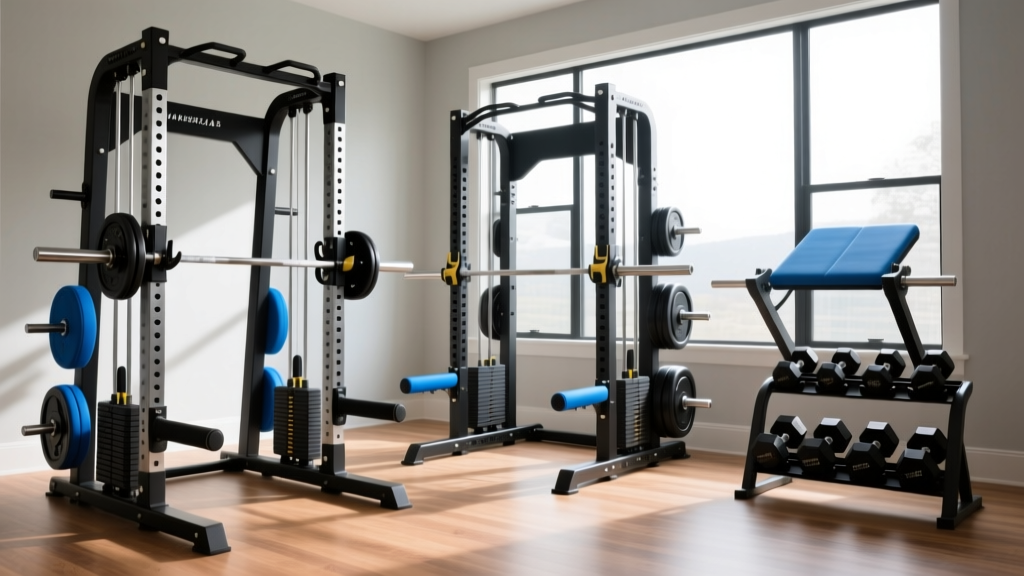
Power Rack vs Squat Rack vs Stand for Dumbbell 45 Hyperextension
Compare power racks, squat racks, and squat stands for 2026. Discover which setup safely supports the dumbbell 45 hyperextension and modular attachments.

The Modularity Test: Why One Exercise Dictates Your Entire Rig
In the 2026 home gym landscape, buying a squat rack is no longer just about safely benching or squatting. The true measure of a rig’s value lies in its modular ecosystem. While most buyers focus on pull-up bars and lat pulldown attachments, the ultimate stress test for any rack’s structural integrity and footprint is the dumbbell 45 hyperextension.
When you bolt a 45-degree back extension bench to your uprights, you fundamentally alter the center of gravity. Add a 200-pound athlete hinging forward while clutching a 100-pound urethane dumbbell to their chest, and the rotational torque placed on the rack’s base and uprights is immense. This single biomechanical demand separates the heavy-duty fortresses from the dangerous, tip-prone lightweights.
Below, we break down the power rack vs squat rack vs squat stand debate, using the mechanical requirements of the 45-degree dumbbell hinge as our ultimate filtering lens.
Structural Contenders: Footprint, Steel, and Price Matrix
Before diving into the physics of the hinge, let’s establish the baseline specifications of the three primary rack categories available on the market today.
| Feature | Full Power Rack (4-Post) | Open Squat Rack (3-Post/Folding) | Squat Stand (2-Post) |
|---|---|---|---|
| Upright Profile | 3x3 or 3x1.5 (11-Gauge) | 3x3 or 2x3 (11 to 14-Gauge) | 2x2 or 2x3 (12 to 14-Gauge) |
| Avg. Footprint | 48″ x 48″ to 49″ x 86″ | 48″ x 24″ (Wall-mounted) | 24″ x 24″ to 30″ x 30″ |
| Base Price Range (2026) | $1,600 - $3,800+ | $900 - $1,800 | $250 - $650 |
| 45° Extension Compatible? | Yes (Front/Side Mount) | Conditional (Requires Bolting) | Strictly No (Tipping Hazard) |
| Hardware Standard | 5/8″ or 1″ Bolts | 5/8″ Bolts | Standard Pins/Bolts |
The Biomechanics of the Dumbbell 45 Hyperextension
According to exercise biomechanics databases like ExRx, the 45-degree hyperextension isolates the erector spinae, glutes, and hamstrings by utilizing a fixed hinge point at the pelvis. When performed with a heavy dumbbell—often held in a goblet position or behind the neck—the load creates a severe anterior leverage multiplier.
Expert Insight: “At a 45-degree angle, the shear force on the lumbar spine is high, but the torsional force transferred into the gym equipment is often overlooked. A 300-pound moment arm can easily bend 14-gauge steel or uproot an unbolted squat stand.”
To perform this safely, your rack must accept a dedicated 45-degree back pad attachment, such as the Rogue Monster 45° Back Extension or comparable Titan/REP Fitness iterations. These attachments require dual-pin or multi-bolt mounting into the uprights to prevent wobble.
Power Racks: The Uncompromising Fortress
If the dumbbell 45 hyperextension is a staple in your programming, a full 4-post or 6-post power rack is the only unequivocally safe option. Models like the REP Fitness PR-4000V2 or the Rogue RM-6 Monster Rack utilize 3x3-inch, 11-gauge steel uprights.
Why the Power Rack Wins
- Torsional Rigidity: The front and rear crossmembers create a closed-loop rectangle. When you lean forward on a 45-degree attachment bolted to the front uprights, the rear uprights and crossmembers act as a counter-lever, neutralizing the tipping force.
- Attachment Stability: Power racks feature 1-inch or 5/8-inch laser-cut holes on all four sides of the upright. A 45-degree bench mounted with UHMW plastic sandwich plates and 4-point bolting exhibits zero lateral wobble, even when dropping a 100lb dumbbell at the bottom of the ROM.
- Weight Storage Integration: You can load the rear uprights with heavy bumper plates, effectively turning the rack into an anchored, 1,000+ lb immovable object.
The Drawback: Footprint and cost. A fully outfitted power rack with a 45-degree attachment, safety straps, and weight storage will easily consume a 6x8 foot area and exceed $2,500.
Open Squat Racks: The Space-Saving Compromise
Open squat racks (often missing the rear uprights or utilizing a wall-mounted folding design) are the darling of the modern garage gym. But can they handle the 45-degree dumbbell hinge?
The Physics of the Open Face
Because open racks lack a front-to-rear enclosed base, bolting a 45-degree extension bench to the front uprights shifts the center of gravity dangerously forward.
⚠ Safety Warning: If you mount a 45° hyperextension attachment to an open squat rack (like the Titan T-3 or Bells of Steel Manticore), the rack must be bolted directly into a concrete slab or a heavily reinforced wooden platform. Relying solely on rear weight storage horns is a failure point; dynamic dropping of a heavy dumbbell can cause the rack to pivot over the front crossmember.However, if you have the ability to bolt down, open racks offer a distinct advantage for the dumbbell 45 hyperextension: unobstructed lateral entry and exit. With a full power rack, stepping into a 45-degree bench while holding a 120-pound dumbbell requires awkward maneuvering around safety spotter arms. An open rack allows you to pick up the dumbbell, step in from the side, and lock into the hip pad seamlessly.
Squat Stands: The Modular Dead End
Squat stands—two independent uprights connected only by the floor and the barbell—are excellent for minimalist lifting. Models like the Rogue S-2 or Fitness Reality X-Class are perfect for low-budget, low-ceiling environments.
They are entirely incompatible with the 45-degree dumbbell hyperextension.
The Failure Modes of Squat Stands
- Lack of Crossmembers: You cannot bolt a commercial 45-degree attachment to independent stands. There is no structural bridge to absorb the horizontal shear force.
- Steel Gauge Limitations: Most squat stands utilize 2x2-inch, 14-gauge or 12-gauge steel to keep shipping weights manageable. The localized stress of a hip pad bolted to a 2x2 tube will warp the steel and tear the mounting brackets under a 250lb dynamic load.
- The DIY Danger: Some lifters attempt to rig DIY hyperextension setups using bench attachments and resistance bands across squat stands. This violates ASTM F3346 safety specifications for stationary fitness equipment and routinely results in catastrophic equipment failure and lumbar injuries.
2026 Buyer’s Decision Matrix
Use this rapid-fire framework to determine which rig aligns with your biomechanical goals and spatial constraints.
- Choose the Power Rack IF: You prioritize heavy, high-volume dumbbell 45 hyperextensions (80+ lbs), share the gym with multiple users, and have a dedicated 10x10 space. Recommended: REP PR-4000V2 with bolt-on 45° pad.
- Choose the Open Squat Rack IF: You have a low ceiling (under 84 inches), can bolt into concrete, and value easy lateral access for heavy dumbbell positioning. Recommended: Titan T-3 Series (Short) bolted to a 3/4″ rubber mat platform.
- Choose the Squat Stand IF: You strictly perform squats, presses, and rack pulls, and are willing to buy a standalone, independent Roman Chair ($150-$250) specifically for your hyperextensions. Recommended: Rogue S-2 paired with a standalone Titan 45° Back Extension bench.
Final Thoughts on Gym Ecosystems
The dumbbell 45 hyperextension is more than just a posterior chain builder; it is the ultimate stress test for your home gym investment. As equipment manufacturers continue to refine their attachment ecosystems in 2026, prioritizing 3x3 11-gauge steel and multi-point mounting hardware will ensure your rig evolves with your strength. Never compromise on the base footprint when off-axis leverage is involved—your lumbar spine, and your wallet, will thank you.
More gear to consider
All reviews
Plate Care: Bumper vs Iron & Alternating Dumbbell Bicep Curls

Barbell Collar & Clamp Comparison: Securing the Dumbbell Circle
Space-Saving Dumbbell Racks to Elevate Your Dumbbell Glutes Workout
Cast Iron vs Competition Kettlebells: Beyond the Single Dumbbell RDL
Cast Iron vs Competition Kettlebells: Beyond Dumbbell Piercing
