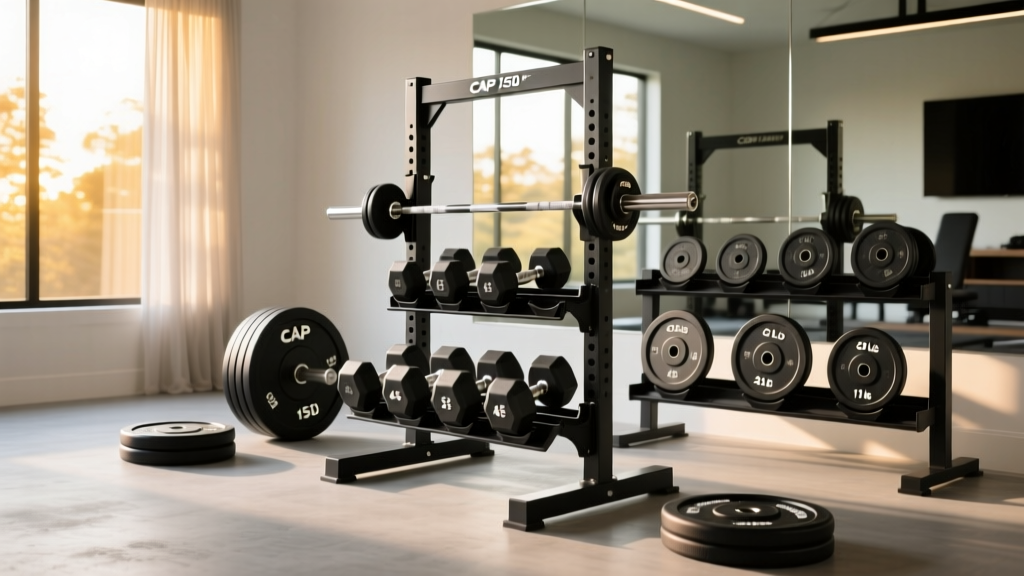
Power Rack vs Squat Rack vs Stand: Setup & Dumbbell Workout Plan PDF
Master your 2026 home gym installation with our power rack vs squat rack vs squat stand setup guide, plus a bonus dumbbell workout plan PDF.

The Foundation: Choosing Your Rack Type for Home Setup
Building a home gym in 2026 requires more than just buying heavy metal; it demands a precise understanding of spatial geometry, floor load limits, and structural physics. Whether you are outfitting a two-car garage or a spare bedroom, the centerpiece of your free weight zone will be your barbell station. But which one? The debate of power rack vs squat rack vs squat stand ultimately comes down to your ceiling height, floor type, and safety requirements.
In this complete setup and installation walkthrough, we will break down the exact hardware, anchoring methods, and spatial requirements for all three options. Furthermore, because no barbell station can cover every movement pattern—especially unilateral joint-health work—we have integrated a structured dumbbell workout plan PDF framework to help you supplement your rack days with adjustable dumbbells.
Quick Decision Matrix: 2026 Rack Ecosystems
| Feature | Full Power Rack | Half Rack (Squat Rack) | Squat Stands |
|---|---|---|---|
| Footprint | ~16 to 24 sq ft | ~12 to 18 sq ft | ~4 to 6 sq ft |
| Upright Profile | 3x3" 11-Gauge Steel | 3x3" or 2x3" Steel | 2x2" or 3x3" Steel |
| Avg 2026 Price | $600 - $1,200+ | $400 - $800 | $250 - $450 |
| Floor Anchoring | Highly Recommended | Mandatory for Pull-ups | Not Possible (Usually) |
Power Rack Installation: The Heavy-Duty Anchor
A full power rack (like the industry-standard REP Fitness PR-5050 or Rogue RM-6 Monster) is a four-post enclosed cage. It is the safest option for solo lifters because the safety pins or straps are supported by the rear uprights, meaning a dropped barbell will not tip the unit forward.
Step 1: Footprint and Floor Prep
Before unboxing, measure your ceiling height. Standard power racks are 90 inches tall. If you have an 8-foot ceiling (96 inches), you must account for the thickness of your lifting platform (usually 1.5 inches) and the barbell sleeve diameter. For low ceilings, opt for an 82-inch short rack. According to comprehensive home gym flooring guides from BarBend, placing your rack over a dedicated 3/4-inch thick rubber horse stall mat or interlocking EVA tiles protects your concrete slab from micro-fractures caused by dropped weights.
Step 2: Assembly and Bolting Down
- Build the Base Frame First: Assemble the bottom crossmembers and uprights on the floor. Do not fully tighten the 5/8" hardware until the entire base is square. Use a carpenter's square on the corners.
- Attach the Top Crossmembers: Stand the rack up. Attach the top rear and side crossmembers. Tighten all bolts to 80-90 ft-lbs using a torque wrench.
- Anchoring to Concrete: If bolting to a concrete slab, use 1/2" x 3-3/4" zinc-plated wedge anchors. Drill a 1/2" hole using a hammer drill, vacuum out the concrete dust (crucial for grip), insert the anchor, and torque to 60 ft-lbs.
- Anchoring to Wood Subfloors: If building over a wood subfloor, you must use 3/8" structural lag screws driven directly into the floor joists. Never rely solely on drywall or plywood for lateral stability.
Squat Rack (Half Rack) Setup: Balancing Space and Safety
Half racks, such as the Bells of Steel Half Rack V2 or Titan T-2 Half Power Rack, feature two front uprights and a rear base extension that doubles as weight storage. They offer an open-air feel for Olympic lifting variations while maintaining a degree of safety.
The Physics of Counterbalancing
The most critical installation and usage rule for a half rack involves the center of gravity. Because the uprights are at the front, performing kipping pull-ups or heavy rack pulls can cause the unit to tip forward. You must counterweight the rear storage horns. As a rule of thumb, for every 50 lbs of bodyweight performing dynamic pull-ups, you need at least 100 lbs of bumper plates loaded onto the rear storage pegs to maintain a safe center of mass.
Spotter Arm Placement
Unlike a full cage, half racks use extended spotter arms that protrude 20 to 24 inches forward. Ensure your spotter arms are set exactly one inch below your lowest squat depth. If set too high, the bar will bounce off your back onto the arms; if set too low, you risk spinal compression before the bar catches.
Squat Stands: The Minimalist Walkthrough
Squat stands are independent, two-post structures. Models like the Rogue SML-1 Monster Lite Squat Stands are incredibly popular for garage gyms due to their minimal 4-square-foot footprint and easy storability. However, they require strict adherence to safety protocols during setup.
Critical Safety Warning: Never use steel pin-pipe safeties with independent squat stands. If you fail a rep and drop a 300 lb barbell onto a rigid steel pipe, the kinetic energy will transfer through the stand's base and flip the heavy steel upright directly onto your face or chest. Always use UHMW nylon safety spotter straps, which absorb the shock and keep the center of gravity grounded.
Base Width and Alignment
When setting up squat stands, do not simply place them where the barbell sleeves end. Position the uprights so the barbell rests in the center of the J-cups. For most standard 7-foot Olympic barbells, this means placing the stands approximately 49 inches apart (measuring from the outside edge of the left upright to the outside edge of the right upright). Use a laser level to ensure both stands are perfectly parallel; even a 2-degree misalignment will cause the barbell to roll forward out of the J-cups during unracking.
Supplementing Rack Work with the Dumbbell Workout Plan PDF
While your power rack or squat stand is the engine for bilateral, heavy axial loading (squats, bench, overhead press), it lacks the ability to isolate unilateral imbalances or provide joint-friendly hypertrophy work. This is where integrating our companion dumbbell workout plan PDF becomes essential for a complete 2026 training ecosystem.
Why Pair Rack Days with Adjustable Dumbbells?
According to exercise databases like ExRx.net, unilateral dumbbell training recruits stabilizing muscles that barbells simply bypass. By utilizing space-saving adjustable dumbbells (like the Nuobell 80s or PowerBlock Pro EXP), you can execute high-volume accessory work without monopolizing the rack.
Inside the Dumbbell Workout Plan PDF
Our structured PDF download outlines a 4-day Upper/Lower split designed specifically to complement barbell rack days. Key modules include:
- Unilateral Lower Body: Bulgarian split squats and deficit reverse lunges to fix left/right power asymmetries discovered during rack squats.
- Joint-Friendly Pressing: Neutral-grip dumbbell floor presses to build triceps lockout strength without the shoulder impingement risks of heavy barbell benching.
- Isolation Hypertrophy: High-rep lateral raises and chest-supported dumbbell rows to build the upper back shelf required for stabilizing heavy barbell squats.
Download the complete dumbbell workout plan PDF via our member portal to sync your accessory volume with your primary rack lifts.
Hardware & Tool Checklist for 2026 Home Gyms
Do not rely on the cheap, poorly sized wrenches included in the rack's shipping box. To ensure your power rack vs squat rack vs squat stand setup is structurally sound, gather the following tools before assembly day:
- Socket Wrench Set: Metric and Standard (most imported racks use 17mm, 19mm, and 24mm sockets; domestic racks use 3/4" and 1-1/16").
- Hammer Drill & Masonry Bits: Required for concrete wedge anchors (1/2" bit for 1/2" anchors).
- Dead Blow Mallet: Essential for tapping tight-fitting 3x3" uprights into base sleeves without damaging the powder coat.
- Threadlocker (Blue Loctite 243): Apply to the threads of all J-cup and spotter arm hardware to prevent vibration loosening over time.
- Digital Torque Wrench: To ensure crossmembers are tightened to the manufacturer's exact specifications, preventing rack sway during heavy kipping or band work.
Frequently Asked Questions
Can I install a power rack on a second-floor bedroom?
Yes, but you must verify the floor joist load capacity. A standard power rack, loaded barbell, and dropped plates can generate over 1,500 lbs of dynamic downward force. You will need to distribute this weight using a 4x8 foot sheet of 3/4-inch plywood under your rubber mats, and ideally, reinforce the ceiling joists below with sistered lumber or steel I-beams.
How do I maintain the powder coat on my squat stands?
In 2026, most premium racks use electrostatically applied powder coat. To prevent rust from sweat and humidity, wipe down the uprights weekly with a mild, non-abrasive cleaner. Avoid bleach-based wipes, as the chlorine will degrade the clear coat and lead to surface oxidation within months.
Is the dumbbell workout plan PDF suitable for beginners?
Absolutely. The PDF includes regression and progression models for every movement. Whether you are using 15 lb neoprene dumbbells or 80 lb adjustable sets, the volume and intensity protocols are scaled to build foundational tendon strength before you transition to heavy barbell rack work.
For more in-depth equipment teardowns and structural safety reviews, consult the experts at Garage Gym Reviews to ensure your specific model meets current safety certifications.
More gear to consider
All reviews
Fake Dumbbells & Plate Security: Barbell Collar and Clamp Comparison
Bumper vs Iron: Dumbbell Shoulder Press vs Overhead Press
Bumper vs Iron Plates: Gear for Incline Dumbbell Y Raises

Bumper vs Iron Plate Maintenance: Cable or Dumbbell Lateral Raises

Value Analysis: Loadable Dumbbells for Dumbbell Chest Press Exercises