Power Rack vs Squat Rack: Incline Dumbbell Press Alternative Mistakes
Avoid costly home gym mistakes. We compare power racks, squat racks, and stands to help you build the perfect incline dumbbell press alternative setup.

The 'Incline Dumbbell Press Alternative' Dilemma in Home Gyms
Building a formidable upper chest at home almost always leads to the same bottleneck: the heavy incline dumbbell press. While dumbbells offer an unparalleled range of motion and unilateral stability, pushing past 80-pound dumbbells for reps without a spotter is a recipe for a torn pectoral or a crushed clavicle. Consequently, savvy lifters begin searching for an incline dumbbell press alternative—either a way to safely fail a dumbbell rep inside an enclosed cage, or a seamless transition to an incline barbell press using a rack and spotter arms.
This is where the great home gym hardware debate begins: Power Rack vs Squat Rack vs Squat Stand. Choosing the wrong equipment for your specific incline pressing needs is one of the most expensive and frustrating mistakes a home gym owner can make in 2026. Below, we break down the exact failure modes, dimensional traps, and troubleshooting steps to ensure your rack purchase actually supports your upper chest training goals.
Defining the Hardware: Power Rack vs Squat Rack vs Squat Stand
Before troubleshooting, we must establish precise definitions, as marketing jargon often blurs these lines:
- Power Rack (Full Cage): A four-post enclosed steel cage with crossmembers and adjustable safety spotter arms or straps. Examples include the Rogue Monster Lite or Titan T-3.
- Squat Rack (Half Rack): Typically a two-post or four-post open-front design. It often includes a rear crossmember for stability and spotter arms that extend forward. Examples include the Rogue Echo Half Rack.
- Squat Stand: Two independent, freestanding uprights with no physical crossmember connecting the left and right sides. Examples include the Rogue SML-2 or Titan X-2.
Common Mistake #1: Confusing Squat Stands with Full Racks for FID Benches
The most dangerous mistake lifters make when seeking an incline dumbbell press alternative is purchasing a pair of squat stands, assuming they can simply place a Flat/Incline/Decline (FID) bench between them.
Failure Mode: The Lateral Drift Strike. When performing heavy incline dumbbell presses, muscular fatigue often causes lateral drift. If your right arm fails before your left, the heavy dumbbell drops outward. On a squat stand setup, that 90-pound dumbbell will strike the upright or the spotter arm, instantly tipping the entire stand over onto your head or torso. According to the ExRx Kinesiology Directory, the biomechanical arc of the incline press naturally pushes the humerus away from the midline under failure, making lateral clearance a critical safety metric.
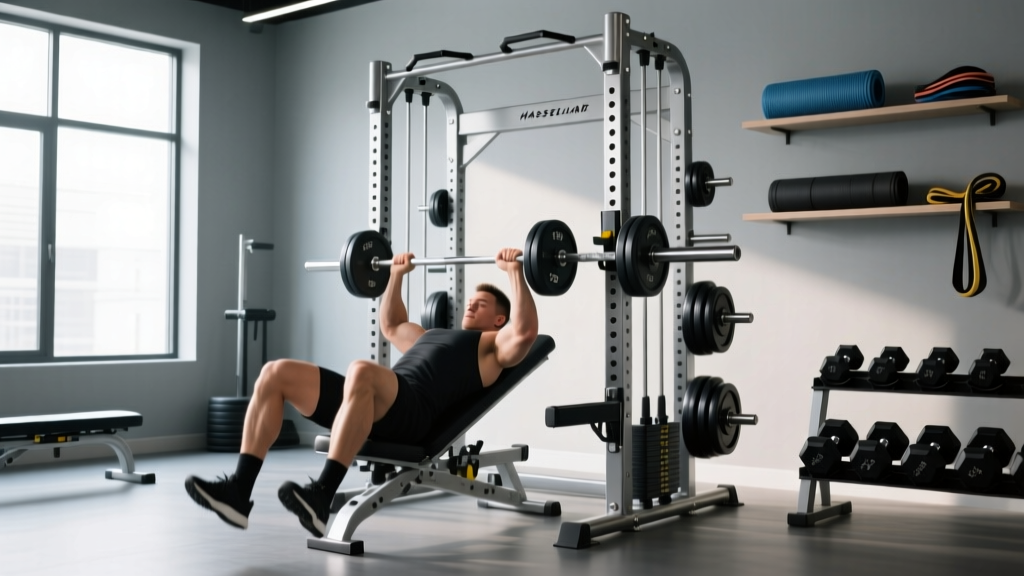
Troubleshooting Fix: If your primary goal is heavy incline dumbbell work, you must use a fully enclosed Power Rack. You can position the FID bench inside the cage, allowing the safety spotter arms to catch the dumbbells (or your wrists) if you drop them laterally. Squat stands should only be used for barbell movements where the bar spans across both uprights, or for light dumbbell work well below your failure threshold.
Troubleshooting Matrix: Hardware vs. Upper Chest Training Needs
| Equipment Type | Avg. Interior Width | Spotter Arm Utility for Incline DBs | Stability Profile (2026) | Price Range |
|---|---|---|---|---|
| Power Rack (4-Post) | 43" - 49" | Excellent (Catches lateral drops) | Maximum (Bolted/Fully enclosed) | $699 - $1,200+ |
| Half Rack (2-Post Open) | 48" - 53" | Good (Requires long spotter arms) | High (Heavy rear crossmember) | $599 - $950 |
| Squat Stand (Freestanding) | N/A (Adjustable) | Dangerous (High tip-over risk) | Low-Medium (Requires banding) | $299 - $450 |
Common Mistake #2: Ignoring Interior Dimensions for Adjustable Benches
Let's say you correctly identify that you need a Power Rack to safely execute your incline dumbbell press alternative setup. You order a budget-friendly 4-post rack from an online marketplace, only to realize your FID bench doesn't fit inside it.
Minimum Width Requirements for 2026 FID Benches
Modern, high-quality FID benches have widened to accommodate heavier lifters and provide better shoulder support. For instance, the highly rated Rep Fitness AB-3100 2.0 has a base footprint that requires significant clearance, and the back pad itself is 12 inches wide. If you are using 100-pound hex dumbbells, the heads of the dumbbells add another 6 to 8 inches of width on each side.
- The 43-Inch Trap: Many entry-level power racks have an interior width of exactly 43 inches. When you place a 12-inch bench inside, you only have 15.5 inches of clearance on each side. A 100-pound hex dumbbell will scrape against the uprights on the way up, ruining your rep and potentially damaging the rack's powder coat or your dumbbell's urethane casing.
- The 49-Inch Solution: Premium racks, such as those found in the Rogue Monster Lite Series, feature a 49-inch interior width. This provides the crucial extra 6 inches of lateral space needed to comfortably press heavy dumbbells inside the cage without striking the uprights.
Troubleshooting Fix: Before purchasing any rack, measure the exact width of your FID bench at its widest point (usually the rear stabilizer bar or the wheel base). Add 16 inches to that number to account for large dumbbell heads. If the rack's interior width is smaller than this total, do not buy it for incline dumbbell pressing.
Common Mistake #3: Miscalculating Spotter Arm Angles on an Incline
Even if you have the right rack and the bench fits inside, lifters frequently fail to adjust their safety spotter arms for the specific geometry of an incline press.
When your bench is set to a 30-degree or 45-degree incline, the barbell or dumbbell path shifts dramatically toward your face and clavicle. If your spotter arms are set at the same height as a flat bench press, they will be entirely useless. The weight will travel forward, missing the spotter arms completely and crashing onto your chest.
Troubleshooting Fix: Use the 'Empty Bar Test'. Set your bench to your preferred incline angle. Lie down with an empty barbell or very light dumbbells. Lower the weight to your upper chest/clavicle line. Have a partner place the spotter arms exactly 1.5 inches below that lowest point of the range of motion. For dumbbells, use safety straps (like the Rogue Monster Lite Safety Straps) rather than rigid steel pin-pipe arms. Straps conform to the odd angles of dropped dumbbells and prevent the dumbbells from bouncing off rigid steel and rolling onto your neck.
Step-by-Step Troubleshooting: Building the Ultimate Incline Setup
- Audit Your Current Dumbbell Weight: If your working sets are under 50 lbs per hand, a squat stand with a standalone bench is acceptable. If you are pushing 60+ lbs, you must upgrade to a 4-post rack.
- Measure Your Bench Footprint: Record the width and length of your FID bench. Ensure the rack interior can accommodate the length of the bench plus the clearance needed to slide it in and out without hitting the crossmembers.
- Select the Right Safeties: Ditch steel pin-pipes for incline work. Purchase heavy-duty nylon safety straps. They catch the rounded edges of dumbbells much more securely than smooth steel pipes.
- Anchor the Rack: Even a 4-post power rack can shift if you drop heavy dumbbells asymmetrically. Bolt the rack to your platform or concrete floor using 3/8-inch lag shields.
Frequently Asked Questions
Can I use a Smith Machine as an incline dumbbell press alternative?
Yes, an incline barbell press inside a Smith Machine is a viable alternative for isolating the upper chest without a spotter. However, the fixed bar path of a Smith machine does not replicate the stabilizer muscle recruitment of dumbbells. It is best used as a hypertrophy finisher rather than a complete replacement for free weight incline pressing.
Is a 30-degree or 45-degree incline better for the upper chest?
Biomechanical studies consistently show that a 30-degree incline maximizes clavicular pectoral (upper chest) activation while minimizing anterior deltoid takeover. A 45-degree angle shifts too much of the load onto the front shoulders. Ensure your FID bench has a precise 30-degree locking notch.
What if my ceiling is too low for a standard 90-inch power rack?
If you have low ceilings (under 84 inches), look for 'shorty' power racks that are 72 or 80 inches tall. You can still perform incline presses inside them, provided you use shorter 6-foot barbells or dumbbells, and ensure the spotter arms are positioned correctly. Just be mindful that you will not be able to perform standing overhead presses inside a short rack.
More gear to consider
All reviews
EZ Curl Bar vs Straight Bar: Beyond Bench Workouts with Dumbbells

Installing a Power Rack vs Squat Stand for Dumbbell Arm Exercises

EZ vs Straight Bar Care & Dumbbell Workouts for Men Over 50

Olympic vs Standard Plates for the Single Dumbbell Shoulder Raise
Power Rack vs Squat Rack vs Stand: Beyond the Bar Dumbbell Phase