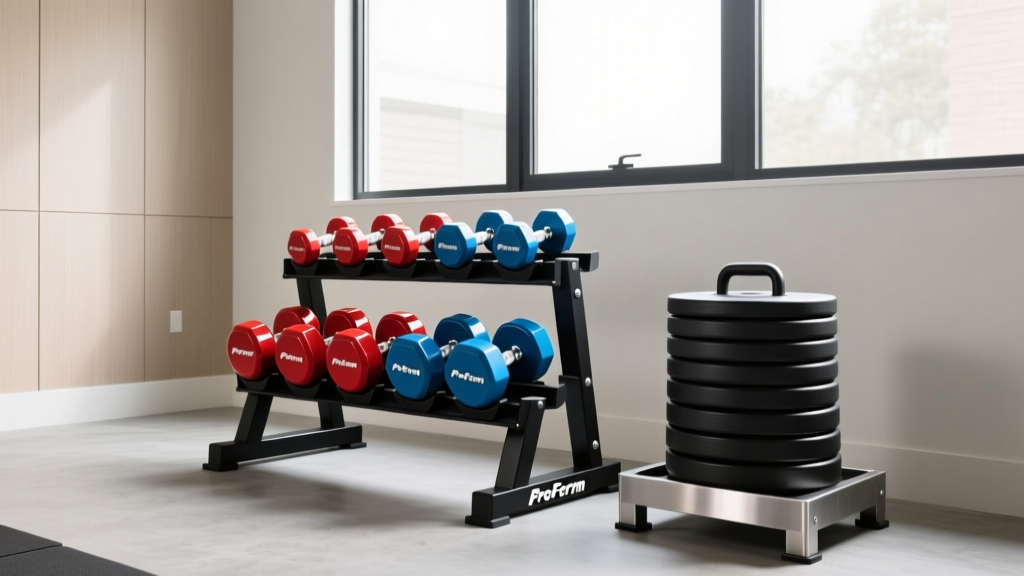
ProForm Dumbbell Set vs Loadable Plates: Space Layout Guide
Compare a ProForm dumbbell set to loadable dumbbells with interchangeable plates. Optimize your home gym layout, footprint, and storage in 2026.

When designing a high-efficiency home gym, floor space is your most unforgiving constraint. Many lifters begin their fitness journey with a dial-adjustable ProForm dumbbell set (such as the popular 50-pound selectorized models) because the marketing promises a "full rack in a single footprint." However, as your strength progresses and your layout needs evolve, the physical reality of these plastic-encased trays often clashes with true space optimization.
In 2026, the gold standard for micro-gym spatial efficiency has shifted toward the loadable dumbbell with interchangeable plates. By decoupling the handle from the weight, lifters can leverage vertical storage, customize weight increments, and eliminate the "dead space" created by fixed-footprint adjustable trays. This guide breaks down the exact spatial, financial, and structural differences between keeping your ProForm set versus transitioning to a plate-loadable system.
The Spatial Reality: Selectorized Trays vs. Vertical Loadable Trees
To understand layout optimization, we must measure the actual footprint of the equipment when not in use. A standard ProForm 50lb adjustable dumbbell set requires a dedicated storage tray. This tray typically measures 38 inches wide by 10 inches deep. While it consolidates 15 weight increments into one area, it permanently monopolizes nearly 4 square feet of prime floor or bench-adjacent real estate.
Conversely, a loadable dumbbell system utilizes separate handles and interchangeable plates. When paired with a vertical dumbbell tree or a wall-mounted peg rack, the footprint drops to near zero.
Layout Insight: A standard vertical dumbbell tree with a 24" x 24" base can hold up to 400 lbs of loadable dumbbells and plates. By moving your storage vertically, you reclaim the 38" x 10" floor zone for functional movement space, such as kettlebell swings or lateral lunges, which require unobstructed flooring.Footprint and Capacity Matrix
| Equipment Type | Storage Footprint (L x W) | Max Weight Capacity | Expandability | Vertical Storage Compatible? |
|---|---|---|---|---|
| ProForm 50lb Selectorized Set | 38" x 10" (Floor Tray) | 50 lbs per hand | None (Capped at 50) | No (Tray required) |
| Rogue Loadable Dumbbell Handles | 2" x 2" (Per Peg on Tree) | 100+ lbs (Sleeve dependent) | Infinite (Buy more plates) | Yes (Standard 2" pegs) |
| Ironmaster Quick-Lock V2 | 14.5" x 7.5" (Per Dumbbell) | 120 lbs (with add-ons) | High (Modular blocks) | Yes (Heavy-duty shelves) |
Failure Modes and Spatial Waste
Space optimization isn't just about square footage; it's about equipment longevity and avoiding "dead weight" in your gym layout. Dial-adjustable dumbbells, including various iterations of the ProForm dumbbell set, rely on internal plastic gears and selector pins. If dropped from shoulder height during a fatigued set of Romanian deadlifts, the internal mechanism can misalign. When this happens, the entire 40-pound housing becomes a useless, space-hogging paperweight until serviced or replaced.
A loadable dumbbell with interchangeable plates eliminates this single point of failure. The handles are typically machined from solid steel or chromed alloy. According to extensive durability testing by Garage Gym Reviews, loadable handles like the Rogue Loadable Dumbbell Handles can withstand thousands of drops onto rubber matting without mechanical failure. If a cast-iron or urethane plate cracks (an extreme rarity), you replace a single $10 plate rather than a $300 integrated system.
Plate Profile: Cast Iron vs. Urethane in Tight Spaces
When configuring a loadable dumbbell, the physical dimensions of your interchangeable plates dictate your maximum load and spatial efficiency. This is a critical edge case many lifters overlook when buying their first set of loadable handles.
- Standard Cast Iron Plates: A traditional 10lb cast iron plate is roughly 1.5 inches thick. A standard 16-inch loadable handle has about 6.5 inches of loadable sleeve space per side. This means you can fit four 10lb plates per side, maxing out at 80lbs plus the handle weight before running out of sleeve.
- Urethane / Calibrated Steel Plates: Urethane plates (like those from Fringe Sport or Rep Fitness) are denser and feature a thinner profile. A 10lb urethane plate might only be 0.9 inches thick. This allows you to stack six to eight plates per side, pushing your loadable dumbbell well past 120lbs without needing to purchase extended sleeve adapters.
"In a 2026 micro-gym, buying thin-profile urethane bumper plates or calibrated steel fractional plates is the ultimate space hack. You double your weight capacity on the exact same loadable handle without requiring a larger storage rack."
Designing the Optimal Storage Layout
Transitioning from a tray-based ProForm set to interchangeable plates requires rethinking your gym's zoning. The American Council on Exercise (ACE) recommends maintaining at least 24 inches of clearance on all sides of a weight storage zone to prevent tripping hazards and allow for safe plate loading.
The "Loading Zone" Configuration
Unlike selectorized dumbbells where you simply turn a dial, loadable dumbbells require a dedicated "Loading Zone." To optimize this:
- Position the Vertical Tree: Place a 2-inch Olympic dumbbell tree at the corner of your lifting platform, exactly 36 inches away from your squat rack or bench. This allows you to step, grab a handle, and slide plates on without walking across the room.
- Plate Orientation: Store your interchangeable plates on the tree's lower pegs in ascending order (2.5lb, 5lb, 10lb, 25lb) from top to bottom. This aligns with natural eye-level scanning and reduces the time spent bending and searching for micro-plates.
- Collar Storage: Use a magnetic collar holder attached to the tree's central pole. Spring collars or spin-lock collars left on the floor are the leading cause of ankle rolls in home gyms.
Cost Per Pound and Spatial ROI
Let's look at the financial and spatial Return on Investment (ROI). A high-quality ProForm or equivalent 50lb selectorized set costs roughly $299, equating to $6.00 per pound. Once you outgrow 50lbs, you must buy a completely new, heavier set, doubling your floor space requirement.
With a loadable system, your initial investment is higher, but the long-term spatial ROI is unmatched:
- Handles: Pair of 16" Loadable Handles = $90
- Plates: 100 lbs of Urethane Plates (2x25, 2x10, 2x5, 2x2.5) = $160
- Storage: Vertical Dumbbell Tree = $70
- Total Initial Cost: $320 for 50lbs per hand ($3.20 per pound).
To scale to 100lbs per hand later, you simply add $160 more in plates. Your floor footprint remains exactly the same; only the vertical density of your storage tree changes.
Warning: Sleeve Diameter MismatchesAlways verify your plate hub diameter before purchasing. Standard Olympic plates require a 2-inch (50mm) sleeve. If you accidentally buy 1-inch standard loadable handles to save space, you will be locked into cheap, low-density cast iron plates that will severely limit your maximum weight capacity due to sleeve length constraints.
Step-by-Step Transition Plan
If you are ready to reclaim your floor space and upgrade from your ProForm dumbbell set to a modular loadable system, follow this layout transition plan:
- Audit Your Current Lifts: Track your heaviest dumbbell movements for 30 days. If your goblet squats and chest presses are consistently pinning the 50lb limit of your ProForm set, the transition is overdue.
- Measure Your Sleeve Needs: Calculate the thickness of your existing plates. Ensure the loadable handles you order have at least 6.5 inches of loadable sleeve length to accommodate future weight jumps.
- Liquidate the Trays: Sell your selectorized sets and trays on local marketplaces. The demand for entry-level adjustable dumbbells remains incredibly high, allowing you to recoup 60-70% of your initial investment.
- Install Vertical Storage: Bolt a heavy-duty vertical tree to your floor (if on concrete) or use a wall-mounted 2-peg dumbbell hanger to completely eliminate floor-level storage hardware.
Ultimately, while a ProForm dumbbell set offers undeniable convenience for beginners, the loadable dumbbell with interchangeable plates is the undisputed champion of long-term space optimization. By shifting your storage vertically and embracing modular weight progression, you future-proof your 2026 home gym layout against both strength plateaus and spatial clutter.
More gear to consider
All reviews
Power Walking With Dumbbells to Lifting: Olympic vs Standard Plates

NordicTrack Select A Weight Dumbbells: Review & Troubleshooting

Neoprene Dumbbells for Home: Perfecting Dumbbell Squat Technique

Weight Lifting Equipment: Dumbbells & Olympic vs Standard Plates
Dumbbell Snatch Muscles Worked: Beginner Guide for Neoprene Weights
