Rack Guide: Power vs Squat Rack vs Stand + Dumbbell Workout Arms Abs
Compare power rack vs squat rack vs squat stand for 2026. Plus, master our beginner-friendly dumbbell workout for stronger arms and abs using your new rig.

Step 1: Demystifying the Hardware (Power Rack vs Squat Rack vs Squat Stand)
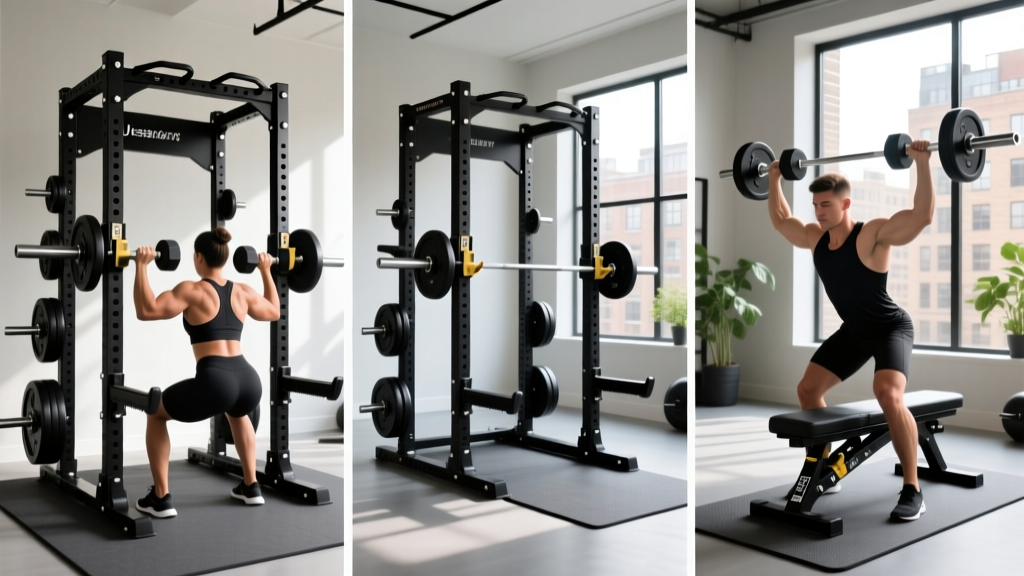
Building a home gym in 2026 is an investment in your long-term health, but staring at the sheer volume of steel on the market can be paralyzing for a beginner. The centerpiece of any serious free-weight setup is the rack. However, not all racks are created equal. Choosing between a power rack, a squat rack (often called a half rack), and a squat stand depends entirely on your spatial constraints, budget, and lifting style.
Before we dive into the accessory work, let us break down the structural differences. A power rack (or power cage) features four main uprights and an enclosed design, offering maximum safety for solo lifters. A squat rack typically features two front uprights and two rear stabilizers, providing an open front for Olympic lifts while maintaining a sturdy base. A squat stand consists of two independent uprights, offering the smallest footprint but requiring strict attention to spotter arm placement.
| Feature | Power Rack (Cage) | Squat Rack (Half Rack) | Squat Stand |
|---|---|---|---|
| Uprights | 4 (Enclosed) | 2 Front + 2 Rear | 2 (Independent) |
| Avg. Footprint | 48" x 48" or 48" x 24" | 48" x 48" | 40" x 45" (Base) |
| 2026 Price Range | $400 - $900 | $500 - $1,100 | $250 - $500 |
| Safety for Solo Lifts | Excellent (Built-in pins) | Very Good (Requires spotter arms) | Moderate (Requires spotter arms) |
| Best For | Heavy solo squats, bench, rack pulls | Olympic lifts, kipping, heavy squats | Tight spaces, budget builds, travel |
Step 2: Choosing the Right 2026 Rig for Your Space
When shopping for 11-gauge steel, the tubing size matters just as much as the design. Most modern budget-to-mid-tier racks use either 2x2-inch or 3x3-inch tubing. If you plan on doing heavy barbell work and eventually adding cable attachments, opt for 3x3 tubing with 1-inch holes, as the attachment ecosystem is vastly superior.
Top 2026 Model Recommendations:- Best Power Rack: Titan Fitness T-2 Series (approx. $449). Features 2x2 tubing, perfect for beginners and low ceilings.
- Best Squat Rack: Rep Fitness SR-4000 (approx. $699). Offers 3x3 uprights and incredible attachment compatibility.
- Best Squat Stand: Rogue SML-1 Monster Lite (approx. $495). Heavy-duty 3x3 steel with a fold-back option to save space.
Step 3: Setting Up Your Safe Lifting Zone
- Anchor It Down: According to safety guidelines highlighted by the National Strength and Conditioning Association (NSCA), unanchored racks can tip during failed reps or pull-ups. Bolt your rack to a wooden subfloor or use heavy-duty flat-foot plates weighted with 45lb bumpers if you are on concrete.
- Spotter Arm Placement: Set your safety spotter arms exactly one inch below your lowest range of motion (e.g., the bottom of your squat or bench press). This ensures you can escape a failed lift without the barbell crushing your chest or spine.
- Clearance Check: Ensure you have at least 18 inches of clearance behind the rack for loading plates, and 24 inches of overhead clearance above the pull-up bar.
Step 4: The Beginner Dumbbell Workout for Stronger Arms & Abs
Many beginners assume a rack is strictly for heavy barbell compounds. In reality, your rack's adjustable bench and pull-up bar create the ultimate station for isolation work. To build a balanced physique, you must pair heavy structural loading with targeted hypertrophy. Below is a highly effective dumbbell workout stronger arms abs routine designed to be performed inside and around your new rack setup.
The Accessory Anchor Routine
Perform this routine 2 times per week, either after your heavy barbell lifts or as a standalone active-recovery session. Rest 60-90 seconds between sets.
- 1. Incline Dumbbell Bicep Curls (3 sets x 10-12 reps)
Set your rack's adjustable bench to a 45-degree angle. This incline places the long head of the bicep in a stretched position, triggering greater mechanotransduction and muscle growth. Keep your elbows pinned behind your torso.
- 2. Dumbbell Skull Crushers on Flat Bench (3 sets x 10-12 reps)
Lie flat on the bench inside the power rack. Lower the dumbbells toward your ears, keeping your upper arms vertical. This isolates the triceps, which make up roughly 60% of your upper arm mass. If you fail a rep, the rack's safety pins are right there to catch the weights.
- 3. Dumbbell Suitcase Carries (3 sets x 30 seconds per side)
Hold a heavy dumbbell (start with 35-50 lbs) in one hand and walk slowly. This unilateral load forces your obliques and quadratus lumborum to fire intensely to prevent lateral flexion. It is one of the most functional ab exercises available.
- 4. Hanging Leg Raises on Rack Pull-Up Bar (3 sets x 12-15 reps)
Utilize the pull-up bar on your squat stand or power rack. Hang with a slight forward pelvic tilt and raise your legs until your knees reach chest height. This targets the lower rectus abdominis and improves grip strength simultaneously.
'Core stability is not just about doing crunches; it is about resisting movement under load. Unilateral carries and hanging variations force the deep stabilizers to adapt, creating a functional, armor-plated midsection.' — Principles of functional hypertrophy.
Step 5: Progression, Recovery, and Safety
To see continuous results from your dumbbell workout for stronger arms and abs, you must apply progressive overload. The American Council on Exercise (ACE) recommends increasing the weight by 5% to 10% once you can comfortably complete the top end of your target rep range with perfect form for two consecutive sessions.
Warning: Grip FatigueBecause hanging leg raises and suitcase carries heavily tax your grip, perform your bicep and tricep exercises first. If your forearms fail early, your abdominal and arm workouts will suffer from premature central nervous system fatigue.
Ultimately, whether you choose the enclosed safety of a power rack, the versatility of a squat rack, or the space-saving design of a squat stand, the equipment is only a tool. Consistency in your programming—like the targeted dumbbell arm and ab routine outlined above—is what yields results. Measure your space, secure your steel, and start lifting.
More gear to consider
All reviews
Barbell Collars vs Clamps: Securing the Dumbbell Deadlift to Row

Can Rust-Oleum Be Used on Iron Dumbbells? DIY & Rack Guide
Barbell Collar Setup & The Dumbbell Squat Front Raise Station

Bumper vs Iron Plates for Dumbbell Tenements: 2026 Guide

Beyond the 30 Min Dumbbell Workout: Barbell Collar Guide