Power Rack vs Squat Rack vs Stand: The Fair Haired Dumbbell
Compare power racks, squat racks, and squat stands for your 2026 home gym. Find the fair haired dumbbell of fitness gear with our expert buying guide.

The Myth of the Perfect Centerpiece
In the niche forums of home gym builders, you will occasionally see references to 'the fair haired dumbbell'—a tongue-in-cheek metaphor for that elusive, golden-child piece of gear that flawlessly balances form, function, and budget. While enthusiasts obsess over finding this mythical iron, the true anchor of any 2026 garage gym is not a dumbbell at all. It is the rack.
Choosing between a power rack, a squat rack (half rack), and a squat stand dictates your safety, your floor plan, and your future expandability. According to equipment testing by Garage Gym Reviews, the wrong choice leads to either a cramped workout space or a dangerous tipping hazard. Let us break down the physics, spatial geometry, and financial realities of the big three to help you find the true centerpiece of your home gym.
Defining the Contenders: Cages, Half-Racks, and Stands
Power Racks (Full Cages)
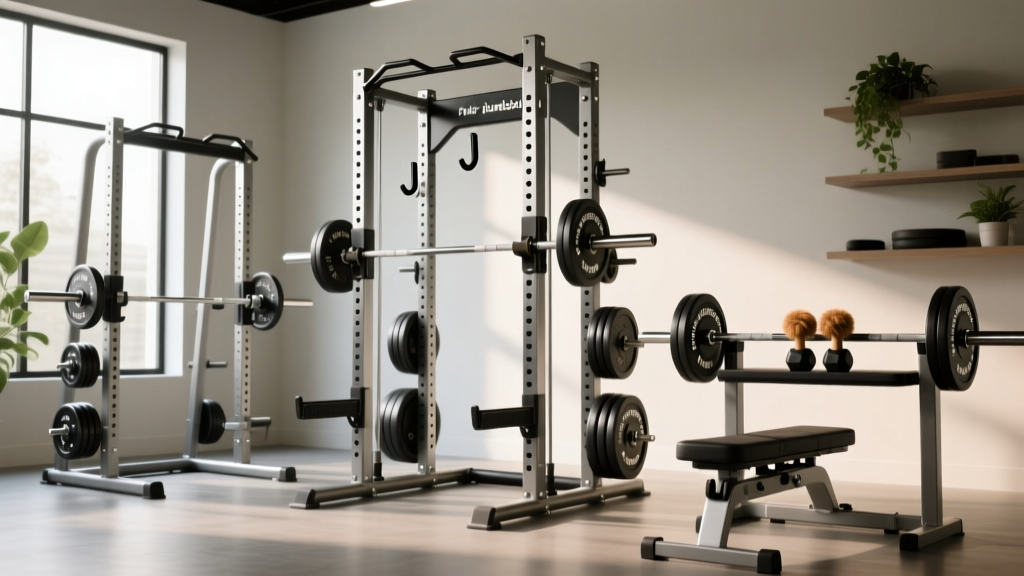
A power rack consists of four to six vertical uprights connected by horizontal crossmembers, creating an enclosed 'cage.' Models like the Rep Fitness PR-4000 or the Rogue RM-6 Monster utilize 11-gauge steel and 3x3-inch tubing. The enclosed design means you can fail a rep safely inside the cage without needing a human spotter.
- Pros: Ultimate safety, massive attachment ecosystem (cable pulleys, lat towers, belt squat arms), highest weight capacity (1,000+ lbs).
- Cons: Largest footprint, highest price point, can feel claustrophobic for tall lifters doing overhead presses.
Half Racks (Squat Racks)
Half racks, such as the Rogue SML-2C Monster Lite, feature two main front uprights and two shorter rear uprights that double as weight plate storage. They offer an open front for Olympic weightlifting variations (like cleans and snatches) where a lifter might need to bail forward, while still providing a degree of enclosed safety.
- Pros: Open front for dynamic movements, built-in plate storage saves floor space, excellent compromise between safety and footprint.
- Cons: Spotter arms must be carefully aligned, less stable than a full cage if not bolted down.
Squat Stands
Squat stands are the minimalist option. They consist of two independent or lightly connected uprights. The Titan T-2 and Fitness Reality 8000 are popular entry-level choices. They are designed strictly to hold the barbell at shoulder height and catch it on spotter arms if you fail.
- Pros: Minimal footprint, highly portable, budget-friendly.
- Cons: Lowest safety margin, severe attachment limitations, high risk of tipping if misloaded.
Head-to-Head Comparison Matrix
| Feature | Power Rack (Full Cage) | Half Rack (Squat Rack) | Squat Stand |
|---|---|---|---|
| Uprights | 4 to 6 | 4 (2 tall, 2 short) | 2 |
| Avg. Footprint | 48' x 48' to 53' x 53' | 48' x 24' to 49' x 34' | 48' x 16' or less |
| Safety Rating | Exceptional (Enclosed) | High (Open Front) | Moderate (Tipping Risk) |
| 2026 Price Range | $800 - $2,500+ | $450 - $1,200 | $150 - $400 |
| Expandability | Limitless (Cables, Pull-ups) | High (Storage, Dips) | Low (Basic J-Cups/Spotters) |
Spatial Geometry: Footprints and Ceiling Clearances
Before purchasing, you must measure your space. A standard residential garage ceiling is 8 feet (96 inches). However, as Men's Health fitness experts frequently note, you need at least 12 to 18 inches of clearance above your pull-up bar to perform muscle-ups or strict pull-ups without cracking your head on the drywall.
Pro-Tip for Low Ceilings: If your ceiling is under 90 inches, avoid standard 90-inch or 108-inch racks. Look for 'Short' variants (typically 82 to 84 inches tall). Alternatively, you can perform pull-ups on the lower crossmembers of a power rack, though this limits your range of motion unless you bend your knees.For floor space, squat stands are the undisputed champions of small apartments and tight corners. A pair of independent stands can be pushed against a wall or stored in a closet when not in use. Power racks, conversely, are permanent architectural installations. Once a 500-pound RM-6 is bolted into a concrete slab, it is not moving.
The Physics of Safety: Failure Modes and Edge Cases
Safety is where the distinction between these three categories becomes a matter of physical well-being. According to Rogue Fitness engineering standards, the structural integrity of a rack relies on its base footprint and steel gauge.
The Squat Stand Tipping Hazard
The most common failure mode in home gyms involves squat stands. When a lifter racks a heavy barbell (e.g., 315+ lbs) slightly off-center or with forward momentum, the kinetic energy transfers into the uprights. Because squat stands have a shallow front-to-back footprint (often just 16 to 24 inches), this forward force can easily tip the entire rig onto the lifter. Always bolt squat stands to a wooden platform or concrete floor if you plan to lift heavy.
Steel Gauge and Hole Spacing
Budget squat stands often use 14-gauge steel with 2x2-inch tubing and 1-inch hole spacing. While adequate for beginners, 14-gauge steel can visibly deflect (bend) under 400+ lb loads. Premium power racks use 11-gauge steel and 3x3-inch tubing. Furthermore, look for Westside hole spacing (1-inch spacing in the bench press zone) on premium cages, allowing for micro-adjustments of the J-cups that cheaper 2-inch spacing simply cannot provide.
'A rack is only as safe as its spotter arms. UHMW-lined plastic spotter arms protect your barbell's knurling, but the steel shear pin inside must be rated for dynamic drops, not just static holds.'
The 2026 Attachment Ecosystem
If you view your rack as a long-term investment, the attachment ecosystem will dictate your choice. Power racks are modular playgrounds. In 2026, the market is flooded with rack-integrated cable crossover systems, functional trainer attachments, landmine stations, and belt squat mechanisms.
Half racks offer a solid middle ground, frequently utilizing the rear uprights for plate storage, band pegs, and lat pulldown attachments. Squat stands, however, are a dead end for expandability. You cannot mount a heavy cable pulley system to a freestanding squat stand without creating a catastrophic tipping hazard. If your goal is to build a comprehensive commercial-style gym in your garage over the next five years, a 4-post or 6-post power rack is mandatory.
Budget Breakdown: Where Does Your Money Go?
- Under $400 (Squat Stands): You are paying for basic steel and J-cups. Expect to spend extra on a good set of spotter arms, as many budget brands sell them separately.
- $500 - $1,200 (Half Racks & Entry Cages): This is the sweet spot for most lifters. You get 11-gauge steel, 3x3 tubing, and basic safety straps or UHMW-lined spotter arms.
- $1,500 - $3,000+ (Premium Power Racks): At this tier, you are paying for precision laser-cut steel, integrated weight storage, monolift attachments, and heavy-duty cable pulley systems.
Final Verdict: Claiming Your Golden Child
Finding the fair haired dumbbell of home gym lore means finding the perfect balance for your specific constraints.
Choose a Power Rack if you train alone, lift heavy, have an 8-foot or higher ceiling, and want the option to add cable attachments later. Choose a Half Rack if you practice Olympic weightlifting and need an open front to bail safely on cleans. Choose a Squat Stand only if you are on a strict budget, lack the floor space for a cage, and are willing to bolt the stands to the floor for safety.
Measure your space, check your ceiling height, and invest in 11-gauge steel. When the rack matches your training style perfectly, you will know you have finally found your gym's version of the fair haired dumbbell.
More gear to consider
All reviews
Aldi Dumbbells vs Top Adjustables: 2026 Buying Guide

Olympic vs Standard Plates: Mistakes & Dumbbell Toe Touches
Beyond the Dumbbell Workout to Lose Belly Fat: Olympic Barbell Guide

How Heavy Dumbbells Do I Need? Sizing Neoprene Dumbbells for Home Use

Best Neoprene Dumbbells for the Incline Dumbbell Curl (2026)