
Power Rack vs Squat Stand: How Dumbbell Dimensions Guide Your Choice
Choosing between a power rack, squat rack, or stand? Learn how dumbbell dimensions and storage needs dictate the safest setup for your home gym.

The Hidden Variable in Home Gym Planning
When beginners start planning their home gym, the debate between a power rack, a squat rack, and a squat stand usually revolves around three factors: budget, ceiling height, and floor space. While these are critical, there is a hidden variable that frequently leads to costly mistakes and frustrating workouts: dumbbell dimensions.
If you plan to perform dumbbell bench presses, goblet squats, or heavy dumbbell rows inside your rack, the total length, head diameter, and handle clearance of your free weights will dictate which rack type is actually safe and functional for your space. In this step-by-step guide, we will break down the structural differences between the big three rack types and show you exactly how to match them to your dumbbell collection in 2026.
The Big Three: Definitions and 2026 Market Realities
Before we measure our free weights, we need to establish the baseline architectures of the three primary rack systems available on the market today.
1. The Power Rack (Full Cage)
A power rack consists of four main uprights connected by crossmembers, creating a fully enclosed cage. It typically includes a pull-up bar and offers the highest weight capacity and safety.
2026 Pricing: $800 to $1,600+
Standard Internal Width: 43 to 49 inches.
Best For: Heavy barbell lifting, kipping pull-ups, and lifters who use spotter arms for solo dumbbell pressing.
2. The Squat Rack (Half Rack / Open Rack)
A squat rack usually features two front uprights and two shorter rear stabilizers, or four uprights with an open front. It provides a good balance of safety and spatial openness.
2026 Pricing: $400 to $900
Standard Internal Width: 42 to 48 inches.
Best For: Lifters who want barbell safety but prefer the feeling of an open workspace for dynamic movements.
3. The Squat Stand (Independent Uprights)
Squat stands are two independent, freestanding posts with weighted bases. They offer zero enclosed safety unless you attach extended spotter arms.
2026 Pricing: $250 to $550
Standard Internal Width: 48 to 54 inches (highly variable based on placement).
Best For: Minimalist garages, outdoor gyms, and lifters who primarily use adjustable dumbbells and need maximum lateral clearance.
The Clearance Trap: Why Dumbbell Dimensions Matter
Imagine buying a highly rated, budget-friendly squat rack with an internal width of 44 inches. You place a standard 12-inch wide utility bench inside. You then pick up a pair of 80lb Nuobell adjustable dumbbells, which measure 16 inches in total length each.
Let us do the math: 12-inch bench + 16-inch left dumbbell + 16-inch right dumbbell = 44 inches. You have exactly zero inches of clearance on either side. When you lie back to press, your knuckles will scrape the steel uprights, and the adjustment dials on your dumbbells will crush against the rack, potentially breaking the internal locking mechanisms.
⚠️ CRITICAL SAFETY WARNING: Never assume the advertised 'internal width' of a rack is your actual working clearance. If you add UHMW plastic sandwich J-cups to protect your barbell knurling, you will lose up to 1.5 inches of internal width on each side. Always subtract 3 inches from the total rack width to find your true dumbbell wingspan clearance.2026 Dumbbell Dimension & Rack Compatibility Matrix
To help you visualize the spatial requirements, refer to the table below. This data synthesizes the physical footprints of the most popular home gym dumbbells against standard rack architectures.
| Dumbbell Type (2026 Models) | Total Length | Head Width / Profile | Minimum Rack Internal Width Required | Ideal Rack Type |
|---|---|---|---|---|
| Standard 50lb Cast Iron Hex | 14.5 inches | 6.5 inches | 44 inches | Squat Rack / Power Rack |
| Bowflex SelectTech 552 | 15.8 inches | 7.5 inches (Bulky) | 48 inches | Wide Power Rack / Squat Stand |
| PowerBlock Elite EXP | 12.0 inches | 6.0 inches (Blocky) | 42 inches | Any (Highly Space Efficient) |
| Nuobell 80lb Adjustable | 16.0 inches | 5.5 inches (Long) | 49 inches | Squat Stand / Wide Cage |
| Rep Fitness Urethane 50lb | 13.8 inches | 5.0 inches | 43 inches | Standard Squat Rack |
Step-by-Step Decision Framework for Beginners
Follow this exact sequence before adding a rack to your shopping cart. This framework ensures your free weights and your steel infrastructure will coexist safely.
Step 1: Audit Your Dumbbell Collection
Take a tape measure to your current dumbbells. If you are planning to buy adjustable dumbbells, check the manufacturer's specification sheet for total length. According to PowerBlock's official specs, their compact design saves up to 4 inches of lateral space compared to dial-adjust models, which fundamentally changes your rack requirements.
Step 2: Calculate Your True Wingspan Clearance
Use this formula to find your required internal width:
(Bench Width) + (Left Dumbbell Length) + (Right Dumbbell Length) + 4 inches (Safety Buffer) = Minimum Internal Width.
If your result is 47 inches, a standard 44-inch squat rack is automatically disqualified. You must look at 49-inch wide power racks or independent squat stands.
Step 3: Evaluate Spotter Arm Integration
If you are lifting alone, you need spotter arms. In a power rack, spotter arms run parallel to the bench inside the cage, meaning your dumbbell dimensions only need to clear the uprights. On a squat stand, spotter arms extend outward from the front posts. Long dumbbells (like the 16-inch Nuobells) can easily catch on the extended spotter arm brackets during the eccentric lowering phase of a bench press if the stand is not spaced wide enough.
Step 4: Match Storage Attachments to Head Profiles
Rack storage is not one-size-fits-all.
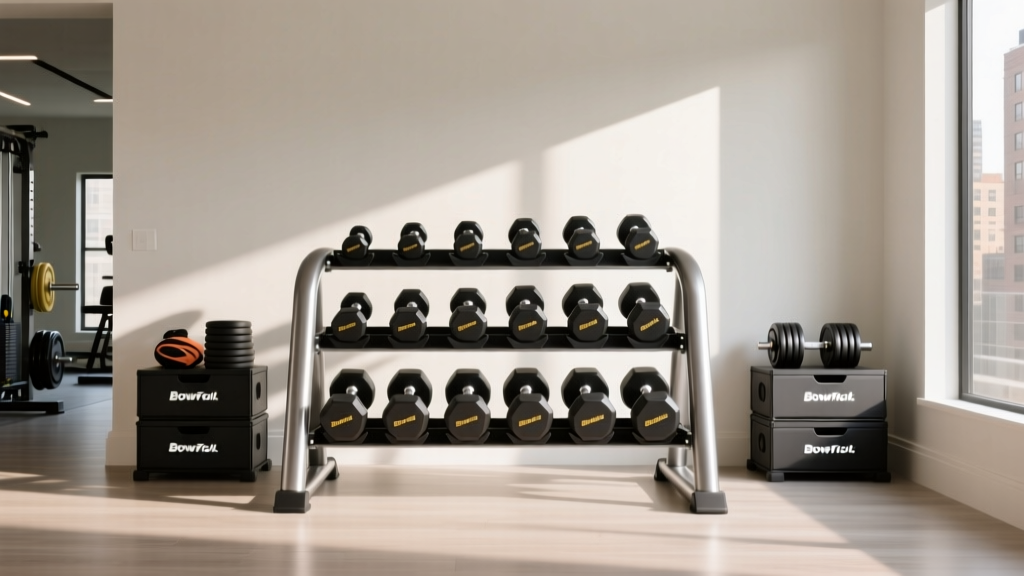
- Hex / Urethane Dumbbells: Require standard 3-tier saddle shelves. These bolt directly to the uprights and add 12 inches to the exterior footprint of your rack.
- Adjustable Dumbbells: Cannot be stored on standard shelves due to their flat, blocky bases or fragile adjustment dials. You must purchase specialized 'Adjustable DB Trays' that mount to the lower crossmembers. Ensure your chosen rack brand actually manufactures these specific trays in 2026, as many budget brands do not.
Real-World Edge Case: The Tall Lifter Dilemma
Height and wingspan compound the dumbbell dimension issue. A lifter who is 6-foot-4 with a 74-inch wingspan will naturally press dumbbells on a wider arc than a lifter who is 5-foot-8.
Expert Insight: According to biomechanical analyses featured in Garage Gym Labs' comprehensive rack reviews, tall lifters using long adjustable dumbbells inside a 44-inch internal cage frequently report 'ulnar deviation' (bending the wrist inward) to avoid scraping the rack. This not only ruins the mind-muscle connection but drastically increases the risk of wrist impingement injuries under heavy loads.
If you are over 6 feet tall and use dial-adjust dumbbells, bypass the squat rack entirely. Opt for a 49-inch wide power rack (like the Rogue RML-390F series, detailed on the Rogue Fitness Power Rack catalog) or use independent squat stands spaced exactly to your personal wingspan.
Final Verdict: Which Setup Wins?
There is no universal 'best' rack—only the best rack for your specific equipment profile.
- Choose the Power Rack if: You use compact adjustable dumbbells (PowerBlock) or standard hex dumbbells under 50lbs, you lift alone and need internal safety spotters, and you want integrated pull-up and cable attachment options.
- Choose the Squat Rack if: You have a standard 44-inch clearance requirement, primarily use barbells, and only use dumbbells for lighter accessory work outside the cage.
- Choose the Squat Stand if: You own long adjustable dumbbells (Nuobell, Bowflex), have a wide wingspan, and need the freedom to space your uprights 52+ inches apart to guarantee zero dial-crushing clearance issues.
By prioritizing dumbbell dimensions alongside budget and ceiling height, you will build a home gym that is not only safe but ergonomically optimized for years of progressive overload.
More gear to consider
All reviews
Dumbbell Rack Storage & Value: Does Setup Impact Skull Crusher Form?

Loadable Sets for Chest Workouts With Dumbbells at Home: 2026 Budget

Best Neoprene Dumbbells for a 10 Minute Dumbbell Workout (2026)
Best Bowflex Dumbbells Rack & Storage Solutions for 2026

Beyond Dumbbell Exercises at Home for Beginners: Olympic Barbell Guide
