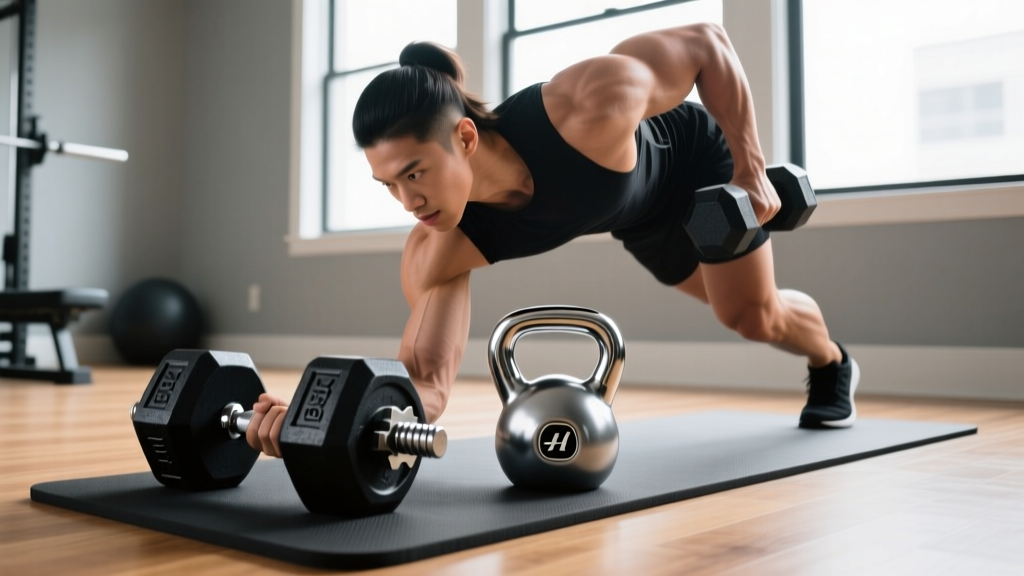
One-Arm Dumbbell Row vs Kettlebell: Cast Iron vs Competition
Is a kettlebell better for unilateral rows? We break down the budget, value, and ergonomics of cast iron vs competition kettlebells for pulling.

The Biomechanical Shift: Dumbbell Rows vs. Kettlebell Pulls
For decades, the one-arm dumbbell row has been the undisputed gold standard for unilateral latissimus dorsi and rhomboid development. The centered grip and balanced load allow for heavy overloading and strict scapular retraction. However, as functional fitness and strongman-inspired training have evolved, lifters are increasingly swapping the dumbbell for a kettlebell to introduce an offset center of mass. This subtle shift demands greater anti-rotation torque from the core and grip, transforming a standard pulling movement into a full-body stabilization challenge.
When you execute a standard one-arm dumbbell row, the load is perfectly centered within your palm, allowing for a direct line of pull from the elbow to the hip. The kettlebell, however, suspends the bulk of the mass below the handle. This creates a pendulum effect that forces the flexor carpi ulnaris and radialis to work overtime to prevent the bell from twisting. Furthermore, during the concentric phase of the row, the kettlebell naturally wants to swing forward, requiring the rear deltoid and rhomboids to engage earlier in the range of motion to stabilize the scapula. But when you decide to make this transition, you are immediately met with a critical purchasing dilemma: should you invest in traditional cast iron kettlebells or opt for premium competition-style bells? In this budget breakdown and value analysis, we evaluate the true cost-per-pound, ergonomic advantages, and long-term ROI of both styles specifically through the lens of unilateral rowing and pulling mechanics.
Cast Iron Kettlebells: The Budget-Friendly Workhorse
Cast iron kettlebells, such as the Rogue Powder Coat line, represent the entry point for most home gym owners. Priced between $1.50 and $2.50 per pound, a standard 24kg (53lb) bell will cost roughly $75 to $95. The value proposition here is sheer mass-to-dollar ratio. For lifters who simply need a heavy object to pull, cast iron delivers the necessary stimulus without emptying your wallet.
However, when adapting the one-arm dumbbell row to a kettlebell offset row or a renegade row, the physical dimensions of cast iron bells introduce specific friction points. Unlike competition bells, cast iron kettlebells scale in physical size as the weight increases. A 32kg cast iron bell has a significantly wider 'horn' (the side pillars of the handle) and a larger bell diameter than a 12kg bell. For high-repetition unilateral rows, these wide horns can repeatedly impact the medial forearm, leading to bruising and compromised grip endurance. Furthermore, the handle thickness varies wildly between brands, ranging from 30mm to over 38mm, which can alter your grip mechanics compared to the standardized 28mm-30mm handles of most hex dumbbells. If your programming relies heavily on high-volume pulling, the ergonomic inconsistencies of cast iron can become a limiting factor in your progression.
Competition Kettlebells: Premium Ergonomics for Serious Pullers
Competition kettlebells, engineered to exact International Union of Kettlebell Sport (IUKL) specifications, offer a radically different value proposition. Brands like Kettlebell Kings and Onnit manufacture these bells from solid steel, ensuring that every single bell—from 8kg to 48kg—shares the exact same physical dimensions: an 8-inch bell diameter and a standardized 33mm handle width (with 35mm options for heavier loads). Priced at a premium of $3.50 to $5.50 per pound, a 24kg competition bell will set you back $120 to $145.
Why pay double for the same weight? The answer lies in ergonomic consistency and biomechanical efficiency. When performing offset kettlebell rows or transitioning from a push-up into a renegade row, the narrow horns of a competition bell allow the weight to sit flush against the ribcage and hip without catching on the forearm. The flat, machined steel base also provides superior stability for renegade row starting positions, eliminating the wobbling often experienced with rounded cast iron bases. According to biomechanics experts at StrongFirst, maintaining a consistent grip diameter and bell profile across all weight increments is crucial for neurological patterning and joint health, particularly during high-volume unilateral pulling. You are not just paying for steel; you are paying for the elimination of variables that disrupt your training mechanics.
Head-to-Head Value & Budget Matrix
| Metric | Cast Iron Kettlebell | Competition Kettlebell |
|---|---|---|
| Average Cost per Pound | $1.50 - $2.50 | $3.50 - $5.50 |
| Handle Diameter | Varies (30mm - 38mm) | Standardized (33mm or 35mm) |
| Horn Width | Scales with weight (Wide) | Uniform (Narrow, flush fit) |
| Base Profile | Rounded or slightly flat | Machined perfectly flat |
| Best Rowing Application | Heavy, low-rep gorilla rows | High-rep offset & renegade rows |
| Material & Finish | Cast Iron (Powder/E-Coat) | Solid Steel (E-Coat/Bare) |
The Hidden Budget Killers: Shipping and Freight
The sticker price of a kettlebell is only half of the budget equation; freight and shipping are the silent budget killers in the free weights category. Because cast iron kettlebells are often sold by general fitness retailers or via Amazon, you can frequently leverage free shipping thresholds (e.g., spending over $100 to unlock free freight). However, buying a single 24kg cast iron bell for $80 might incur a $35 shipping surcharge due to its dense weight class, effectively raising your cost-per-pound to over $3.00.
Competition kettlebells are typically sold direct-to-consumer through specialized strength vendors. While the upfront cost is higher, many specialized vendors offer flat-rate shipping or free shipping on orders over $150, making it more economical to buy competition bells in pairs or as part of a larger set. Additionally, consider the longevity cost. Powder-coated cast iron can chip and rust if used outdoors or dropped on concrete, requiring maintenance or replacement. Solid steel competition bells, finished with durable e-coat or bare steel polish, can survive decades of abuse, effectively driving their long-term cost-per-use down to pennies.
Final Verdict: Maximizing Your Equipment ROI
Ultimately, the decision between cast iron and competition kettlebells hinges on your training age, budget flexibility, and specific exercise selection. If your primary goal is to build raw mass through heavy, low-repetition gorilla rows and you are outfitting a garage gym on a strict budget, cast iron bells offer an unbeatable cost-per-pound ratio. Brands like Titan Fitness and Rogue provide durable, powder-coated options that will survive years of heavy pulling.
However, if your programming heavily features high-repetition offset rows, renegade rows, and complex flows where the bell transitions between the legs and the rack position, the uniform dimensions and narrow horns of competition kettlebells are non-negotiable. The premium upfront cost is offset by the elimination of forearm bruising, superior base stability for floor work, and a lifetime warranty against structural degradation. Treat your equipment acquisition like your training programming: invest heavily in the tools that provide the most consistent, friction-free stimulus for your specific biomechanical needs.
FAQ: Optimizing Your Unilateral Pulling Arsenal
Can I just use my existing dumbbells instead of buying kettlebells?
While the one-arm dumbbell row is exceptional for pure lat isolation, it lacks the offset center of mass that challenges the rotator cuff and oblique stabilizers. If your budget is strictly limited, stick to dumbbells. But if you want to build functional grip strength and anti-rotation core stability, a kettlebell is a necessary investment.
What weight should I start with for kettlebell rows?
Because the offset handle increases grip fatigue and core demand, you will likely need to drop down from your standard dumbbell rowing weight. If your working weight for the one-arm dumbbell row is 80lbs (36kg), start with a 20kg or 24kg kettlebell to master the stabilization pattern before overloading.
Do I need chalk for kettlebell rows?
Yes. The smooth steel or powder-coated handles of kettlebells become highly slippery when sweating, especially during high-rep offset rows. Investing in a $10 block of magnesium carbonate chalk will drastically improve your grip endurance and ensure your lats fail before your fingers do.
More gear to consider
All reviews
Dumbbell Upper Body Workout Female Lifters Outgrow: Barbell Guide
Beyond the Shake Weight Dumbbell: Smart Storage Layouts

Rubber Hex vs Urethane Care for a Home Dumbbell Workout for Women
Olympic vs Standard Plates: Dumbbell Behind Head Exercise
Best Adjustable Dumbbells for Starting Dumbbell Exercises (2026)
