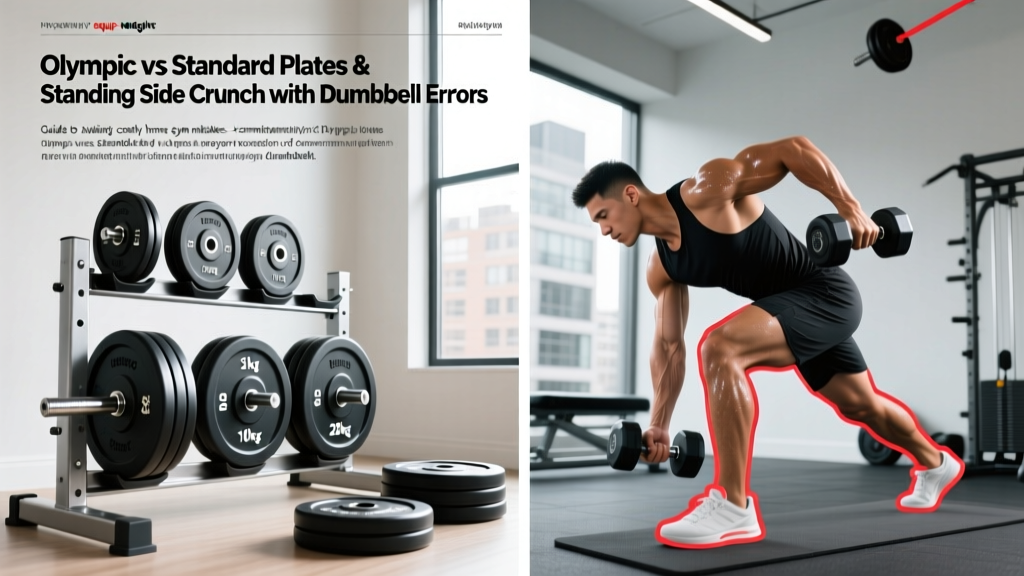
Olympic vs Standard Plates & Standing Side Crunch with Dumbbell Errors
Avoid costly home gym mistakes. We compare Olympic vs standard weight plates and troubleshoot form errors for the standing side crunch with dumbbell.

The Home Gym Paradox: Heavy Iron vs. Finesse Movements
Building a home gym in 2026 requires navigating a minefield of equipment compatibility and biomechanical execution. Two of the most frequent troubleshooting requests we receive at FitGearPulse involve foundational gear selection and isolation exercise form. Specifically, lifters frequently misallocate their budget by misunderstanding the differences between weight plate types (Olympic vs standard), and subsequently struggle with micro-loading for core isolation work like the standing side crunch with dumbbell. This guide dissects these interconnected mistakes, providing a concrete troubleshooting framework to save your wallet and your lumbar spine.
⚠️ Troubleshooting Alert: If you are experiencing lower back pain during lateral flexion movements, or if your adjustable dumbbell handles feel dangerously unbalanced, you are likely suffering from a mismatch between your plate ecosystem and your exercise selection. Read on for the diagnostic fixes.Equipment Mistake #1: The 'Standard' vs. Olympic Plate Misconception
The fitness industry's naming conventions are notoriously misleading. What commercial retailers label as 'Standard' weight plates are actually the budget-tier, 1-inch (25.4mm) center-hole plates. Conversely, 'Olympic' plates feature a 2-inch (50mm) center hole and represent the true global standard for serious strength training. Buying the wrong ecosystem is the most expensive mistake a home gym owner can make.
Diagnostic Comparison: 1-Inch Standard vs. 2-Inch Olympic
| Feature | 'Standard' (1-Inch) | Olympic (2-Inch) |
|---|---|---|
| Center Hole Diameter | 1 inch (25.4mm) | 2 inches (50mm) |
| Typical Material | Vinyl/Cement or Cast Iron | Cast Iron, Steel, Urethane, Rubber |
| 2026 Avg. Cost Per Lb | $1.00 - $1.60 | $1.80 - $4.50+ |
| Max Dumbbell Load (14in Handle) | ~35 lbs (before collar interference) | ~65 lbs (with slim-line urethane) |
| Calibration Accuracy | +/- 5% to 10% | +/- 1% to 3% (Calibrated Steel) |
Troubleshooting the Loading Bottleneck
The primary failure mode for 'Standard' 1-inch plates occurs when lifters attempt to use them for adjustable dumbbell work. A standard 14-inch spin-lock dumbbell handle weighs about 2.5 lbs. If you use bulky, cement-filled 10-pound standard plates, you can only fit one plate per side before the collars run out of thread. This caps your dumbbell weight at a mere 22.5 lbs. Furthermore, 1-inch handles lack the knurling depth and tensile strength of Olympic dumbbell handles, making heavy unilateral work hazardous.
The Fix: If your goal is progressive overload for compound lifts, liquidate your 1-inch gear and invest in a 2-inch Olympic ecosystem. However, if you are strictly doing light isolation and core work, 1-inch cast iron (not cement) plates remain a viable, space-saving budget option.
Form Troubleshooting: Standing Side Crunch with Dumbbell
The standing side crunch with dumbbell is a staple for targeting the obliques and the quadratus lumborum (QL). However, because lifters often only have access to large, bulky weight plates at home, they fail to micro-load appropriately for this highly sensitive isolation movement. Grabbing a 45-pound dumbbell because 'it's the only one loaded' is a fast track to a lumbar strain.
According to biomechanical data from ExRx Kinesiology, the obliques function primarily in lateral flexion and rotation of the vertebral column. Overloading lateral flexion with excessive momentum shifts the sheer force directly onto the intervertebral discs rather than the muscular target.
3 Critical Execution Errors (and How to Fix Them)
- Error: The 'Lateral Raise' Swing (Momentum Overload)
The Mistake: Lifters use a heavy dumbbell (30+ lbs) and hike their hip upward, using momentum to swing the weight up and down. This completely disengages the obliques and overworks the hip flexors and erector spinae.
The Fix: Drop the weight to a 10 lb or 15 lb fixed neoprene dumbbell. Stand in front of a mirror and ensure your hips remain entirely stationary. Imagine your torso is a pendulum hinging strictly at the waist. - Error: Forward Flexion Drift
The Mistake: As fatigue sets in, the dumbbell drifts forward, turning the movement into an awkward, loaded forward crunch. This violates the sagittal plane and risks herniation.
The Fix: Keep the dumbbell strictly aligned with your lateral midline. The ACE Fitness Exercise Library emphasizes keeping the weight close to the leg, sliding it down the side of your shorts as if tracing a seam. - Error: Grip Fatigue Preceding Core Failure
The Mistake: Squeezing a thick, poorly knurled adjustable dumbbell handle causes the forearm flexors to burn out before the obliques reach mechanical failure.
The Fix: Use a lifting strap to secure the dumbbell to your wrist, or switch to a kettlebell. A kettlebell's handle allows the weight to hang naturally from the crook of your fingers, reducing grip demand by up to 40%.
Bridging the Gap: Micro-Loading for Core Isolation
The intersection of your plate collection and your exercise execution is where most home gym routines fall apart. If you own a 2-inch Olympic dumbbell handle (which typically weighs 5 to 7 lbs on its own), loading it for a standing side crunch with dumbbell is notoriously difficult. Standard 2.5 lb Olympic plates bring the total weight to 12 lbs, which might still be too heavy for a beginner's lateral flexion.
💡 The 2026 Micro-Loading Protocol
To properly troubleshoot your core isolation routines without buying a full rack of fixed dumbbells, invest in Fractional Magnetic Plates or 0.5 lb / 1 lb Micro Plates. Brands like Rogue and PlateMate offer magnetic fractional weights that adhere directly to the ends of your dumbbell or barbell. This allows you to load an Olympic dumbbell handle with just 1.25 lbs per side, yielding a perfectly balanced 9.5 lb implement—ideal for high-rep, strict-form standing side crunches.
Summary: Aligning Gear with Biomechanics
Troubleshooting your home gym requires looking at the macro (your plate ecosystem) and the micro (your exercise execution). Avoid the trap of buying bulky 'Standard' 1-inch plates if you plan on progressing in strength; they will bottleneck your dumbbell loading and limit your ceiling. Conversely, respect the biomechanical fragility of the spine during the standing side crunch with dumbbell. Do not let your ego, or your lack of fractional plates, force you into using loads that compromise your lateral flexion mechanics. Equip your gym with precision, and train your core with intent.
More gear to consider
All reviews
Things to Do with a Dumbbell vs Barbell: Collar Guide

Rubber Hex vs Urethane: Dumbbell March Maintenance Tips
Olympic Barbell Knurling Guide & Lying Dumbbell Reverse Fly Setup

Beyond a Beginner Workout with Dumbbells: Olympic Barbell Guide

Cast Iron vs Competition Kettlebells: Leg Workout Gym with Dumbbells