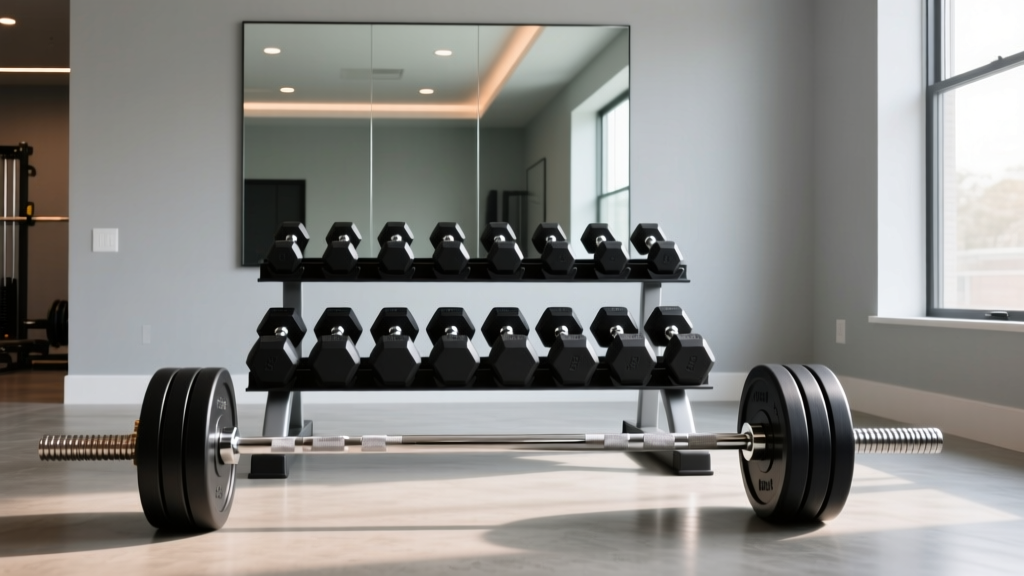
Olympic vs Standard Plates for the Single Hand Dumbbell Row
Compare Olympic and standard weight plates for plate-loaded dumbbells. Find the best setup for heavy single hand dumbbell row variations in your home gym.

The Biomechanical Demand of the Single Hand Dumbbell Row
When building a thick, wide back, the single hand dumbbell row remains undisputed. It allows for a deep stretch at the bottom, unilateral focus to correct imbalances, and a massive load capacity that machines simply cannot replicate. But for home gym owners and garage lifters relying on plate-loaded adjustable dumbbells, a critical question arises: should you load your handles with Olympic (2-inch) or Standard (1-inch) weight plates?
This is not just a matter of what fits on your rack. The geometry, sleeve length, and diameter of your plates directly impact the range of motion (ROM), floor clearance, and safety of your rowing mechanics. As of 2026, with plate-loaded loadable dumbbell handles surging in popularity for heavy strongman and bodybuilding prep, understanding the nuances between Olympic and standard plates is essential for optimizing your back day.
"The single-arm dumbbell row heavily targets the latissimus dorsi, rhomboids, and posterior deltoids. Maintaining a neutral spine and allowing a full stretch at the bottom of the movement is critical for maximizing muscle fiber recruitment." — American Council on Exercise (ACE)
Head-to-Head Comparison Matrix
Before diving into the biomechanical implications, let us look at the raw specifications and 2026 market realities of both plate types when paired with plate-loaded dumbbell handles.
| Feature | Olympic Plates (2-Inch) | Standard Plates (1-Inch) |
|---|---|---|
| Center Hole Diameter | 50.6 mm (2 inches) | 25.4 mm (1 inch) |
| Diameter Consistency | High (Bumpers are always 450mm) | Low (Varies wildly by weight) |
| Handle Type Required | Loadable Dumbbell (e.g., Rogue, Titan) | Spin-Lock / Threaded Collar |
| Max Load per Handle | 150+ lbs (Sleeve dependent) | 60-80 lbs (Handle length limited) |
| Collar Security | Spring / Clamp Collars (Silent, rigid) | Star Collars (Prone to vibrating loose) |
| Avg Cost per Lb (2026) | $1.50 - $2.80 (Cast Iron / Urethane) | $0.90 - $1.40 (Often cheaper used) |
The Sleeve Clearance Problem: A Real-World Failure Mode
The most significant point of failure when using Olympic plates for the single hand dumbbell row is sleeve interference. Olympic loadable dumbbell handles, such as the Rogue Loadable Dumbbell, feature sleeves that are typically 6.5 to 8.5 inches long to accommodate heavy loads.
⚠️ Warning: Torso Smash at Peak ContractionWhen you load an Olympic handle with 100+ lbs, the plates sit far away from the knurled grip. During the concentric phase of the single hand dumbbell row, as you drive your elbow past your torso, the extended Olympic sleeve and the outer edge of the plates can violently collide with your ribcage or latissimus dorsi. This prematurely halts your ROM and can cause bruising over time.
The Standard Plate Advantage: Standard 1-inch spin-lock handles (like the classic CAP Barbell 14-inch threaded dumbbell) have a much shorter overall profile. Because the 1-inch plates are narrower and the threaded collars sit flush against the plate, the center of mass remains tightly packed near your hand. This allows you to pull the dumbbell deep into your hip pocket without the hardware smashing into your torso.
Deficit Rows and Floor Clearance Geometry
If you are utilizing the single hand dumbbell row to perform deficit rows (resting the dumbbell on the floor or a low block between reps to increase the stretch-mediated hypertrophy of the lats), plate diameter becomes your most important metric.
Olympic Bumper Plates: The Deficit King
Olympic bumper plates are manufactured to a strict International Weightlifting Federation (IWF) standard of 450mm (17.7 inches) in diameter, regardless of whether the plate weighs 10 lbs or 45 lbs. This means a 10-lb bumper plate provides the exact same floor clearance and deficit stretch as a 45-lb plate. According to comparative analyses by BarBend, this uniform geometry makes Olympic bumpers vastly superior for exercises requiring consistent floor contact.
Standard Cast Iron: The Inconsistency Trap
Standard plates scale their physical diameter with their weight. A 10-lb standard plate might only be 7 inches across, while a 25-lb plate is roughly 10 inches. If you are doing heavy single-arm deficit rows and resting the dumbbell on the floor, a light warm-up set with small standard plates will force you into an awkward, hinged-over starting position. As you add weight and the plates get wider, your starting posture changes entirely, ruining your biomechanical consistency.
Security and the Eccentric Rattle
The single hand dumbbell row involves a forceful, explosive concentric pull followed by a controlled, 2-to-3-second eccentric lowering phase. This creates immense rotational torque on the dumbbell handle.
- Standard Star Collars: The threaded star collars on 1-inch handles are notorious for vibrating loose during the eccentric phase of rowing. If the collar shifts even a quarter-inch, the plates clank, the center of gravity shifts mid-rep, and you risk dropping the weight. You must constantly re-tighten them, often requiring a rubber mallet or wrench to secure them properly for heavy sets.
- Olympic Clamp Collars: Using 2-inch Olympic handles allows you to secure the plates with aluminum clamp collars (like the Rogue HG 2.0 or Lock-Jaw). These clamp down with hundreds of pounds of lateral pressure, completely eliminating plate rattle and ensuring the weight distribution remains perfectly static from the first rep to the twentieth.
Expert Verdict: Which Setup Should You Build?
Choosing between Olympic and standard plates for your single hand dumbbell row setup ultimately depends on your maximum strength levels and your tolerance for hardware maintenance.
Choose Standard Plates (1-Inch) If:
You are a beginner to intermediate lifter rowing under 70 lbs per arm. The compact profile of a standard spin-lock dumbbell keeps the weight close to your center of gravity, preventing the sleeve-to-torso collision that plagues heavy Olympic setups. It is also significantly cheaper to outfit a home gym with standard cast iron in 2026, especially on the secondary market.
Choose Olympic Plates (2-Inch) If:
You are an advanced lifter pulling 80+ lbs per arm, or you prioritize deficit rows for lat development. The superior securing mechanism of Olympic clamp collars ensures safety during heavy, torque-heavy rows. To mitigate the "torso smash" failure mode, advanced lifters should load Olympic handles with fractional plates or calibrated steel plates (which are much thinner than cast iron) to keep the overall sleeve length as short as possible while still achieving heavy loads.
Frequently Asked Questions
Can I use Olympic bumper plates on a standard 1-inch dumbbell handle?
No. Olympic plates have a 50.6mm center hole, while standard handles are 25.4mm thick. Adapters exist (1-inch to 2-inch sleeve adapters), but they add dangerous lateral length to the handle, exacerbating the torso-clearance issue during the single hand dumbbell row.
Why do my standard dumbbell collars keep loosening during rows?
The rotational torque of pulling a heavy weight unilaterally causes the threaded handle to spin inside the star collar. To fix this, ensure the threads are clean of chalk and grease, and tighten the collar using a rubber mallet to tap the ridges securely into place before starting your set.
More gear to consider
All reviews
EZ vs Straight Bar & Back Workouts with Dumbbells Female Space Guide
Space-Saving Racks to Organize Your Baadass Dumbbells

What Do Dumbbell Lunges Work? Adjustable Dumbbell Reviews & Form Troubleshooting

Bumper vs Iron Plates: Layouts & Face Pull Alternative with Dumbbells

Troubleshooting Your Press: What Muscles Does Dumbbell Bench Press Work vs. Barbell Knurling