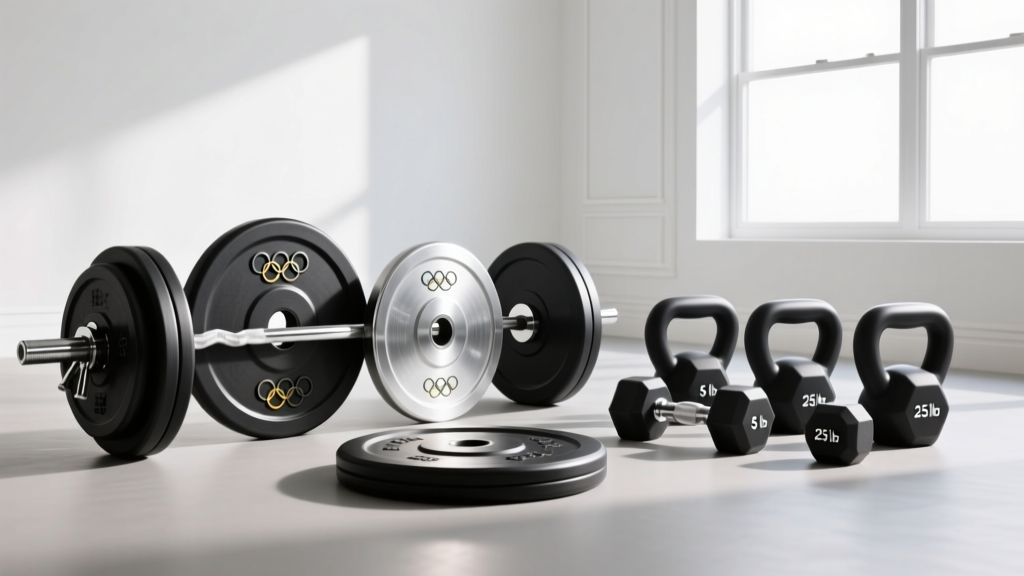
Olympic vs Standard Plates: Plus, What Weight Dumbbells Should I Use?
Compare Olympic vs standard weight plates for your home gym, and discover exactly what weight dumbbells you should use for accessory lifts.

Building a comprehensive home gym requires navigating a maze of equipment specifications. Two of the most common roadblocks for lifters are choosing the right barbell plate ecosystem and determining the correct dumbbell sizes for accessory work. While barbell foundations dictate your heavy compound lifts, dumbbells are the undisputed kings of unilateral training, hypertrophy, and joint stabilization. In this in-depth 2026 buying guide, we will dissect the mechanical differences between Olympic and standard weight plates, and definitively answer the golden question: what weight dumbbells should I use to maximize your training adaptations?
The Foundation: Olympic vs. Standard Weight Plates
The divide between Olympic and standard weight plates is not merely cosmetic; it is rooted in structural engineering and load-bearing physics. Standard plates feature a 1-inch (25mm) center hole, designed to fit on lightweight, often hollow or basic solid-steel bars. Olympic plates feature a 2-inch (50mm) hole, pairing with heavy-duty bars equipped with rotating sleeves and high-tensile steel shafts.
| Feature | Standard Plates (1-inch) | Olympic Plates (2-inch) |
|---|---|---|
| Center Hole Diameter | 25mm (1 inch) | 50mm (approx. 1.97 inches) |
| Barbell Sleeve Type | Fixed, non-rotating | Rotating (bushings or bearings) |
| Max Safe Load Capacity | 200 - 300 lbs (bar yields) | 700 - 1,500+ lbs |
| Plate Materials | Cast iron, vinyl/cement | Cast iron, urethane, virgin rubber |
| Resale Value & Longevity | Poor (niche market) | Excellent (universal standard) |
The Biomechanical Flaw of Standard Plates
Standard bars lack rotating sleeves. When you perform dynamic movements like cleans, snatches, or even heavy bicep curls, the torque generated by the plates transfers directly into the barbell shaft and your wrists. According to equipment testing by Garage Gym Reviews, standard bars begin to permanently deform (bend) when loaded beyond 250 lbs. Olympic bars, conversely, utilize needle bearings or bronze bushings that allow the sleeves to spin independently of the grip, dissipating rotational inertia and protecting your connective tissue.
Why Serious Lifters Abandon Standard Plates
If you are lifting purely for general fitness and your total barbell load will never exceed 150 lbs, a standard cast-iron set from a big-box retailer might suffice. However, for anyone pursuing progressive overload, Olympic plates are the only logical investment. Furthermore, Olympic bumper plates (made of high-density virgin rubber) are calibrated to a precise 450mm diameter, meaning a 10-lb plate and a 45-lb plate share the same outer dimensions. This allows you to safely drop the bar from overhead without shattering the plates or your garage floor—a physical impossibility with standard iron.
The Accessory Equation: What Weight Dumbbells Should I Use?
Once your barbell foundation is set, you must address unilateral imbalances and hypertrophy. This brings us to the most frequently asked question in home gym design: what weight dumbbells should I use? The answer is not a single number, but a strategic spectrum based on exercise biomechanics, your current 1-Rep Max (1RM), and the principle of Rate of Perceived Exertion (RPE).
The NSCA '2-for-2' Progression Rule:The National Strength and Conditioning Association recommends that if you can complete two or more reps beyond your target rep range in the final set of an exercise for two consecutive workouts, it is time to increase the dumbbell weight by 5% to 10%. (Source: Mayo Clinic / NSCA Guidelines).
Exercise-Specific Dumbbell Weight Mapping
The musculature of the human body varies wildly in force-production capacity. Using the same dumbbells for lateral raises and goblet squats is a recipe for either joint injury or severe under-stimulation. Below is a data-driven matrix for an intermediate male lifter (approx. 180 lbs body weight) to serve as a baseline. Women or beginners should scale these starting points down by 40-50%, focusing on form mastery via ExRx exercise databases before adding load.
| Exercise Category | Specific Movement | Target Rep Range | Recommended DB Weight (Per Hand) |
|---|---|---|---|
| Lower Body (Compound) | Goblet Squats / Lunges | 8 - 12 | 35 lbs - 60 lbs |
| Chest (Compound) | Flat / Incline DB Press | 8 - 12 | 40 lbs - 75 lbs |
| Back (Compound) | Single-Arm Dumbbell Rows | 8 - 12 | 50 lbs - 90 lbs |
| Shoulders (Isolation) | Lateral Raises | 12 - 20 | 10 lbs - 20 lbs |
| Arms (Isolation) | Bicep Curls / Tricep Extensions | 10 - 15 | 20 lbs - 35 lbs |
Fixed vs. Adjustable: Solving the Weight Dilemma
Answering 'what weight dumbbells should I use' is easy; affording a full rack of them is not. A complete set of fixed urethane dumbbells from 5 to 50 lbs (in 5-lb increments) requires 10 pairs. At the 2026 average market rate of $2.50 to $3.50 per pound, a full commercial-grade rack will cost between $1,400 and $2,000, not including the $300 storage rack.
The Adjustable Solution: For 90% of home gym owners, adjustable dumbbells are the superior choice. Models like the Nuobell 80 (approx. $379/pair) or the PowerBlock Elite (approx. $349/pair for the 50-lb base) allow you to toggle between 5 lbs and 80 lbs in seconds. This single purchase effectively answers the 'what weight' question by giving you access to 15+ different weight increments within the exact footprint of a single pair of shoes.
2026 Budgeting Realities: Building Your Arsenal
When allocating your home gym budget, prioritize the Olympic barbell and plates first, as they govern your central nervous system adaptations and heavy compound strength. Allocate approximately 60% of your free-weight budget to a high-quality Olympic bar (look for 190k+ PSI tensile strength), a set of rubber-grip bumper plates, and a sturdy squat rack. Dedicate the remaining 40% to a premium pair of adjustable dumbbells and a set of adjustable benches. Avoid the trap of buying cheap standard plates and a 50-pair fixed dumbbell set; you will outgrow the standard plates within six months, and the fixed dumbbells will consume your entire garage.
Frequently Asked Questions
Can I use standard plates on an Olympic bar?
No. Standard plates have a 1-inch hole and will not fit over the 2-inch sleeves of an Olympic bar. While you can buy plastic adapters that slip onto the Olympic sleeve to reduce the diameter to 1 inch, this creates a dangerous instability during heavy lifts and is highly discouraged.
How do I know if my dumbbells are too heavy?
If you cannot complete the minimum target reps with a controlled eccentric (lowering) phase of at least 2 seconds, or if you must use 'body English' (momentum from your hips and back) to move the weight, the dumbbell is too heavy. Drop the weight by 10-15% and prioritize time-under-tension.
Are hex dumbbells better than round dumbbells?
Hexagonal rubber-coated dumbbells are superior for home gyms because they will not roll away when placed on the floor, making them ideal for renegade rows and push-up variations. However, for exercises like dumbbell curls or presses where the weight rests against your body or legs, round urethane or chrome dumbbells offer more ergonomic comfort.
More gear to consider
All reviews
Leg Raises Dumbbell Mistakes: Adjustable Set Reviews

Loadable Dumbbell Care: Surviving the Leg Press with Dumbbells

Space Layouts for Alternate Incline Dumbbell Curls: Hex vs Urethane

Bumper vs Iron Plates Value & Deltoid Workouts with Dumbbells

Cast Iron vs Competition Kettlebell Care & Two Dumbbell Back Workout
