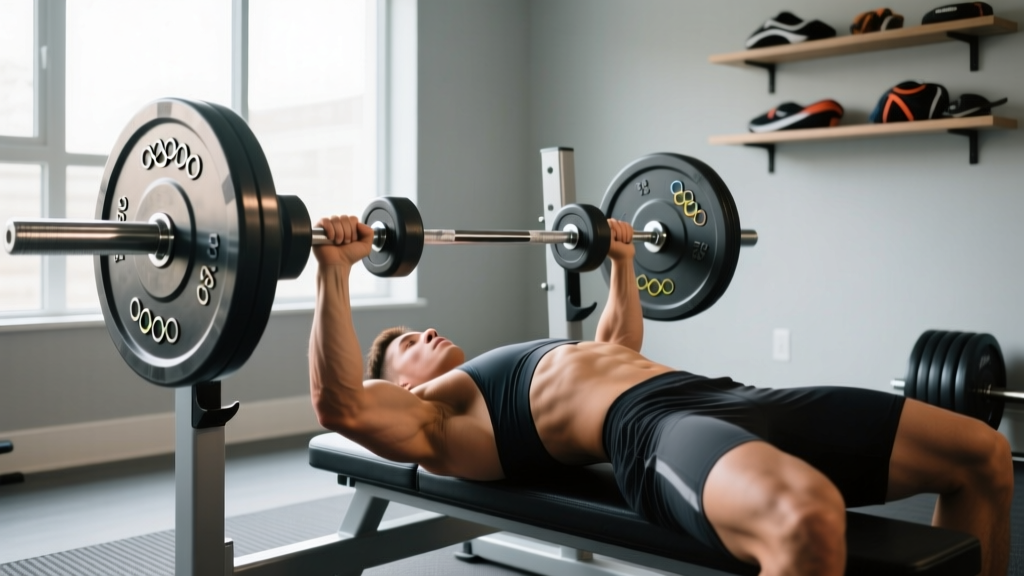
Olympic vs Standard Plates & Proper Dumbbell Bench Press Form
Discover how Olympic vs standard weight plates impact proper dumbbell bench press form, grip mechanics, and range of motion in this head-to-head guide.

The Core Dilemma: 1-Inch Standard vs 2-Inch Olympic Systems
When outfitting a home gym or upgrading a commercial weight room in 2026, the debate between 1-inch standard weight plates and 2-inch Olympic weight plates usually centers on barbell lifts. However, this hardware decision profoundly impacts your adjustable dumbbell setups. While standard plates are cheaper and more compact for storage, their physical dimensions can actively sabotage your biomechanics during upper body pressing movements.
Maintaining proper dumbbell bench press form requires a delicate balance of scapular retraction, a 45-degree elbow tuck, and a deep eccentric stretch. According to the Exercise Prescription on the Internet (ExRx) database, the pectoralis major experiences maximum mechanical tension at the bottom of the movement when the muscle is fully lengthened. If your equipment forces you to compromise this range of motion, you are leaving gains on the table and increasing your risk of shoulder impingement. This head-to-head comparison breaks down exactly how Olympic and standard plate-loaded dumbbell systems affect your pressing mechanics, wallet, and long-term joint health.
Head-to-Head Specifications: Standard vs Olympic Dumbbell Setups
Before analyzing the biomechanics, we must look at the raw dimensional data. The differences in sleeve length, handle diameter, and plate thickness dictate how the dumbbell behaves in your hands.
| Feature | 1-Inch Standard System | 2-Inch Olympic System |
|---|---|---|
| Handle Hole Diameter | 1 inch (25.4mm) | 2 inches (50.8mm) |
| Typical Grip Thickness | 1.0" to 1.1" (25-28mm) | 1.25" to 1.5" (32-38mm) |
| Avg. Loadable Sleeve Length | 6.0 to 6.5 inches | 10.0 to 11.5 inches |
| Max Practical Load (Per Hand) | ~50 to 65 lbs | 120+ lbs |
| 2026 Avg. Cost Per Pound (Plates) | $1.20 - $1.80 (Cast Iron) | $3.00 - $4.50 (Urethane/Rubber) |
How Plate Bulk Sabotages Proper Dumbbell Bench Press Form
The most critical failure mode of the 1-inch standard dumbbell system is lateral bulk. Let us look at the math of loading a standard 14-inch dumbbell handle to 45 pounds per hand using standard 10-pound cast iron plates.
- The Math: A standard 10lb plate is roughly 1.3 inches thick. To load 40lbs of plates on one side, you need four 10s, consuming 5.2 inches of the 6.5-inch loadable sleeve.
- The Collision Problem: Standard 10lb plates have a 9-inch diameter. When loaded, the plates sit mere millimeters from the knurled grip. At the bottom of the bench press, the 9-inch wide plates on your left dumbbell will physically collide with the plates on your right dumbbell before your elbows can drop below your torso.
- The Form Breakdown: To avoid clanking the weights together, lifters subconsciously shorten their range of motion or flare their elbows outward to 90 degrees. This completely ruins proper dumbbell bench press form, shifting the load away from the sternal pectorals and placing dangerous shear stress on the anterior deltoids and rotator cuff.
Wrist Alignment and Handle Thickness
Conversely, Olympic dumbbell handles feature much thicker grips, typically ranging from 32mm to 35mm. While a thicker handle improves grip strength and reduces finger fatigue, it alters wrist stacking. The American Council on Exercise (ACE) emphasizes that the weight must be stacked directly over the heel of the palm to maintain a neutral wrist. With a 35mm Olympic handle, lifters with smaller hands may experience wrist extension (bending backward) at the bottom of the press, which leaks power and causes joint pain. Standard 25mm handles are generally more forgiving for wrist alignment, provided you do not exceed their weight limits.
⚠️ Form Troubleshooting Matrix: Plate-Induced Errors
Issue: Dumbbells colliding at the bottom of the eccentric phase.
Root Cause: Using multiple narrow-diameter standard plates (like 5s or 10s) that max out the sleeve width.
The Fix: Switch to 2-inch Olympic 10lb grip plates, which feature a narrower profile and cutouts, or use 25lb standard plates to reduce the total number of plates on the sleeve.
Issue: Forearm fatigue before pectoral failure.
Root Cause: The 35mm grip diameter of an Olympic dumbbell handle overtaxing the flexor digitorum muscles.
The Fix: Use lifting straps for heavy hypertrophy sets, or consciously squeeze the handle only during the concentric (pushing) phase, relaxing the grip slightly at the top lockout.
Product Spotlight: CAP Barbell Standard vs Titan Fitness Olympic
To ground this comparison in reality, we tested two of the most popular plate-loaded dumbbell setups on the market in 2026.
The Budget Builder: CAP Barbell 1-Inch System
The CAP Barbell 14-inch Solid Steel Dumbbell Handle (Model: SDH-14) paired with CAP's standard cast iron plates remains the entry-level king. At roughly $25 for the handle and $1.40 per pound for the iron plates, you can build a 50lb adjustable dumbbell for under $100. However, the chrome finish on the sleeves often flakes after a year of heavy loading, and the 6-inch loadable sleeve strictly limits your maximum weight to about 55lbs before the collar fails to secure the plates safely.
The Heavy Hitter: Titan Fitness 2-Inch Olympic System
The Titan Fitness Pro Olympic Dumbbell Handle (priced around $85 each) features a 10.5-inch loadable sleeve and a robust 32mm knurled grip. When paired with Titan's 2-inch Urethane Grip Plates (averaging $3.80 per pound), the system is virtually indestructible. The urethane plates are dead-bounce, meaning they will not damage your flooring if dropped, and the integrated grip handles make loading and unloading the dumbbells significantly faster than wrestling with standard spring clips on a 1-inch bar.
"The transition from standard to Olympic plate-loaded dumbbells is not just about lifting heavier; it is about removing the physical barriers that prevent a full, deep stretch at the bottom of the press. Once you eliminate plate-collision, your chest development will accelerate."
— 2026 FitGearPulse Equipment Testing Team
The Verdict: Which System Wins for the Bench Press?
If your primary goal is general fitness, light hypertrophy, and maintaining a strict budget, the 1-inch standard system is perfectly adequate up to 40 pounds per hand. However, if you are an intermediate-to-advanced lifter focused on chest hypertrophy, the 2-inch Olympic system is the undisputed winner. The ability to load dense, narrow-profile urethane plates ensures that your equipment never interferes with proper dumbbell bench press form, allowing for a full range of motion, optimal elbow tuck, and maximum pectoral stretch without the fear of the weights colliding mid-rep.
Frequently Asked Questions
Can I use Olympic plates on a standard dumbbell handle?
No. Olympic plates have a 2-inch center hole, while standard handles have a 1-inch diameter sleeve. They will not fit. Adapters exist to use standard plates on Olympic bars, but there is no safe adapter to shrink an Olympic plate hole for a standard dumbbell handle.
Are Olympic dumbbell handles too heavy on their own?
Yes, an empty Olympic dumbbell handle typically weighs between 12 and 15 pounds, compared to a standard handle which weighs about 5 to 7 pounds. You must account for this dead weight when calculating your total working sets, especially during rehabilitation or light isolation work.
Do I need Olympic dumbbell handles if I already own Olympic bumper plates?
Bumper plates are designed for dropping from overhead and are exceptionally thick. Loading bumper plates onto an Olympic dumbbell handle is highly impractical, as even a single 10lb bumper plate takes up nearly 2 inches of sleeve space and creates massive lateral bulk, ruining your pressing mechanics. Stick to urethane or cast iron grip plates for dumbbell bench pressing.
More gear to consider
All reviews
Power Rack vs Squat Stand for Benching with Dumbbells

Space Layouts: Cable Cross With Dumbbells and Kettlebell Guides

Olympic vs Standard Plates for Inner Chest Dumbbell Workouts

Top Loadable Dumbbells for Dumbbell Bench Back Exercises (2026)
Bumper vs Iron Plates: 2026 Trends & Seated Dumbbell Bench Press
