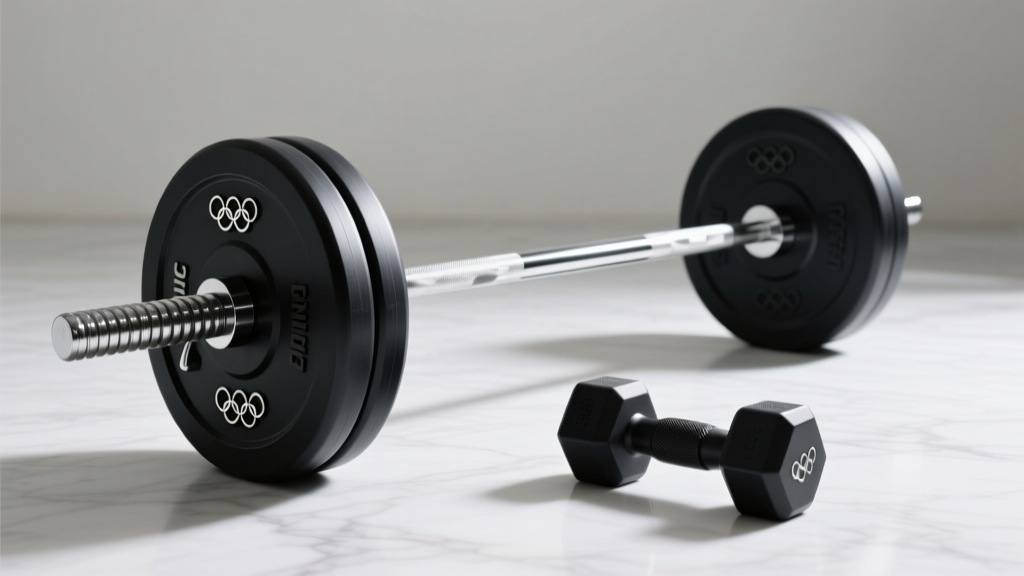
Olympic Barbell Knurling vs. Forearm Exercise Dumbbell: 2026 Guide
Compare Olympic barbell knurling and weight specs against a dedicated forearm exercise dumbbell to build elite grip strength in 2026.

The 2026 Grip Training Paradigm: Heavy Shafts vs. Isolated Loads
Grip strength has firmly established itself as a primary biomarker for both athletic performance and overall longevity. As we move through 2026, home gym owners and strength coaches are increasingly debating the most efficient tools for developing crush grip and forearm hypertrophy. The debate typically centers on two distinct approaches: leveraging the aggressive knurling and bilateral weight distribution of a high-spec Olympic barbell, or utilizing a specialized, thick-handled forearm exercise dumbbell for unilateral isolation. Both tools have distinct biomechanical advantages, but understanding the metallurgy, weight distribution, and friction coefficients of each is critical before making a purchase.
This head-to-head comparison merges our comprehensive Olympic barbell buying guide—focusing specifically on weight distribution and knurling profiles—with an analysis of dedicated forearm isolation tools. Whether you are a powerlifter trying to stop the bar from rolling out of your hands during a 500-pound deadlift, or a bodybuilder seeking deeper brachioradialis development, the equipment you choose dictates your physiological adaptations.
Olympic Barbell Buying Guide: Weight Distribution and Knurling Specs
When evaluating an Olympic barbell for grip and forearm development, the total weight of the bar (typically 20kg or 44lbs) is secondary to how that weight is distributed and how the steel interfaces with your skin. The shaft diameter and the knurl profile are the two most critical variables in your buying decision.
Shaft Diameter and Tensile Strength
Olympic barbells generally come in three shaft diameters, each demanding a different grip response:
- 28mm (Weightlifting Bars): Designed for the hook grip. The thinner shaft allows the fingers to wrap entirely around the bar and lock over the thumb. While excellent for the snatch and clean & jerk, a 28mm shaft offers less surface area for the flexor digitorum muscles to engage during heavy static holds.
- 28.5mm (Multi-Purpose Bars): The standard compromise. It provides a moderate grip challenge but lacks the extreme forearm taxation required for elite grip specialization.
- 29mm (Power Bars): The gold standard for grip training. A 29mm shaft (like the one found on the Rogue Ohio Power Bar, priced around $395) forces the hand into a more open position. This increases the moment arm at the wrist and demands significantly higher contractile force from the forearm flexors to maintain a crush grip under heavy loads.
Decoding Knurl Profiles: Mountain vs. Volcano
Knurling is not just about roughness; it is a precise geometric pattern machined into the steel. According to Barbend's comprehensive barbell knurling guide, the shape of the knurl peaks dictates both grip security and skin tolerance.
- Mountain Knurl: Sharp, pointed peaks that dig deeply into the dermis. Excellent for chalky, heavy singles, but highly prone to tearing calluses during high-volume forearm training.
- Volcano Knurl: The preferred choice for 2026 powerlifters and grip specialists. The peaks are deep and wide but feature a microscopic flat top (roughly 0.1mm). This provides immense surface area for friction without acting like a cheese grater on your hands. A high-quality 205,000 PSI tensile strength bar with volcano knurling will cost between $350 and $450.
The Biomechanics of the Forearm Exercise Dumbbell
While a barbell requires bilateral stabilization, a dedicated forearm exercise dumbbell shifts the focus to unilateral isolation and altered leverage. In the context of grip training, a "forearm exercise dumbbell" usually refers to either a thick-grip hex dumbbell (featuring a 2-inch to 2.5-inch handle diameter) or a specialized wrist-roller dumbbell attachment.
When you use a thick-handled forearm exercise dumbbell (such as the Rogue Fat Grip Dumbbells, retailing around $185 per pair), you eliminate the ability to wrap your thumb and fingers around the handle. This forces a "support grip" or "open-hand grip." ExRx kinesiology data highlights that when the fingers cannot fully flex, the isometric tension on the extensor carpi radialis and the brachioradialis increases exponentially to prevent the wrist from buckling under the load.
💡 Pro-Tip: The Leverage DisadvantageA 50lb thick-grip forearm exercise dumbbell will feel significantly heavier to your central nervous system than a 50lb plate loaded onto an Olympic barbell. The concentrated, unilateral mass of the dumbbell creates a harsher leverage disadvantage at the wrist joint, demanding higher motor unit recruitment in the forearm extensors.
Head-to-Head Comparison Matrix
| Feature | Olympic Power Barbell (29mm) | Thick-Grip Forearm Exercise Dumbbell |
|---|---|---|
| Primary Grip Type | Crush Grip (Closed Hand) | Support / Open-Hand Grip |
| Handle Diameter | 29mm (1.14 inches) | 2.0 to 2.5 inches |
| Friction Mechanism | Machined Steel Knurling (Volcano) | Smooth or Knurled Steel / Urethane |
| Load Capacity | 800+ lbs (Bilateral) | 50 - 120 lbs (Unilateral) |
| Target Muscles | Flexor Digitorum Profundus | Brachioradialis, Extensor Carpi |
| Average Cost (2026) | $350 - $450 | $80 - $185 (per pair) |
Friction, Calluses, and Skin Tearing Thresholds
One of the most overlooked aspects of grip training is dermatological tolerance. The aggressive knurling on a 29mm Olympic barbell generates immense shear force. When performing barbell holds or heavy rows, the skin on the distal palmar crease is compressed between the steel peaks and the metacarpal bones. Over time, this builds thick calluses, but without proper maintenance (using a pumice stone and moisturizing), these calluses will avulse (tear off) under heavy loads.
Conversely, a smooth-handled or mildly knurled forearm exercise dumbbell relies purely on compressive force rather than shear friction. This allows for higher volume, hypertrophy-focused repetitions (like Zottman curls or wrist extensions) without destroying the epidermis. If your goal is high-rep forearm pump and localized muscle damage for hypertrophy, the dumbbell is vastly superior. If your goal is neurological grip endurance and connective tissue conditioning, the barbell's knurling is mandatory.
Programming: The Hybrid Grip Protocol
To maximize forearm development in 2026, elite strength coaches recommend a hybrid approach that leverages the unique weight distribution of both tools. Below is a highly effective, actionable protocol designed to be performed twice a week at the end of your pulling sessions.
- Bilateral Barbell Static Holds (Neurological Overload): Load a 29mm volcano-knurl Olympic barbell to 80% of your 1RM deadlift. Hold for 15-20 seconds. Perform 3 sets. This conditions the flexor tendons and central nervous system to handle maximal compressive loads.
- Unilateral Thick-Grip Dumbbell Farmer Walks (Stabilization): Grab a 70lb thick-grip forearm exercise dumbbell. Walk for 40 meters per arm. The unilateral load forces the obliques and quadratus lumborum to stabilize while the open-hand grip taxes the brachioradialis. Perform 3 sets per arm.
- Dumbbell Wrist Extensions (Hypertrophy): Use a standard adjustable dumbbell (or a lighter forearm exercise dumbbell). Rest your forearm on a bench, hanging the wrist off the edge. Perform 3 sets of 15-20 slow, controlled extensions. This targets the often-neglected extensor muscles, preventing elbow tendonitis and balancing the forearm musculature.
The 2026 Verdict: Which Should You Buy?
If your budget allows for only one piece of equipment, the Olympic barbell remains the undisputed king of the home gym. A high-quality 29mm power bar with volcano knurling will build a formidable crush grip, serve as the foundation for your squats and deadlifts, and last a lifetime. However, if you are a bodybuilder, an arm wrestler, or an athlete specifically trying to break through a forearm hypertrophy plateau, investing in a dedicated thick-handled forearm exercise dumbbell is a non-negotiable addition. The altered leverage and open-hand demands provide a stimulus that even the most aggressively knurled barbell simply cannot replicate.
More gear to consider
All reviews
Safe Lower Back Exercise Dumbbell Home Setup Guide

Lower Body Dumbbell Workout Plateau? Power Rack vs Squat Rack vs Stand
Kabata Smart Dumbbells & Bumper vs Iron Plate Guide
Rubber Hex vs Urethane: 2026 Market Trends & Dumbbell Face Pulls
Power Rack vs Squat Rack vs Stand: Dumbbell Oblique Crunch Setup
