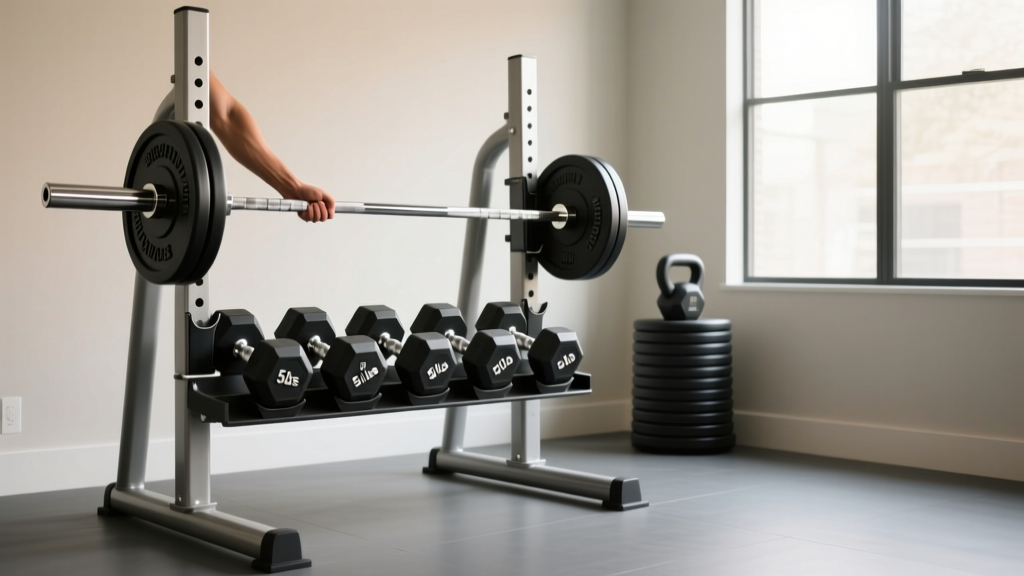
How Much Can I Bench If I Dumbbell Press 50? Barbell Buying Guide
Discover how much you can bench if you dumbbell press 50 lbs. Plus, our expert Olympic barbell buying guide on weight, shafts, and knurling for 2026.

Transitioning from dumbbells to the barbell is a pivotal milestone in any lifter's journey. You have finally stabilized the heavy 50-pound dumbbells, pressing them with control, full range of motion, and confidence. Naturally, the next logical question arises: how much can I bench if I dumbbell press 50? Answering this requires understanding the biomechanical differences between unilateral and bilateral pressing. But once you know your numbers, you need the right equipment to progress safely and effectively. This step-by-step Olympic barbell buying guide will walk you through calculating your barbell equivalent, followed by a deep dive into barbell weight, shaft diameter, and knurling patterns to ensure your 2026 home gym investment is flawless.
Step 1: Calculating Your Barbell Equivalent
When asking 'how much can I bench if I dumbbell press 50 lbs,' you must account for the stabilization factor. Dumbbells require each arm to independently control the weight's path, engaging the rotator cuff, serratus anterior, and core stabilizers to prevent the weights from drifting forward or backward. A barbell, conversely, locks your hands into a single plane of motion. This bilateral stability allows you to transfer more raw force into the lift. According to strength standards and biomechanical analyses from ExRx.net Bench Press Standards, lifters can typically press 10% to 20% more total weight with a barbell than with dumbbells.
| Dumbbell Weight (Per Hand) | Total DB Volume | Estimated Barbell Working Set (5-8 Reps) | Estimated Barbell 1RM |
|---|---|---|---|
| 35 lbs | 70 lbs | 85 - 95 lbs | 115 - 125 lbs |
| 40 lbs | 80 lbs | 95 - 105 lbs | 125 - 135 lbs |
| 45 lbs | 90 lbs | 105 - 115 lbs | 135 - 145 lbs |
| 50 lbs | 100 lbs | 115 - 135 lbs | 155 - 165 lbs |
| 60 lbs | 120 lbs | 140 - 155 lbs | 175 - 195 lbs |
If you are pressing 50-pound dumbbells for working sets of 8-10 reps, your total dumbbell volume is 100 pounds. Applying the 15% bilateral stability bonus, your estimated barbell working weight will be around 115 to 125 pounds. Factoring in the standard 45-pound Olympic bar, you are likely ready to bench press 135 pounds (one 45-pound plate per side) for multiple reps right out of the gate. For a true 1-Rep Max (1RM), a lifter handling 50-pound dumbbells for reps is generally capable of a 155 to 165-pound barbell bench press.
2026 Progression Tip: Do not jump straight to your estimated 1RM. Spend your first 4 weeks with the barbell focusing on grip width, arch, and leg drive. The barbell bench press places higher sheer stress on the AC joint and sternum. Use 135 lbs for sets of 5 to build connective tissue tolerance before testing your max.Step 2: Decoding Olympic Barbell Weight and Shaft Diameter
Once you have established your baseline strength, selecting the right barbell is critical. Not all Olympic barbells are created equal, and the physical dimensions of the bar directly impact your bench press mechanics and force transfer.
The 20kg vs. 15kg Decision
Standard men's Olympic barbells weigh exactly 20kg (44 lbs), while women's Olympic barbells weigh 15kg (33 lbs). For a lifter pressing 50-pound dumbbells, the 20kg bar is the appropriate starting point. The 20kg bar features a standard 28mm or 29mm shaft diameter, which accommodates heavier loads without permanent deformation. The 15kg bar features a thinner 25mm shaft, designed for smaller hands and Olympic weightlifting, but it will exhibit excessive 'whip' (bending) under heavy bench press loads, making the lift unstable.
Shaft Diameter: 28mm vs. 29mm
For the bench press, shaft diameter dictates how the bar feels in your palm and how much it flexes under load. According to grip mechanics research featured on Stronger By Science, a thicker barbell shaft increases the surface area in contact with the hand, improving force transfer and reducing wrist extension.
- 28mm Shaft: Common in Olympic weightlifting bars and multi-purpose bars (like the Rogue Ohio Bar). It offers more 'whip' and is easier to grip for smaller hands, but can feel slightly unstable during heavy, slow bench presses.
- 29mm Shaft: The gold standard for powerlifting and dedicated bench pressing. Bars like the Rogue Ohio Power Bar or Rep Fitness Power Bar feature a 29mm shaft. The extra millimeter provides a stiffer, more rigid feel, eliminating bounce and maximizing force transfer directly from your palms to the bar.
'If your primary goal is maximizing your bench press and you have average to large hands, a 29mm power bar is non-negotiable. The stiffness prevents the bar from oscillating at the bottom of the press, keeping your pecs and triceps in a stable firing pattern.'
Step 3: Knurling Patterns and Grip Mechanics
Knurling is the cross-hatched pattern machined into the steel shaft to provide friction. When you are pushing 135+ lbs, sweat and chalk will compromise your grip. The type of knurling you choose will dictate your comfort and control.
The Three Knurl Profiles
- Hill Knurling: Found on budget or older bars. The peaks of the knurl are rounded off. It feels smooth and comfortable but offers poor grip security when heavy loads and sweat are introduced.
- Mountain Knurling: Features sharp, aggressive peaks that bite deeply into the skin. Common in elite Olympic bars like the Eleiko OP Competition Bar. It provides incredible grip but can tear calluses during high-volume pressing or deadlifting.
- Volcano Knurling: The optimal choice for bench pressing. Machined to have a 'rim' around the peak rather than a sharp point, volcano knurling (famously utilized on the Rogue Ohio Power Bar) provides massive surface area for friction without acting like a cheese grater on your palms.
Center Knurl and IPF Marks
Does your bar need a center knurl? For pure bench pressing, no. The center knurl is designed to grip the back of your shirt during squats. However, if you are buying a single multi-purpose bar for your home gym, a passive center knurl is acceptable. Furthermore, ensure the bar features dual knurl rings. The inner rings (32 inches apart) are IPF marks for powerlifting bench press grip limits, while the outer rings (36 inches apart) are IWF marks for Olympic lifting. Aligning your pinky or ring finger with the IPF marks is the safest starting point for shoulder health when transitioning from dumbbells.
Step 4: Tensile Strength, Finish, and 2026 Pricing
The final step in your buying guide is understanding the metallurgy and coating of the barbell. This dictates the lifespan of your equipment and the total cost of ownership.
Tensile Strength (PSI)
Tensile strength measures the steel's resistance to snapping or permanently bending. As you progress from dumbbell pressing 50s to barbell benching 225 lbs and beyond, the bar will experience significant torque.
- Below 165,000 PSI: Avoid. These bars will permanently bend if dropped or loaded heavily over time.
- 190,000 PSI: The baseline for a quality home gym bar (e.g., Rep Fitness PR-1100 series). Excellent for general strength training.
- 200,000+ PSI: Premium power bars (e.g., Rogue Ohio Power Bar). Virtually indestructible under standard human loads.
Finish Options and Current Market Pricing
In 2026, the market for Olympic barbells has stabilized, but material costs dictate your choices. The finish protects the bar from oxidation (rust) and affects the feel of the knurl.
| Finish Type | Oxidation Resistance | Knurl Feel | Estimated 2026 Price Range |
|---|---|---|---|
| Bare Steel / Light Zinc | Low (Requires oiling) | Sharp, raw, aggressive | $200 - $275 |
| Black Zinc / E-Coat | Medium | Slightly muted, smooth | $250 - $325 |
| Cerakote (Ceramic Polymer) | High | Moderately muted, durable | $325 - $450 |
| Stainless Steel | Maximum | Raw feel, zero rust | $450 - $600+ |
Final Thoughts on Your Transition
Knowing how much you can bench if you dumbbell press 50 gives you a fantastic baseline—expect to comfortably handle 135 lbs for reps and test a 1RM around 155 lbs. However, the barbell is an entirely different beast that rewards precision, tight setups, and specialized equipment. By prioritizing a 29mm shaft, volcano knurling, and a high-tensile steel core, you are not just buying a piece of metal; you are investing in the structural foundation of your upper body strength for decades to come. Review the specs on Rogue Fitness's official barbell guide to compare current shaft tolerances, chalk up your hands, and get ready to break your dumbbell plateaus.
More gear to consider
All reviews
Best Adjustable Dumbbells for Abdomen Exercises: 2026 Review

Barbell Collars & Long Head Tricep Exercises Dumbbell Safety

Best Loadable Dumbbells for the Single Arm Dumbbell Row (2026)

What Does Bent Over Dumbbell Row Work? 2026 Loadable Trends

Loadable Dumbbells for Dumbbell Squats for Quads: Budget Breakdown
