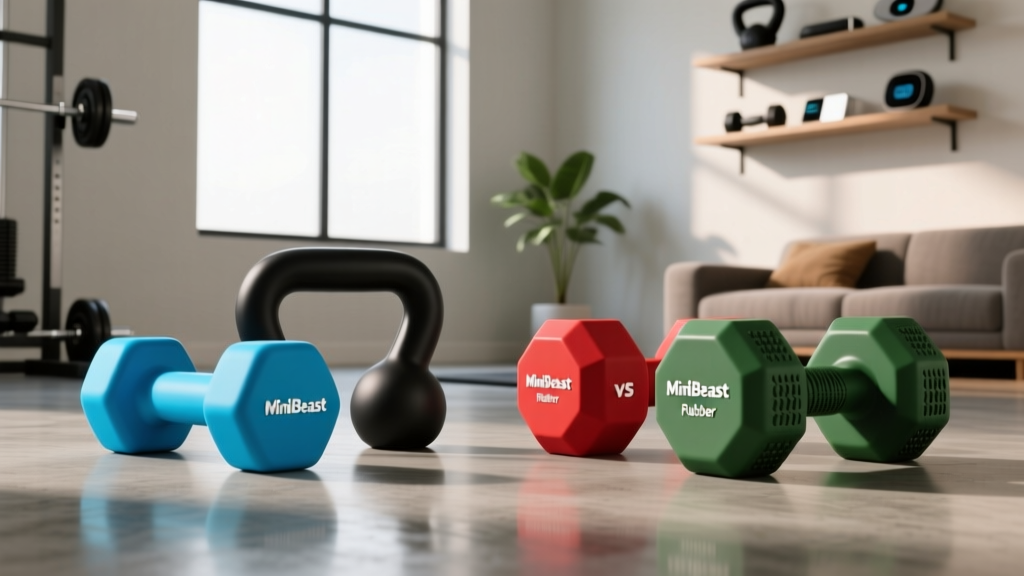
2026 Market Analysis: MiniBeast Dumbbells vs Rubber Hex Trends
Explore the 2026 free weight market as MiniBeast dumbbells disrupt the industry. We analyze urethane vs. rubber hex dumbbells, pricing, and durability.

The 2026 Free Weight Landscape: Material Science Meets Market Demand
The fitness equipment market has undergone a radical transformation over the last few years, shifting away from budget-oriented, high-off-gassing materials toward premium, durable elastomers. As we navigate the 2026 fitness equipment cycle, the debate between traditional rubber hex dumbbells and premium urethane alternatives has never been more relevant. Commercial gym owners and high-end home gym builders are increasingly scrutinizing the total cost of ownership, indoor air quality, and long-term durability of their free weight investments.
According to recent data from Grand View Research’s Fitness Equipment Market Report, the demand for premium home and commercial gym equipment has grown at a CAGR of 7.4% since 2023, driven largely by consumer awareness of material safety and equipment longevity. At the center of this market disruption are direct-to-consumer (DTC) brands like MiniBeast dumbbells, which are aggressively challenging legacy rubber hex manufacturers by offering commercial-grade urethane at mid-tier price points. This trend report breaks down the material science, market economics, and real-world failure modes defining the rubber hex versus urethane dumbbell debate in 2026.
The Material Divide: Vulcanized Rubber vs. Polyurethane Elastomers
To understand the market shift, we must first examine the manufacturing realities of both materials. Traditional rubber hex dumbbells are typically constructed using a cast iron core coated in recycled tire rubber crumb. This rubber is bound together using polyurethane-based adhesives and vulcanized under heat. While cost-effective, this process leaves the material porous, susceptible to UV degradation, and prone to retaining moisture and bacteria.
Urethane dumbbells, conversely, utilize a virgin polyurethane elastomer. The liquid polyurethane is injection-molded or hot-cast directly onto a steel or machined cast iron core. The resulting chemical cross-linking creates a non-porous, ultra-dense surface that is impervious to sweat, UV rays, and most cleaning chemicals. The difference in durometer (hardness) is stark: standard rubber hex dumbbells measure around 75A to 80A on the Shore A hardness scale, resulting in a ‘bouncy’ drop that can damage gym flooring. Premium urethane options measure between 88A and 92A, providing a ‘dead bounce’ that absorbs kinetic energy and protects both the dumbbell and the platform.
Off-Gassing and the Indoor Air Quality Mandate
One of the primary catalysts for the shift away from rubber hex dumbbells in 2026 is indoor air quality (IAQ). Recycled rubber is notorious for emitting Volatile Organic Compounds (VOCs), which create the pungent ‘tire smell’ associated with budget gym equipment. As residential building codes and commercial HVAC standards have tightened regarding VOC exposure, facility managers are actively purging rubber-coated weights in favor of odorless, virgin urethane alternatives.
| Feature | Standard Rubber Hex | Premium Urethane | MiniBeast DTC Urethane |
|---|---|---|---|
| Average Cost per Pound | $1.35 - $1.80 | $4.20 - $5.50 | $2.95 - $3.40 |
| Shore A Durometer | 75A - 80A (Bouncy) | 88A - 92A (Dead) | 90A (Optimized Dead) |
| VOC Off-Gassing | High (Requires airing out) | None (Odorless) | None (Odorless) |
| UV & Sweat Resistance | Poor (Degrades/Cracks) | Excellent | Excellent |
| Collar Attachment | Adhesive / Friction Fit | Press-Fit / Welded | Friction-Welded Steel |
The MiniBeast Dumbbells Disruption: Bridging the DTC Gap
Historically, gym owners faced a binary choice: buy cheap, high-maintenance rubber hex dumbbells from big-box retailers, or invest heavily in legacy commercial urethane brands like Rogue, Eleiko, or Ivanko, which often charge upwards of $5.00 per pound. In 2026, MiniBeast dumbbells have emerged as a critical market disruptor, leveraging a streamlined DTC supply chain to offer hot-cast urethane at approximately $3.15 per pound.
Industry watchdogs have taken note of this shift. As highlighted by market analysts at Club Industry, boutique fitness brands that bypass traditional wholesale distributors are capturing significant market share by offering commercial warranties directly to prosumers. MiniBeast’s current 2026 lineup features a proprietary 90A durometer urethane coating and a 32mm contoured, hard-chrome knurled handle. By eliminating the middleman and utilizing automated friction-welding for their steel collars, they have effectively neutralized the primary price barrier that previously kept urethane out of home gyms.
Market Insight Callout: The ‘Prosumer’ segment (home gym owners spending $5,000+ on equipment) is the fastest-growing demographic in the free weight sector. MiniBeast dumbbells are specifically engineered for this cohort, offering commercial aesthetics and drop-testing durability without the commercial freight shipping surcharges associated with palletized legacy brands.Failure Modes and Edge Cases: What the Warranties Don’t Tell You
When conducting a market analysis, it is crucial to look beyond the marketing copy and examine the actual mechanical failure modes of the equipment. Understanding how and why dumbbells break informs the true ROI of your purchase.
Rubber Hex Failure Modes
- Adhesive Degradation (Head Fly-Off): The most catastrophic failure of rubber hex dumbbells occurs at the collar. Because the rubber head is often glued to the steel handle, repeated drops cause micro-fractures in the adhesive bond. Over 12 to 18 months of heavy use, the head can separate entirely during a lift, posing a severe safety hazard.
- UV and Ozone Cracking: Recycled rubber lacks UV stabilizers. If placed near a window or in a garage gym with high ozone exposure, the rubber will dry rot, flake, and leave black residue on the user’s hands and flooring.
- Handle Spin-Out: Budget rubber hex dumbbells frequently use simple friction pins or low-grade bolts to secure the handle to the core. Under the torque of heavy pressing movements, these handles can loosen and spin, tearing calluses and compromising grip security.
Urethane and MiniBeast Edge Cases
- Cold-Weather Brittleness: While urethane is incredibly durable at room temperature, it undergoes a glass transition phase in extreme cold. If your garage gym drops below 32°F (0°C), urethane can become brittle and chip if dropped from shoulder height. Rubber hex, surprisingly, handles extreme cold slightly better due to its softer compound, though it remains prone to cracking.
- Cosmetic Scratching: High-durometer urethane (90A+) is resistant to tearing, but it can show superficial scuff marks when dragged across rough concrete or diamond-plate steel. This is purely cosmetic and does not affect structural integrity, but it is a consideration for pristine commercial facilities.
The 5-Year ROI Framework: Cost-Per-Pound Analysis
To accurately assess the market, we must calculate the 5-year Total Cost of Ownership (TCO) for a standard 5-50 lb dumbbell set (15 pairs, 825 total lbs).
- Rubber Hex TCO: Initial cost at $1.50/lb = $1,237.50. However, commercial and heavy home use typically necessitates replacing 10-15% of the set (usually the most frequently dropped weights like 25s and 35s) by year 3 due to head separation or severe cosmetic degradation. Factoring in replacement and disposal fees, the 5-year TCO rises to approximately $1,550.
- Legacy Urethane TCO: Initial cost at $4.80/lb = $3,960. Zero replacement costs over 5 years. TCO remains $3,960.
- MiniBeast DTC Urethane TCO: Initial cost at $3.15/lb = $2,598.75. Backed by a commercial-grade warranty and friction-welded collars, replacement costs are negligible. TCO remains $2,598.75.
The data clearly illustrates that while rubber hex dumbbells win the initial point-of-sale price war, the long-term financial and safety liabilities make them an inferior asset for serious lifters and facility owners. The emergence of DTC urethane brands has effectively collapsed the premium price barrier, making the upgrade mathematically sound for almost all buyers.
Final Market Verdict for Home and Commercial Gym Owners
The 2026 free weight market has definitively turned against recycled rubber hex dumbbells for indoor, high-use environments. The combination of VOC off-gassing, adhesive failure risks, and high long-term replacement costs renders them obsolete for anyone outside of temporary or outdoor fitness setups. Urethane remains the undisputed champion of durability, safety, and user experience.
For commercial gym owners outfitting large facilities, legacy urethane brands still offer the prestige and bulk-freight logistics required for massive deployments. However, for the rapidly expanding prosumer market, boutique studios, and high-end home gyms, MiniBeast dumbbells represent the most significant market disruption of the decade. By delivering 90A durometer urethane, precision-knurled handles, and welded collars at a DTC price point, they have fundamentally altered the ROI calculus of free weight procurement. If you are building or upgrading a gym in 2026, skipping the rubber hex aisle and investing in a modern urethane lineup is no longer a luxury—it is the baseline standard for safety and financial prudence.
More gear to consider
All reviews
Dumbbell to Barbell Bench Conversion: Squat vs Power Rack

Rack Maintenance for Safe Collar Bone Exercises with Dumbbells
Neoprene Dumbbell Guide: Lower Chest Workout With Dumbbells at Home

2026 Dumbbell Rack Market Trends for the Bent Over Two Dumbbell Row

Brian Shaw Dumbbell Grip vs Olympic Barbell Knurling Guide