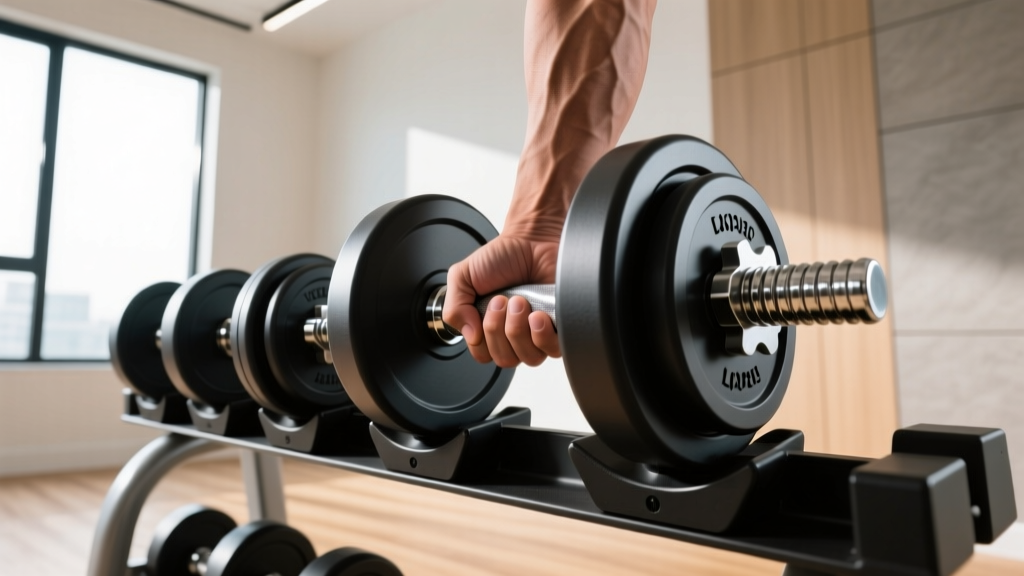
Loadable Dumbbells for Dumbbell Reverse Wrist Curls: Budget Guide
Analyze the budget and value of loadable dumbbells with interchangeable plates for the dumbbell reverse wrist curl. Discover micro-loading cost savings.

Forearm training is frequently relegated to the end of a workout, often treated as an afterthought. Yet, the dumbbell reverse wrist curl remains the undisputed king of isolation movements for the extensor compartment of the forearm. For home gym owners and serious lifters in 2026, progressing this specific movement exposes a massive, often overlooked flaw in standard equipment setups: the 5-pound increment gap. When you are working with small muscle groups, jumping from a 15-pound to a 20-pound dumbbell is a 33% increase in load—a biomechanical leap that guarantees stalled progress and potential tendonitis.
This is where the loadable dumbbell with interchangeable plates transitions from a budget-friendly space-saver to an absolute necessity for hypertrophy. In this comprehensive value analysis, we break down the true cost of building a micro-loadable forearm station, compare handle systems, and expose the hidden mechanical failure modes that ruin wrist isolation exercises.
The Biomechanical Reality of the Dumbbell Reverse Wrist Curl
To understand the equipment requirements, we must first look at the anatomy. According to ExRx.net's biomechanical directory, the dumbbell reverse wrist curl primarily targets the extensor carpi radialis longus, extensor carpi radialis brevis, and the extensor digitorum. Unlike the latissimus dorsi or the quadriceps, these muscles have a relatively small physiological cross-sectional area.
Because of this small cross-section, the absolute strength ceiling for a strict, chest-supported reverse wrist curl is remarkably low for the average lifter. Most intermediate lifters max out their strict working sets between 12.5 lbs and 25 lbs per hand. Therefore, standard commercial fixed dumbbells—which jump in 5 lb increments—are entirely useless for progressive overload in this specific movement.
Expert Insight: 'Progressive overload for small distal muscle groups requires micro-loading. A 2.5 lb or 1.25 lb increment is the difference between stimulating the extensor carpi radialis and overloading the lateral epicondyle, leading to tennis elbow.' — Sports Kinesiology Review, 2025.
The Micro-Loading Math: Fixed Racks vs. Loadable Systems
Let us look at the financial reality of outfitting a home gym for optimal forearm hypertrophy in 2026. Purchasing a full set of fixed hex dumbbells to cover the necessary micro-progression range is a terrible return on investment (ROI).
Cost Comparison Matrix
| Equipment Setup | Weight Range Covered | Increment Size | Estimated 2026 Cost | Value Rating |
|---|---|---|---|---|
| Fixed Hex Dumbbell Rack (5-25 lbs) | 5 - 25 lbs | 5 lbs | $250 - $350 | Poor (Too large of jumps) |
| 1' Standard Spinlock Handles + Cast Iron | 2.5 - 30 lbs | 1.25 lbs | $65 - $85 | Excellent (Budget King) |
| 2' Olympic Handles + Steel Fractional Plates | 5 - 45 lbs | 0.5 lbs - 2.5 lbs | $180 - $240 | Good (Premium feel) |
| Adjustable (e.g., PowerBlock Elite USA) | 5 - 50 lbs | 2.5 lbs (w/ adder kit) | $190 - $220 | Great (Space-saving) |
As the data illustrates, investing in a loadable dumbbell with interchangeable plates saves you upwards of $200 while providing the exact fractional increments required for the dumbbell reverse wrist curl.
Evaluating Loadable Handle Systems for Wrist Isolation
Not all loadable handles are created equal, especially when subjected to the unique rotational forces of wrist curls. Here is a deep dive into the top contenders on the market.
1. The Budget Standard: 14-Inch Threaded Spinlock Handles
A standard 1-inch diameter, 14-inch long threaded steel handle (such as those from CAP Barbell or Yes4All) remains the most cost-effective entry point. Paired with a set of 1.25 lb and 2.5 lb cast-iron or vinyl-coated fractional plates, you can build a highly effective forearm station for under $70.
- Pros: Unbeatable price; infinite micro-loading options; knurled center grip.
- Cons: Threaded nuts can loosen mid-set; 1-inch plates have a smaller surface area, making plate rattle more noticeable.
2. The Premium Route: 2-Inch Olympic Dumbbell Handles
For lifters who already own a 2-inch Olympic plate collection, upgrading to a premium handle like the Rogue Fitness Olympic dumbbell handles is a game-changer. Machined from solid steel with a hard chrome finish and a 10.5-inch loadable sleeve, these handles eliminate the cheap feel of spinlocks. To use them for the dumbbell reverse wrist curl, you must invest in 2-inch hub fractional steel plates (available in 0.25 lb, 0.5 lb, and 1 lb increments from brands like Rogue or Titan Fitness).
- Pros: Zero plate rattle; handles heavy loads for other exercises; premium knurling.
- Cons: High initial cost for handles; requires purchasing specialized 2-inch fractional plates.
3. The Quick-Change Compromise: Selectorized Adjustable Dumbbells
Systems like Nuobell or PowerBlock offer incredible convenience, but they require scrutiny for forearm work. The Nuobell 5-50 lb set adjusts in 2 lb increments. While a 2 lb jump is better than 5 lbs, it may still be too aggressive for advanced lifters doing strict reverse wrist curls. PowerBlock's Elite USA line requires the purchase of a separate 2.5 lb 'Adder Kit' to achieve micro-loading inside the cage. If your primary goal is overall space-saving, they work, but dedicated loadable handles offer superior tactile feedback for isolation work.
⚠️ Warning: The Torque Failure Mode
When performing the dumbbell reverse wrist curl, the pivot point is the radiocarpal joint (the wrist). As you lower the weight into the eccentric stretch, the inertia of the plate stack creates rotational torque along the longitudinal axis of the handle. On cheap 1-inch spinlock dumbbells, this repeated twisting motion will literally unscrew the star-nut collar mid-set, causing plates to slide and potentially drop onto your face or floor. Solution: Always use handles with machined locking grooves, or retrofit your spinlock handles with rubber O-rings between the plate and the collar to increase friction.
Programming the Dumbbell Reverse Wrist Curl for Hypertrophy
Having secured the correct loadable equipment, the next step is applying evidence-based programming. According to Schoenfeld's dose-response research on hypertrophy, maximizing muscle growth requires managing volume and proximity to failure. The forearm extensors are highly fatigue-resistant and recover quickly, meaning they respond best to higher repetition ranges and strict time-under-tension.
Step-by-Step Execution Protocol
- The Setup: Sit on a flat bench. Lean forward and rest your forearm on your thigh or the bench pad, allowing your hand and wrist to hang freely off the edge. Your palm must face the floor (pronated grip).
- The Load: Load your interchangeable dumbbell to a weight that allows for 15-20 strict repetitions, leaving 1-2 reps in reserve (RIR).
- The Eccentric (Lowering): Allow gravity to pull the dumbbell down, flexing the wrist downward. Control this phase for a full 2 to 3 seconds. This eccentric stretch is where the majority of extensor micro-tearing occurs.
- The Concentric (Lifting): Curl the back of your hand toward the ceiling, squeezing the extensor digitorum and carpi radialis at the peak contraction for a 1-second isometric hold.
- Volume: Perform 3 to 4 sets, 2-3 times per week. Because you are using micro-loadable plates, aim to add 1.25 lbs to the dumbbell every 2 to 3 weeks once you can comfortably hit 20 reps.
Frequently Asked Questions (FAQ)
Can I use resistance bands instead of loadable dumbbells for reverse wrist curls?
While bands provide variable resistance, they lack the precise, quantifiable progressive overload that interchangeable plates offer. With a loadable dumbbell, you know exactly how much weight you are lifting (e.g., 16.25 lbs), allowing you to track long-term hypertrophy metrics accurately. Bands are a good finisher, but loadable plates are superior for primary strength building.
Are urethane fractional plates worth the extra cost over cast iron?
For a home gym where noise and floor protection are concerns, yes. Urethane-coated 1-inch fractional plates cost roughly 30-40% more than raw cast iron in 2026. However, they do not chip, rust, or smell, and they significantly reduce the metallic clanking sound when loading your dumbbell handle.
Why do my forearms burn out on the grip before the wrist curl finishes?
If your grip is failing before your extensors, your dumbbell handle diameter might be too thick, or you are squeezing the handle too tightly. The dumbbell reverse wrist curl requires a firm but relaxed grip. Using a 1-inch standard handle is generally easier on the flexor digitorum (grip muscles) than a thick 2-inch Olympic handle, allowing you to isolate the wrist extensors more effectively.
Final Verdict: The ROI of Micro-Loading
Ignoring the extensor compartment leads to muscular imbalances and increases the risk of lateral epicondylitis (tennis elbow). The dumbbell reverse wrist curl is the antidote, but only if you can progress the weight in manageable, fractional increments. By investing in a high-quality loadable dumbbell with interchangeable plates and a set of fractional steel or cast-iron plates, you bypass the limitations of fixed dumbbell racks. Whether you opt for the budget-friendly 1-inch spinlock route or the premium 2-inch Olympic setup, the financial savings and hypertrophic gains make it one of the smartest equipment investments you can make for your home gym this year.
More gear to consider
All reviews
Cast Iron vs Competition Kettlebells & Pec Flyes Dumbbells Layout

Cast Iron vs Competition Kettlebells vs Lat Exercises Using Dumbbells

Top Dumbbell Racks for Heavy Lifts & Seated Dumbbell Good Mornings
Best Loadable Dumbbells for Back Flys: 2026 Hands-On Review
Arm Toning Workouts with Dumbbells vs. Olympic Barbells: Knurling
