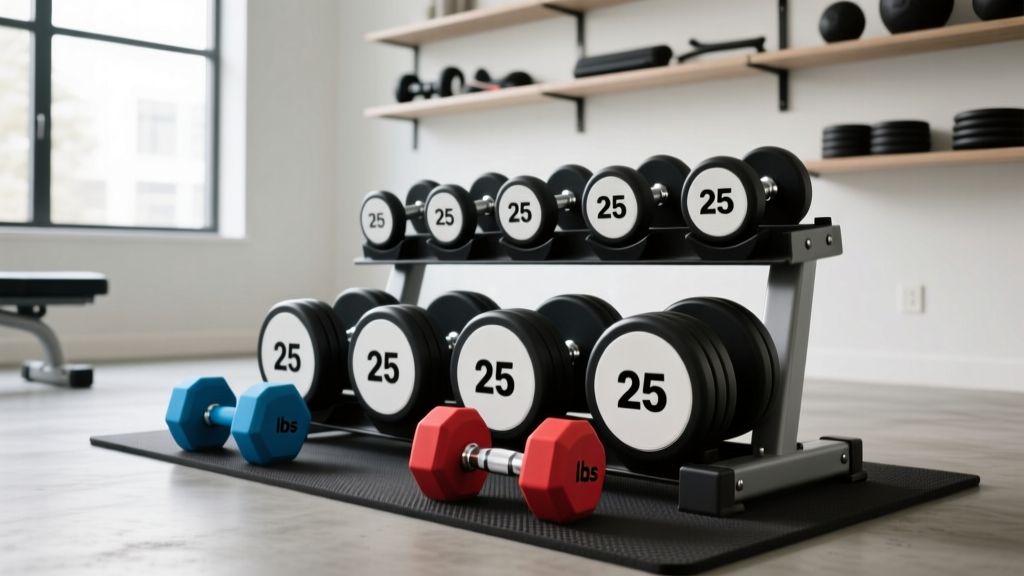
Good Shoulder Exercises With Dumbbells: Loadable Plate Layouts
Discover how to perform good shoulder exercises with dumbbells using loadable plate systems while optimizing your home gym layout and saving space.

The Spatial Dilemma: Loadable Dumbbells in Compact Home Gyms
Designing an efficient home gym layout requires balancing equipment versatility with strict spatial limitations. When athletes prioritize deltoid development, they often seek out good shoulder exercises with dumbbells to target the anterior, lateral, and posterior heads. However, traditional fixed-weight dumbbell racks consume massive amounts of linear wall space—often requiring 6 to 8 feet of horizontal racking for a complete 5lb to 50lb set. Enter the loadable dumbbell with interchangeable plates. While systems like spin-lock handles or modular selectorized blocks drastically reduce the overall footprint of your weight storage, they introduce unique spatial and biomechanical challenges during overhead and lateral movements.
In 2026, the market for plate-loaded and modular adjustable dumbbells has matured, offering robust solutions for garage gyms and spare-bedroom setups alike. But optimizing your layout isn't just about where you store the plates; it is about calculating the dynamic clearance required for safe, effective shoulder training. This guide breaks down the exact spatial requirements, equipment specifications, and layout frameworks needed to master shoulder training with interchangeable plate systems.
Footprint Analysis: Storing Interchangeable Plates
Before mapping out your lifting zone, you must account for the static storage footprint of your loadable dumbbell system. Unlike selectorized dumbbells (which house all weights inside a single cradle), traditional plate-loaded handles require separate shelving or floor racks for the interchangeable plates.
| Equipment Type | Handle Length | Plate Storage Footprint (5-50 lbs) | Total Static Space Required |
|---|---|---|---|
| Standard 1' Spin-Lock (e.g., Yes4All) | 14 inches | 24' W x 10' D x 12' H (Shelved) | ~3.5 sq. ft. |
| Olympic 2' Loadable (e.g., Titan) | 20 inches | 30' W x 14' D x 15' H (Shelved) | ~5.2 sq. ft. |
| Modular Block (e.g., PowerBlock Elite) | 12 inches | Integrated / Expansion Kits (Stacked) | ~1.1 sq. ft. |
For a dedicated shoulder-training zone, the 1-inch standard spin-lock system remains the most cost-effective route in 2026, typically priced between $45 and $65 for handles and a basic 40lb plate kit. However, as the table illustrates, you must allocate dedicated shelving space to prevent plates from cluttering your lifting platform.
Biomechanics & Layout: Positioning for Shoulder Exercises
Executing good shoulder exercises with dumbbells safely requires precise spatial awareness, particularly when dealing with the shifting center of gravity inherent to plate-loaded handles. According to the biomechanical databases maintained by ExRx.net, the shoulder joint (glenohumeral joint) operates through a highly complex range of motion, demanding strict stabilization. When your layout forces you to compromise your stance or bench position, you risk impingement and rotator cuff strain.
1. The Standing Overhead Press: Vertical & Lateral Clearance
The standing overhead press is a cornerstone movement for anterior deltoid mass. When using loadable dumbbells, the physical length of the handle (often 14 inches) plus the loaded plates (up to 10 inches in diameter for a 25lb cast-iron plate) creates a wide lateral profile.
- Ceiling Height Requirement: A 6-foot-tall lifter pressing a 14-inch dumbbell requires a minimum ceiling clearance of 8 feet 4 inches. If your basement gym has drop ceilings or exposed HVAC ducts, map your pressing zone away from obstructions.
- Lateral Clearance: Stand at least 24 inches away from your plate storage rack. If you fail a rep and need to drop the dumbbells, the cast-iron plates will scatter. Position your lifting zone over 3/4-inch thick vulcanized rubber mats to protect both the concrete subfloor and the iron plates.
2. Seated Lateral Raises: Bench Placement Strategy
Seated lateral raises isolate the medial deltoid by eliminating leg drive. To optimize space, many lifters use an adjustable utility bench (typically 45 inches long and 20 inches wide). When placing the bench in your layout, ensure a 36-inch radial clearance on both the left and right sides. Loadable dumbbells can become unbalanced if plates are improperly tightened, and hitting a nearby wall or power rack during the eccentric phase of a lateral raise can cause severe shoulder trauma.
Equipment Deep Dive: 2026 Loadable Dumbbell Market
Choosing the right interchangeable plate system dictates how fluidly you can transition between exercises. Supersets—such as pairing a heavy seated Arnold press with high-rep rear delt flyes—require rapid weight changes. Here is how the top loadable systems perform in a space-optimized layout:
Yes4All 1-Inch Cast Iron Spin-Lock
Price: ~$55 (Handles + 40lb kit)
The Good: Extremely compact handles when unloaded; plates can be stacked tightly on a standard wire rack.
The Edge Case: The traditional star-nut collar requires 10-15 seconds to thread and tighten per side. This completely destroys the pacing of a superset. Pro-Tip: Swap the factory star-nuts for 1-inch HG-2 spring collars to reduce changeover time to 2 seconds.
PowerBlock Elite USA (Modular System)
Price: ~$375 (Base 5-50lb set)
The Good: While technically a selectorized dumbbell, the Elite series uses interchangeable internal add-on kits (expanding from 50 to 70, and up to 90 lbs). The blocky, cage-like design keeps the weight perfectly balanced, making it vastly superior for strict lateral raises where handle wobble can irritate the elbow.
The Edge Case: The rectangular cage restricts wrist supination. Exercises like the Arnold Press require you to start with a neutral grip, which slightly alters the traditional biomechanics of the movement.
Safety Callout: Collar Slippage & Plate Rattle
Warning: Eccentric Loading Hazards
When performing good shoulder exercises with dumbbells—specifically rear delt flyes and lateral raises—the dumbbell experiences high lateral torque. If you are using standard spin-lock collars on a smooth 1-inch chrome sleeve, the vibration from plate rattle can slowly back the collar off the threads. A loose 10lb plate sliding 3 inches outward mid-rep shifts the center of gravity, instantly placing uneven shear force on the rotator cuff. Always use rubber-coated cast iron plates to minimize rattle, and inspect collar tightness before every single set. For comprehensive guidelines on avoiding rotator cuff injuries during overhead and lateral movements, refer to the clinical overviews provided by the Mayo Clinic.
Designing Your 50-Square-Foot Shoulder Zone
If you are dedicating a specific corner of your garage or spare room to upper-body training, a 50-square-foot zone (e.g., 10ft x 5ft) is the optimal footprint for loadable dumbbell shoulder work. Here is the exact layout blueprint:
- The Back Wall (Storage): Mount a 4-tier heavy-duty wire shelving unit (18 inches deep). Dedicate the bottom two tiers to your 1-inch interchangeable plates, organized by weight (2.5s and 5s on top, 10s and 25s on the bottom to lower the center of gravity). Reserve the top tier for the empty dumbbell handles.
- The Center (The Lifting Platform): Place a 4ft x 6ft rubber mat directly in the center. This provides 2 feet of clearance on all sides for a standard utility bench.
- The Perimeter (Mirror & Feedback): Mount a shatterproof acrylic gym mirror on the adjacent side wall. Because loadable dumbbells can feel slightly more unwieldy than perfectly balanced urethane hex dumbbells, visual feedback is critical to ensure your humerus stays in the scapular plane (roughly 30 degrees forward) during lateral raises, a position highly recommended by physical therapists to prevent shoulder impingement syndrome.
Frequently Asked Questions
Can I use bumper plates on loadable dumbbell handles?
Standard 1-inch dumbbell handles do not accommodate 2-inch Olympic bumper plates. While 1-inch 'crumb' or rubber grip plates exist, they are typically limited to 10lbs or 12lbs per plate. For shoulder work, where micro-loading (2.5lb increments) is vital for progressive overload on small muscle groups like the lateral deltoid, standard machined cast-iron plates remain the superior choice.
How do I prevent floor damage when dropping loadable dumbbells?
Cast iron plates will chip and crack your concrete subfloor if dropped from shoulder height. If your layout does not permit a dedicated dropping zone with 2-inch thick drop pads, you must commit to controlling the eccentric (lowering) phase of every rep. This not only protects your floor but also increases time-under-tension for superior muscle hypertrophy.
Are loadable dumbbells better than adjustable selectorized dumbbells for shoulder rehab?
For rehab and physical therapy, traditional spin-lock loadable dumbbells are often preferred over bulky selectorized blocks. The slim profile of a bare 1-inch handle allows for a more natural wrist position during internal and external rotation exercises, whereas the wide cages of selectorized dumbbells can force the wrist into awkward ulnar deviation.
More gear to consider
All reviews
Beyond the Dumbbell Sketch: Bumper vs Iron Plate Value Analysis
Optimizing Gym Space: Rubber Hex vs Urethane & 1lb Dumbbell Storage

Rubber Hex vs Urethane: Testing the Bent Arm Dumbbell Pullover
Best Neoprene Dumbbells for the Dumbbell French Press (2026)
Power Rack vs Squat Rack vs Squat Stand: Beyond 3D Printed Dumbbells
