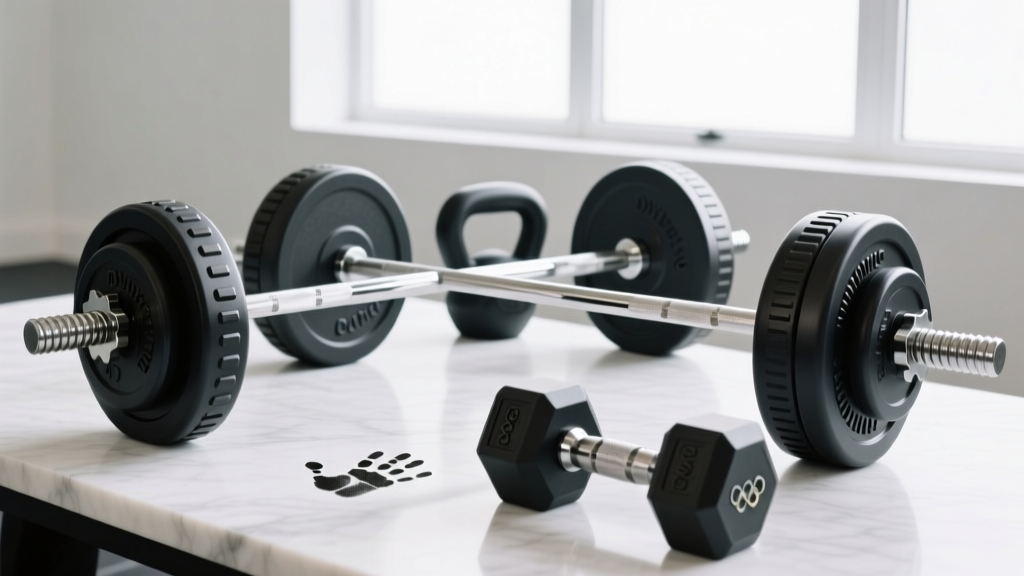
Loadable Dumbbells for Dumbbell Straight Leg Deadlifts: 2026 Trends
Discover why loadable dumbbells with interchangeable plates are dominating the 2026 market for heavy dumbbell straight leg deadlifts and posterior chain work.

The home gym landscape in 2026 has seen a massive shift toward specialized posterior chain training. As lifters move away from generic full-body circuits and toward targeted hypertrophy and strength blocks, the demand for heavy, unilateral hinge movements has skyrocketed. Specifically, dumbbell straight leg deadlifts (often used interchangeably with stiff-leg or Romanian deadlift variations) have become a staple for hamstring and glute development. However, this trend has exposed a critical flaw in standard home gym equipment: traditional fixed hex dumbbells and dial-adjustable models simply cannot support the biomechanical and loading demands of heavy hinge patterns. Enter the market's fastest-growing equipment category: the loadable dumbbell with interchangeable plates.
The Biomechanical Bottleneck of Heavy Hinge Movements
When executing dumbbell straight leg deadlifts, the weight must travel down the midline of the leg, often passing well below the knee to achieve a full hamstring stretch. This movement pattern creates unique spatial and mechanical challenges that standard dumbbells fail to address:
- Clearance Issues: Fixed rubber hex dumbbells over 70 lbs feature massive, bulky heads. When lowered past the knee, the dumbbell heads collide with the thighs, artificially limiting the range of motion and ruining the eccentric stretch.
- Rotational Torque: During the lowering phase of the straight leg deadlift, the weight naturally wants to rotate. Dial-adjustable dumbbells (like the Bowflex 552 or Nuobell) utilize fragile internal mechanisms and plastic housings that degrade rapidly under heavy rotational torque.
- Handle Length Limitations: To load a dumbbell past 100 lbs using standard 1-inch iron plates, you need a handle length of at least 16 inches. Most standard threaded handles max out at 12 to 14 inches, capping your weight at roughly 60 lbs per hand.
According to biomechanical analyses detailed by BarBend, maximizing the eccentric stretch is the primary driver of hypertrophy in straight-leg variations. If your equipment limits your depth due to bulky heads or short handles, you are leaving significant muscle-building stimulus on the table.
2026 Market Analysis: Top Loadable Dumbbell Systems
The market for loadable dumbbell handles has bifurcated into two distinct categories: Olympic (2-inch sleeve) handles and heavy-duty standard (1-inch) threaded handles. Here is how the top contenders stack up for serious lifters this year.
1. Rogue Fitness Loadable Dumbbell Handle (The Premium Standard)
Rogue's loadable handle remains the gold standard for commercial and high-end home gyms. Machined from solid steel, it features a 16.5-inch overall length with a 35mm shaft diameter. Unlike Olympic sleeves, the Rogue utilizes a proprietary 1-inch friction-fit system designed specifically for their Urethane and Echo plates.
- Max Capacity: 115 lbs per dumbbell (using Rogue Urethane plates)
- Price Point: $195.00 per handle (excluding plates)
- Best For: Lifters who prioritize aggressive knurling and zero sleeve rattle.
2. Titan Fitness Olympic Loadable Dumbbell Handle (The Budget Workhorse)
For lifters who already own a massive collection of 2-inch Olympic bumper plates, the Titan Olympic Loadable Handle is the most cost-effective bridge to heavy dumbbell straight leg deadlifts. The 2026 iteration features improved snap-ring collars and a rotating sleeve to mitigate wrist strain during heavy eccentrics.
- Max Capacity: 200+ lbs per dumbbell (sleeve length accommodates multiple 45-lb bumpers)
- Price Point: $89.99 per handle
- Best For: Powerlifters and strongman athletes utilizing existing Olympic plate inventories.
3. CAP Barbell 16-Inch Solid Threaded Handle (The Traditionalist)
If you prefer traditional cast-iron standard plates, the CAP 16-inch solid steel handle is a high-volume seller. It features deep diamond knurling and includes heavy-duty cast-iron star collars to prevent plates from unscrewing mid-set.
- Max Capacity: ~90 lbs per dumbbell (depending on plate diameter)
- Price Point: $34.99 per handle
- Best For: Budget-conscious home gyms utilizing standard 1-inch cast iron.
Equipment Comparison Matrix for Hinge Movements
How do loadable systems compare to traditional options specifically for dumbbell straight leg deadlifts? The data below highlights the clear advantage of interchangeable plate systems.
| Dumbbell Type | Max Weight (Per Hand) | Thigh Clearance | Rotational Durability | Avg. Cost Per Pound |
|---|---|---|---|---|
| Fixed Hex Rubber | 150 lbs | Poor (Bulky Heads) | Excellent (Solid Cast) | $2.00 - $3.50 |
| Dial-Adjustable (e.g., Nuobell) | 80 lbs | Good (Compact) | Poor (Plastic Gears) | $4.50 - $5.00 |
| Olympic Loadable Handle | 200+ lbs | Excellent (Narrow Sleeves) | Excellent (Bushings/Bearings) | $1.50 - $2.50 |
| Standard Threaded Loadable | 100 lbs | Moderate | Moderate (Star Collars) | $1.20 - $1.80 |
The Economics of Interchangeable Plates vs. Fixed Sets
From a financial perspective, outfitting a home gym for heavy posterior chain work heavily favors the loadable dumbbell with interchangeable plates. To perform progressive overload on dumbbell straight leg deadlifts, a lifter will quickly exceed the 50 to 70 lb range. Purchasing fixed dumbbells in 5-lb increments from 50 lbs to 100 lbs requires 11 pairs. At an average 2026 market rate of $2.50 per pound, a complete set costs upwards of $1,925, not including a $300 storage rack.
Conversely, purchasing a pair of Titan Olympic Loadable Handles ($180 total) and 200 lbs of calibrated steel or economy bumper plates ($300 to $500) yields a total investment of under $700. Furthermore, the interchangeable plates can be repurposed for barbells, lunges, and goblet squats, offering a vastly superior return on investment.
Technical Deep Dive: Grip Diameter and Sleeve Tolerances
When selecting a loadable handle for straight leg deadlifts, grip diameter is a frequently overlooked variable that directly impacts grip fatigue. The ExRx exercise database notes that grip strength is often the limiting factor in stiff-leg and Romanian deadlift variations, rather than hamstring capacity.
Expert Insight: The 35mm vs. 50mm Grip Dilemma
Olympic loadable handles feature a 50mm (2-inch) sleeve where the plates rest, but the grip shaft usually tapers down to 35mm or 40mm. Handles that fail to taper, leaving a 50mm grip, will exhaust your forearms before your hamstrings reach failure. Conversely, standard 1-inch handles often feature a 28mm to 30mm grip. While easier to hold, ultra-thin handles concentrate the pressure into a smaller surface area on the palm, causing severe skin tearing and callus ripping when loading past 80 lbs per hand. A 32mm to 35mm shaft with medium-depth volcanic knurling is the optimal specification for heavy hinge movements.
Additionally, sleeve tolerance—the microscopic gap between the plate hole and the dumbbell sleeve—dictates how much the plates will 'clank' and shift during the exercise. Premium handles like those from Rogue Fitness utilize machined tolerances of less than 0.5mm, ensuring the weight acts as a single, cohesive unit rather than a shifting mass of iron that pulls your wrists out of alignment at the bottom of the stretch.
Safety Protocols and Failure Modes
Using a loadable dumbbell with interchangeable plates introduces a unique failure mode not present in fixed dumbbells: collar slippage. During the eccentric phase of dumbbell straight leg deadlifts, the plates experience downward momentum. If the collar is not properly secured, the plates will slide outward, shifting the center of gravity and potentially causing a severe wrist or lower back injury.
⚠️ Critical Safety Warning for Loadable Systems
Never use basic spring collars on loadable dumbbell handles for hinge movements. The lateral force generated when the dumbbell changes direction at the bottom of the stretch can easily compress a spring collar, allowing plates to slide off. Always use heavy-duty locking jaw collars (such as Rogue HG Collars or Titan Lock-Jaws) or threaded star collars tightened with a wrench. Furthermore, always perform heavy straight leg deadlifts inside a power rack with safety pins set just below your lowest range of motion.
Future Forecast: What is Next for Loadable Systems?
As we look toward the latter half of 2026 and beyond, the market is trending toward hybrid loadable systems. Manufacturers are beginning to introduce quick-change magnetic collars specifically designed for dumbbell sleeves, eliminating the tedious process of screwing on star collars or squeezing heavy jaw collars between sets. Additionally, we are seeing a rise in 'fractional' interchangeable micro-plates (0.5 lb and 1.25 lb increments) tailored specifically for loadable dumbbells, acknowledging that unilateral hinge movements require much smaller progressive overload jumps than bilateral barbell deadlifts.
Ultimately, if your training program prioritizes heavy, deep-stretch posterior chain work, abandoning fixed and dial-adjustable dumbbells in favor of a high-quality loadable dumbbell with interchangeable plates is the most biomechanically sound and economically efficient equipment decision you can make this year.
More gear to consider
All reviews
Olympic vs Standard Plates + Chest Workout With Dumbbells No Bench

Rubber Hex vs Urethane: Storage & Dumbbell Bench Press Calculator

Reverse Pec Deck with Dumbbells Setup & Adjustable Dumbbell Comparison
Slight Incline Dumbbell Press Mistakes & Olympic vs Standard Plates
How to Spot Dumbbell Chest Press & Choose Olympic vs Standard Plates