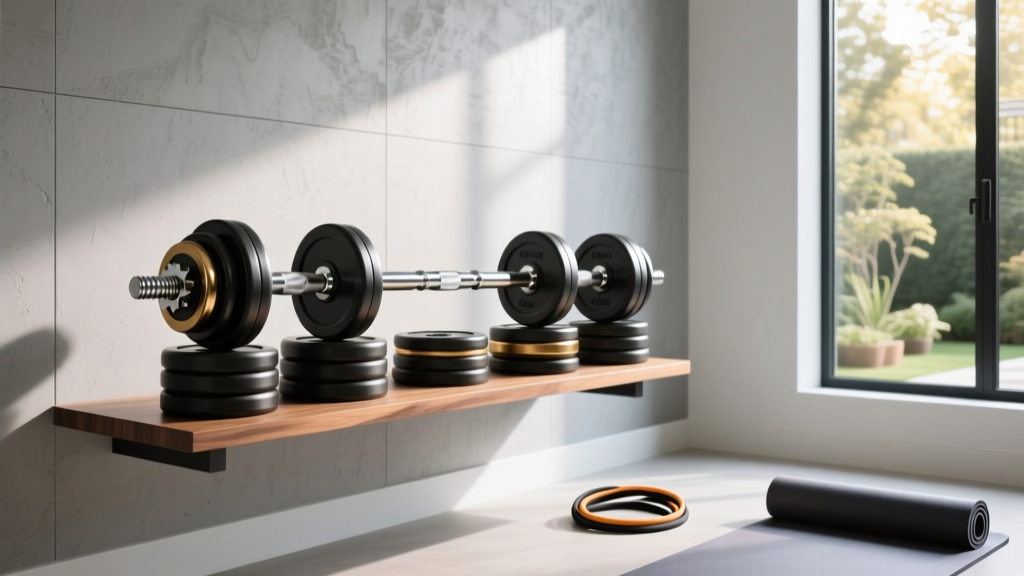
Loadable Dumbbells for the Dumbbell Box Squat: 2026 Budget Guide
Discover how loadable dumbbells with interchangeable plates offer a budget-friendly alternative to fixed weights for heavy dumbbell box squat training.

The Economics of Heavy Unilateral Leg Training
Building a home gym capable of supporting heavy, progressive lower-body training often hits a massive financial wall when it comes to dumbbells. While a barbell and a power rack can facilitate heavy squats for under $500, replicating that intensity with fixed dumbbells is notoriously expensive. This is especially true for the dumbbell box squat, a movement that demands significant load to effectively target the quadriceps and glutes without the aid of a barbell's axial loading.
As we analyze the 2026 fitness equipment market, the 'fixed dumbbell tax' remains a primary barrier for home gym owners. Urethane-coated fixed dumbbells currently average between $3.50 and $5.00 per pound. To perform a challenging dumbbell box squat, most intermediate to advanced lifters require pairs ranging from 60 to 100 pounds. Purchasing a full set of fixed dumbbells to accommodate progressive overload can easily exceed $3,000. Enter the loadable dumbbell with interchangeable plates: a highly modular, budget-friendly alternative that requires careful planning to execute safely and effectively.
2026 Cost Matrix: Fixed vs. Loadable Systems
To understand the true value of loadable handles, we must break down the cost-per-pound and total investment required to reach a working weight of 80 pounds per hand (160 pounds total). The following matrix compares commercial-grade fixed dumbbells against standard 1-inch and Olympic 2-inch loadable systems.
| Equipment Type | Avg. Cost per Pound | Total Cost (Pair of 80s) | Space Footprint |
|---|---|---|---|
| Urethane Fixed Dumbbells | $4.00 / lb | $640.00 | High (Requires Rack) |
| Standard 1' Loadable + Cast Iron | $1.65 / lb | $264.00 | Low (Stackable Plates) |
| Olympic 2' Loadable + Bumpers | $3.20 / lb | $512.00 | Medium |
As the data illustrates, utilizing a standard 1-inch loadable handle paired with cast iron plates cuts the cost of heavy dumbbell training by nearly 60%. However, the cheapest option is not always the most viable for dynamic movements like the box squat, which introduces unique biomechanical and mechanical stresses.
Biomechanics and the Dumbbell Box Squat
The dumbbell box squat differs significantly from its barbell counterpart. By holding the weight at arm's length or racked at the shoulders, the lifter alters their center of mass, demanding intense core stabilization and grip strength. According to ExRx.net's kinesiology breakdown of the dumbbell squat, the movement heavily targets the quadriceps and gluteus maximus while requiring significant isometric contraction from the forearm flexors and trapezius.
When performing the box squat variation, the eccentric phase concludes with a dead stop on the box, eliminating the stretch reflex. This requires pure concentric power to drive back up. If your loadable dumbbell collars are not secured properly, the impact of sitting on the box can cause plates to shift, rattle, or worse, slide off the sleeve mid-rep. Therefore, the structural integrity of your loadable handle is just as critical as the plates themselves.
Evaluating Loadable Handle Architectures
Not all loadable dumbbells are created equal. The market is currently divided into two main categories:
- Standard 1-Inch Handles (e.g., CAP Barbell 16-inch Solid Steel): Priced around $35 to $45 each, these are the budget kings. They feature a solid steel shaft and threaded sleeves with spinlock collars. The primary limitation is sleeve length; a 14-inch handle only offers about 3.5 inches of loadable space per side, severely capping your maximum weight.
- Olympic 2-Inch Handles (e.g., Rogue Loadable Dumbbell Handles 2.0): Priced between $150 and $195 per pair, these accept standard Olympic plates and utilize spring collars or lever-lock collars. As noted in the Rogue Fitness specifications, these handles feature aggressive knurling and longer sleeves, accommodating up to 45+ pounds per side depending on plate width.
Hidden Costs and Failure Modes of Loadable Systems
When budgeting for a loadable dumbbell setup, home gym owners frequently overlook the 'hidden friction' of plate management and mechanical failure modes. Here is what you must account for when building a set specifically for heavy lower-body work.
Warning: The Spinlock Slippage Hazard
Standard threaded spinlock collars are notorious for vibrating loose during high-impact or high-vibration exercises. When you drop into a heavy dumbbell box squat, the sudden deceleration upon hitting the box transfers kinetic energy through the handle. Over a set of 8 reps, this micro-vibration can back the spinlock nut off the threads by a quarter-inch. By the final rep, your plates may be sliding against each other, altering the balance of the dumbbell and risking a crushed toe or torn callus. Solution: Upgrade to 1-inch lever-lock collars or use a secondary rubber O-ring stopper beneath the spinlock nut.
The 'Sleeve Length' Bottleneck
The most common mathematical error in budget gym builds is buying cheap, small-diameter plates without calculating sleeve capacity. Let us break down the geometry of loading an 80-pound standard dumbbell:
- Handle Weight: A standard 16-inch solid steel handle weighs approximately 12 pounds.
- Target Load: 34 pounds of plates required per side.
- Plate Selection A (10lb Cast Iron): A standard 10lb plate is roughly 0.9 inches thick. You would need 3.5 plates per side (3.15 inches total). This leaves less than 0.5 inches for the collar, which is physically impossible to secure safely.
- Plate Selection B (25lb Cast Iron): A 25lb plate is roughly 1.3 inches thick. One 25lb plate and one 10lb plate equal 35 pounds and consume only 2.2 inches of sleeve space, leaving ample room for a secure collar.
Takeaway: To build heavy loadable dumbbells, you must invest in larger denomination plates (25lb and 45lb) to maximize sleeve real estate. Buying a cheap 100-pound set of 5lb and 10lb plates will leave you unable to load the handles past 50 pounds.
Step-by-Step Budget Build for a 100 lb Dumbbell Box Squat
If your goal is to safely execute the dumbbell box squat with 100 pounds per hand in 2026 without spending $800 on fixed urethane bells, follow this exact procurement strategy:
- Purchase 16-Inch or 18-Inch Standard Handles: Spend the extra $10 to get the longer sleeve length. Look for handles with deep, volcano-style knurling to prevent grip slip when your hands are sweaty from heavy leg work.
- Source Used Cast Iron: Check local marketplaces for vintage York or Ivanko cast iron plates. You can often find these for $1.00 to $1.25 per pound, drastically undercutting retail pricing.
- Buy Calibrated Steel Collars: Do not rely on the cheap plastic-coated spinlock nuts included with the handles. Purchase aftermarket aluminum star-lock or lever-lock collars designed for 1-inch bars ($25-$30 per pair).
- Invest in Chalk and Straps: Grip will fail before your quads do on the dumbbell box squat. Budget $15 for a block of magnesium carbonate chalk and $20 for heavy-duty lifting straps for your top working sets.
Final Verdict: Is the Loadable Route Worth the Friction?
Loadable dumbbells with interchangeable plates represent the undisputed champion of budget-friendly home gym leg training. While they lack the aesthetic appeal and instant adjustability of modern dial-system dumbbells or fixed urethane racks, the raw cost-per-pound is unbeatable. For the specific demands of the dumbbell box squat—where heavy loads, dead-stop mechanics, and grip endurance are paramount—a properly spec'd 16-inch loadable handle paired with large-diameter cast iron plates provides a safe, highly effective, and deeply economical solution. By respecting the mathematics of sleeve length and investing in secure collars, you can build a world-class lower-body arsenal for a fraction of the commercial price.
More gear to consider
All reviews
Olympic Barbell Setup: Weight, Knurling & Dumbbells Movie Myths

Best Dumbbell Racks for Weight Bench Dumbbell Exercises (2026)

Collar Types Compared: Safe Dumbbell Skull Crushers Workout
Kettlebell Care: Cast Iron vs Competition & the Dumbbell JM Press

Cast Iron vs Competition Kettlebells & Dumbbell Front Raises Muscles Worked
