
Layout Guide: Dumbbell Racks for the One Leg Dumbbell Deadlift
Maximize your home gym layout with space-saving dumbbell racks designed to provide full clearance for the one leg dumbbell deadlift and dynamic lifts.

The Biomechanical Footprint: Why Unilateral Hinges Dictate Gym Layout
When designing a functional home gym, most lifters focus on the footprint of their power rack or cardio machines. However, the true test of a space-optimized layout is how well it accommodates dynamic, full-range-of-motion movements. The one leg dumbbell deadlift (or single-leg Romanian deadlift) is a prime example. This unilateral hinge exercise demands significant posterior and lateral clearance, making the placement and profile of your dumbbell rack and storage solutions a critical safety and performance factor.
According to biomechanical analyses of unilateral training, the posterior sweep of the non-working leg during a deep single-leg hinge can extend up to 4.5 feet behind the lifter's center of gravity. When you factor in the forward reach of the torso and the dumbbells, the total kinetic envelope requires a minimum 6-foot by 6-foot unobstructed "drop zone." If your dumbbell storage is bulky, poorly positioned, or encroaches on this space, you risk clipping the rack during the eccentric phase, leading to compromised form or severe trip hazards.
Space Optimization Callout: The average traditional 3-tier dumbbell rack measures 48 inches long and 24 inches deep, consuming 8 square feet of floor space. In a standard 10x10 garage gym, this single piece of equipment eliminates nearly 10% of your usable training area, directly conflicting with the spatial demands of the one leg dumbbell deadlift.Space-Efficient Dumbbell Racks: 2026 Market Analysis
As of 2026, the fitness equipment industry has heavily pivoted toward verticality and wall-integration to solve the home gym space crisis. To maintain a pristine floor plan for balance-heavy movements, you must evaluate storage solutions based on their "floor-to-capacity" ratio. Below is an analysis of the top space-saving racks currently on the market, specifically evaluated for their compatibility with dynamic unilateral training zones.
| Rack Model | Footprint | Capacity | Est. Price | SLRDL Clearance Score |
|---|---|---|---|---|
| Titan Fitness Wall-Mounted 3-Tier | 0 sq ft (Floor) | 3 Pairs (up to 50 lbs) | $149 | 10/10 (Maximum) |
| Rogue Vertical Dumbbell Rack | 24" x 24" (4 sq ft) | 5-10 Pairs | $295 | 8/10 (High) |
| Rep Fitness 3-Tier (UR-1060) | 43" x 23" (6.8 sq ft) | 5-10 Pairs | $249 | 5/10 (Moderate) |
| Bells of Steel 2-Tier Compact | 31" x 22" (4.7 sq ft) | 4 Pairs | $179 | 7/10 (Good) |
Wall-Mounted vs. Vertical vs. Compact Tiered
Wall-Mounted Solutions: The Titan Fitness Wall-Mounted rack is the undisputed champion of floor preservation. By anchoring the storage to the wall studs, you reclaim 100% of the floor space beneath it. This allows you to perform a one leg dumbbell deadlift just inches from the wall (provided your head clearance is managed), as there is no base to trip over. The limitation is weight capacity; drywall anchors will fail, requiring direct stud mounting, and heavier 80+ lb dumbbells are generally unsupported on standard wall tiers.
Vertical Racks: The Rogue Vertical Dumbbell Rack utilizes a 24" x 24" base, making it ideal for "dead corners" of the gym where a traditional horizontal rack would block walkways. Because the center of gravity is stacked vertically, the footprint remains minimal, leaving the central 8x8 area of your gym completely open for the sweeping leg extensions required in unilateral deadlifts.
Designing the "Drop Zone": A Step-by-Step Layout Guide
To safely execute the one leg dumbbell deadlift without spatial anxiety, follow this layout protocol to engineer your training zone:
- Map the 6x6 Swing Radius: Stand in the center of your intended training zone. With a 45 lb dumbbell in hand, simulate the deepest part of the hinge. Measure from the tip of your extended rear foot to the front of the dumbbell. Add 18 inches of buffer space in all directions. This is your non-negotiable drop zone.
- Anchor Storage to the Lateral Perimeter: Never place a 3-tier rack directly behind the lifter's starting position. The rearward sweep of the non-working leg during the eccentric phase of the deadlift will inevitably collide with a 24-inch deep rack base. Push all horizontal storage to the lateral walls, at least 7 feet away from the center of the drop zone.
- Optimize Flooring Transitions: Spatial awareness is heavily influenced by proprioceptive feedback from the floor. According to research on unilateral versus bilateral training mechanics, stabilizing forces are paramount. Ensure your drop zone features uniform 3/4" vulcanized rubber matting. Avoid 1/2" interlocking foam tiles, as the compressive variance during the single-leg stance can throw off your vestibular balance, causing you to drift laterally into your equipment racks.
Real-World Failure Modes in Compact Home Gyms
Even with space-saving racks, improper layout execution leads to distinct failure modes during dynamic lifts:
- The Eccentric Heel-Clip: When fatigue sets in around rep 8 of a single-leg RDL, lifters lose spatial awareness. If a standard A-frame or 3-tier rack is positioned 3 feet behind the lifter, the sweeping heel catches the steel upright during the hinge, resulting in a sudden forward collapse and potential lower back strain.
- The Roll-Away Hazard: If you are using round dumbbells (often found in commercial-grade urethane sets) instead of hex dumbbells, a failed rep where the weight is dropped to the floor will result in the dumbbell rolling aggressively toward the base of your rack. If the rack lacks a solid base plate or retaining lips, the rolling weight can wedge under the rack, creating an invisible trip hazard for your next set.
- Mirror Proximity Illusions: Many home gyms place racks directly against mirrored walls to save space. While this looks expansive, performing a one leg dumbbell deadlift facing away from the mirror removes your visual feedback loop, while performing it facing the mirror limits your forward torso travel, artificially shortening your range of motion.
"In facility design, the clearance for dynamic, balance-dependent movements must be calculated based on the 95th percentile of the user's limb length plus the implement length. A static footprint measurement is entirely insufficient for exercises like the single-leg hinge, where the body acts as a dynamic seesaw."
— Principles of Strength and Conditioning Facility Layout, NSCA Guidelines
Frequently Asked Questions
Can I use kettlebells instead to save space during single-leg deadlifts?
Yes, kettlebells offer a slightly more compact storage profile (often utilizing simple vertical shelving or corner nests). However, the grip mechanics of a kettlebell single-leg deadlift differ from a dumbbell. The offset center of mass of a kettlebell requires greater grip strength and alters the wrist angle, which may not translate perfectly if your primary goal is barbell deadlift carryover. From a layout perspective, kettlebell storage still requires lateral clearance to avoid clipping the bell during the swing phase.
What is the minimum ceiling height required for this layout?
While the one leg dumbbell deadlift is a floor-based hinge and does not require overhead clearance, a truly optimized space must account for multi-directional movements. If your rack is positioned near the center of the room to save wall space, ensure a minimum ceiling height of 8 feet (96 inches). This allows you to transition seamlessly from floor-based hinges to standing overhead presses or dumbbell snatches without modifying your gym's layout or moving the heavy storage racks.
How do I secure a vertical rack to prevent tipping during heavy pickups?
Vertical racks like the Rogue model have a high center of gravity when fully loaded with 50+ lb dumbbells. When you aggressively pull a heavy dumbbell from the top tier, the lateral force can tip the rack if it is not secured. You must either bolt the 24" x 24" base plate directly into concrete using wedge anchors, or utilize L-brackets to tether the top of the rack to a wall stud. Never rely on the sheer weight of the dumbbells to keep the rack grounded in a tight space where bumping is inevitable.
More gear to consider
All reviews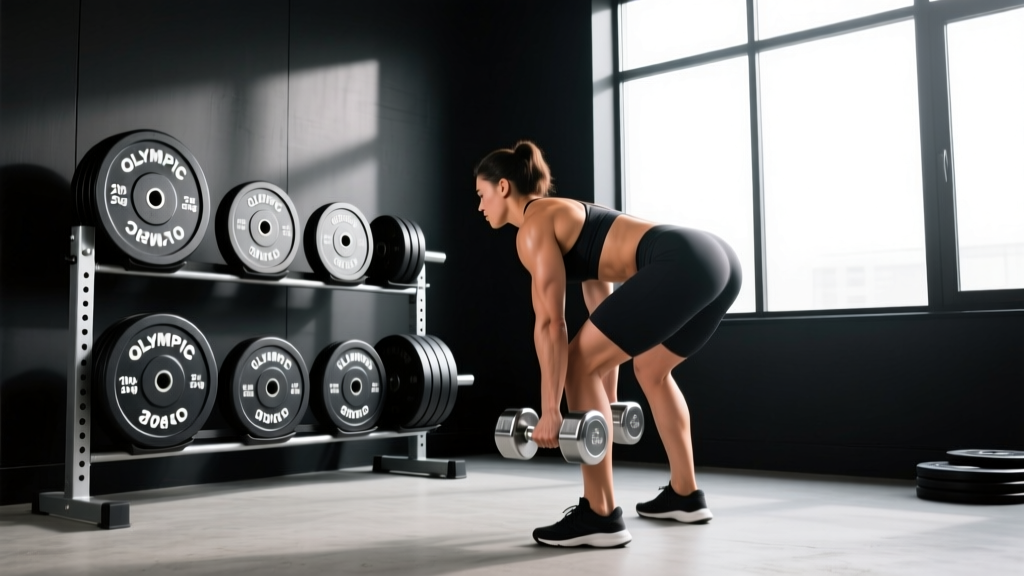
Olympic vs Standard Plates: Buying Guide & Dumbbell RDL for Glutes

Olympic Barbell vs Purple Dumbbell: Grip and Weight

Neoprene Dumbbells for Home Use: Buying Guide & Dumbbell Shoulder Press Angle

Safe Lower Back Exercise Dumbbell Home Setup Guide
Olympic vs Standard Plates: Setup for Military Press Dumbbells
