Competition vs Cast Iron Kettlebells: Better Than Dumbbell Set Deals?
We break down cast iron vs competition kettlebell costs to see if they offer better long-term value than typical dumbbell set deals in 2026.

When outfitting a home gym, the temptation to chase the latest dumbbell set deals is undeniable. You can often find 100-pound adjustable spinlock kits or vinyl hex dumbbell bundles for under $1.50 per pound on major retail sites. However, dumbbells cannot replicate the ballistic, offset-center-of-mass mechanics required for swings, snatches, and Turkish get-ups. As ExRx.net notes in their biomechanical exercise directory, the unique leverage and grip demands of kettlebell training recruit stabilizer muscles and posterior chain dynamics that standard dumbbells simply cannot match.
This forces a critical budget pivot: investing in kettlebells. But as you allocate funds away from those cheap dumbbell set deals, you face a secondary dilemma in the free weights market—should you buy traditional cast iron kettlebells or premium competition-grade steel bells? This guide provides a forensic budget breakdown and value analysis of cast iron versus competition kettlebells, evaluating cost-per-pound, biomechanical advantages, and long-term durability to determine which style truly maximizes your home gym investment.
The Bottom Line Up Front: Cast iron bells offer the best raw cost-per-pound ratio for general conditioning, while competition bells are a mandatory investment for high-rep Olympic-style lifts (snatches, cleans) where handle uniformity prevents severe hand tearing.The Economics of Free Weights: Dumbbell Set Deals vs. Kettlebell Investments
To understand kettlebell value, we must first contextualize it against standard dumbbell pricing. A typical budget-friendly dumbbell set deal (like a 100lb adjustable kit) averages $1.20 to $1.50 per pound. However, these deals often suffer from poor ergonomics, loose collar mechanisms, and bulky heads that interfere with movements like goblet squats or lunges.
Kettlebells inherently cost more to manufacture due to the complex molding required for the handle and horn. In 2026, the baseline entry point for a reputable cast iron kettlebell is roughly $1.60 per pound, while competition-grade steel bells can exceed $6.00 per pound. The goal is not to find the cheapest bell, but to identify the highest utility per dollar based on your specific training modalities.
Cast Iron Kettlebells: The Budget-Friendly Workhorse
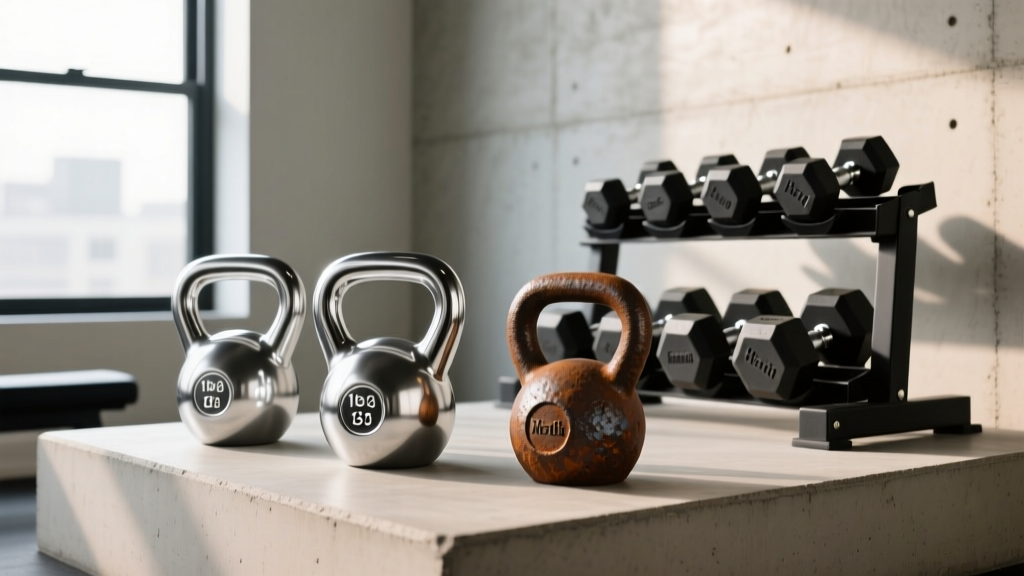
Cast iron kettlebells are the traditional choice, cast from molten iron into a mold. Brands like Rogue Fitness, Titan Fitness, and Rep Fitness dominate this space. The primary advantage is the dense, compact profile and the aggressive price point.
Coating and Finish Variables
Not all cast iron bells are created equal. The coating drastically alters both the price and the lifespan of the bell:
- Enamel / Gloss Paint: The cheapest option ($1.30 - $1.60/lb). Highly prone to chipping and flaking after a few hundred swings. Avoid for serious home gyms.
- E-Coat (Electrophoretic Deposition): A mid-tier finish ($1.70 - $2.00/lb) that bonds at a molecular level. It preserves the texture of the iron for better grip but can feel slightly rough on the palms during high-rep cleans.
- Powder Coat: The premium cast iron standard ($2.00 - $2.50/lb). Provides a durable, slightly textured matte finish that holds chalk exceptionally well without being abrasive.
Edge Cases and Failure Modes
The most common failure mode with budget cast iron bells is an uneven base. Because they are cast in sand molds and hand-ground, cheaper bells often have a microscopic wobble. If you program renegade rows or plank drag-throughs, a wobbly bell will shift under load, risking wrist sprains. Furthermore, cast iron horns vary in thickness depending on the weight; a 12kg bell might have a 32mm horn, while a 24kg bell might swell to 38mm, forcing your grip to constantly adapt.
Competition Kettlebells: The Premium Biomechanical Standard
Competition kettlebells are forged from steel and machined to exact, uniform dimensions. Whether you are holding an 8kg or a 32kg bell, the physical size, base footprint, and handle diameter remain identical. According to the Kettlebell Kings Sizing Guide, this standardization is critical for technical consistency in competitive kettlebell sport (Girevoy Sport).
The 35mm Horn Standard
The most significant value proposition of a competition bell is the universal 35mm handle diameter. This specific measurement allows the bell to rest perfectly in the 'rack position' (against the forearm) and the 'overhead lockout' without crushing the wrist or requiring awkward grip adjustments. For athletes focusing on the long-cycle (clean and jerk) or the snatch, this uniformity prevents the severe callus tearing associated with thicker, variable cast iron handles.
Internal Construction: Solid vs. Hollow
While lighter competition bells (8kg-12kg) are often hollow steel with internal filler to maintain the standard physical volume, premium heavier bells (16kg+) are typically single-cast solid steel. The flat, machined base of a steel competition bell guarantees zero wobble during floor-based movements, making them vastly superior for tactical and functional fitness programming.
Head-to-Head Value Matrix
The following comparison matrix breaks down the core differences to help you evaluate which style offers the best return on your specific training investment.
| Feature | Cast Iron (Powder Coat) | Competition (Solid Steel) |
|---|---|---|
| Average Cost per Pound | $1.80 - $2.50 | $4.50 - $7.00 |
| Handle Diameter | Variable (32mm - 38mm) | Strict 35mm Standard |
| Base Flatness | Prone to minor wobble | Machined perfectly flat |
| Best Use Case | Swings, Goblet Squats, Carries | Snatches, Cleans, Jerks, Sport |
| Chalk Retention | Excellent (Textured iron) | Poor to Fair (Smooth steel) |
Real-World 2026 Pricing Breakdown: The 3-Bell Starter Set
To illustrate the actual budget impact, let us break down the cost of a standard male starter set (16kg, 20kg, and 24kg) from reputable mid-tier brands in 2026.
The Cast Iron Route (e.g., Rep Fitness / Titan)
- 16kg (35 lbs): ~$75.00
- 20kg (44 lbs): ~$90.00
- 24kg (53 lbs): ~$105.00
- Total Equipment Cost: $270.00 (Plus ~$45 freight shipping due to 132 lbs total weight).
Estimated Total: $315.00
The Competition Route (e.g., Kettlebell Kings / Onnit)
- 16kg (35 lbs): ~$165.00
- 20kg (44 lbs): ~$195.00
- 24kg (53 lbs): ~$225.00
- Total Equipment Cost: $585.00 (Plus free shipping promotions often offered by premium brands).
Estimated Total: $585.00
Shipping Warning: When chasing cheap cast iron bells on Amazon or discount sites, always check the shipping surcharge. Heavy freight fees can easily add 20% to 30% to your final checkout price, erasing the initial cost-per-pound advantage over premium brands that offer flat-rate or free shipping thresholds.The Final Decision Framework: Which Should You Buy?
If your primary goal is general physical preparedness (GPP), heavy swings, farmer carries, and goblet squats, the cast iron kettlebell is the undisputed value champion. The aggressive knurling or powder-coat texture provides a secure grip for heavy, low-rep ballistic work, and the savings can be reallocated toward buying a heavier bell sooner. You will sacrifice handle uniformity, but for movements where the bell does not flip over the wrist, this is a negligible trade-off.
Conversely, if your training involves high-repetition snatch tests, clean and jerks, or you suffer from sensitive skin and frequent torn calluses, the competition kettlebell is not a luxury—it is a medical necessity for your hands. The 35mm steel horn and smooth finish allow the bell to glide around the wrist during the drop phase of a snatch, absorbing impact rather than tearing flesh. The 100% flat base also makes them indispensable if your programming includes heavy renegade rows or plyometric push-ups on the bells.
Ultimately, while the allure of ultra-cheap dumbbell set deals might seem like the easiest way to stock a home gym, allocating a dedicated budget for the correct style of kettlebell ensures you have the right tools for posterior chain development, grip strength, and true functional fitness.
More gear to consider
All reviews
Loadable Dumbbell Care: Protecting Sleeves and Dumbbell Hooks

Power Rack vs Squat Rack vs Stand & Back Workout With One Dumbbell

Strict Press Dumbbells Setup: Olympic vs Standard Weight Plates Guide

Bumper vs Iron Plates & Single Dumbbell Chest Exercises: 2026 Data
Barbell Collar Clamps Compared: Squats to Rotating Dumbbell Curls