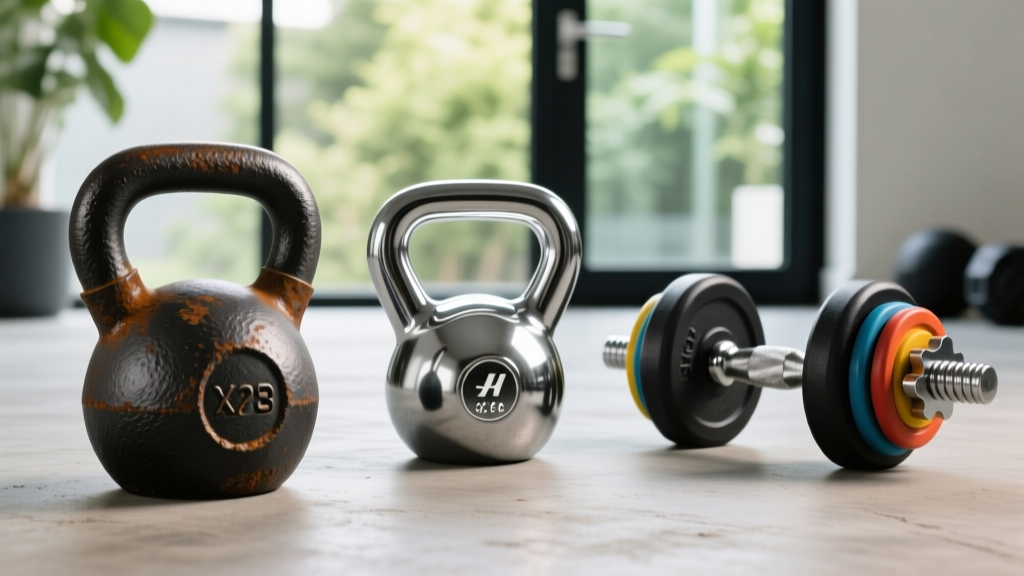
Cast Iron vs Competition Kettlebells vs Back Routine with Dumbbells
We break down the budget of cast iron vs competition kettlebells and compare the value against investing in a back routine with dumbbells for 2026.

The 2026 Home Gym Budget Dilemma: Iron, Steel, or Adjustable?
Building a home gym in 2026 requires a ruthless approach to budget allocation. With freight surcharges for heavy steel continuing to impact e-commerce pricing, every dollar spent on free weights must deliver maximum ROI. For many lifters, the debate centers around the Rogue Fitness kettlebell lineup: do you invest in traditional cast iron, or pay the premium for uniform competition steel? Furthermore, if your primary goal is hypertrophy rather than ballistic endurance, you must ask yourself if a kettlebell purchase is a misallocation of funds that would be better spent facilitating a dedicated back routine with dumbbells.
This guide breaks down the exact metallurgy, cost-per-pound metrics, and biomechanical realities of these three equipment paths. We will analyze where your money actually goes, the hidden failure modes of each option, and how to build a decision matrix based on your specific training goals.
Budget Callout: The Hidden Cost of Freight
When calculating your budget, never look at the sticker price alone. In 2026, carriers like UPS and FedEx apply aggressive 'heavy package' surcharges to any single box over 50 lbs. A single 32kg (70lb) cast iron kettlebell will incur a $90-$115 freight surcharge at checkout. Adjustable dumbbells, which package densely and ship under standard weight thresholds per box, often bypass these surcharges, drastically altering the true cost-per-pound analysis.
Metallurgy and Manufacturing: Cast Iron vs. Competition
To understand the price gap, you have to understand the manufacturing process. Cast iron kettlebells are created by pouring molten iron into sand molds. Because of this, the physical dimensions of the bell change as the weight increases. A 12kg bell has a noticeably smaller horn (the handle loop) and a smaller base than a 24kg bell. The Kettlebell Kings and Rogue powder-coat cast iron lines are industry standards here, typically retailing between $2.25 and $2.80 per pound.
Competition kettlebells, on the other hand, are engineered for the sport of Girevoy. They are constructed from welded steel and filled with internal ballast (lead or steel shot) to ensure that every bell, from 8kg to 48kg, shares the exact same dimensions: a 330mm circumference, a 210mm height, and a strict 35mm (1.38-inch) handle diameter. This uniformity allows athletes to maintain consistent rack positions and grip mechanics regardless of the weight. However, the labor-intensive welding and ballast calibration push competition bells to $3.80–$4.50+ per pound.
| Feature | Cast Iron (Powder Coat) | Competition (Welded Steel) | Adjustable Dumbbells (e.g., Nuobell 80) |
|---|---|---|---|
| Cost Per Pound | $2.25 - $2.80 | $3.80 - $4.50+ | $2.81 (Effective) |
| Handle Diameter | Varies (1.2' to 1.5') | Uniform 35mm (1.38') | Knurled, Ergonomic |
| Center of Mass | Shifts with size | Perfectly centered | Bilateral symmetry |
| Primary Use Case | Grinds, Hardstyle Swings | Sport, Snatches, Jerks | Hypertrophy, Isolation |
The Budget Breakdown: Allocating a $450 Tier
Let us apply a realistic $450 budget tier to see what your money actually secures in the current market.
- The Kettlebell Route: $450 buys you roughly one 16kg and one 24kg pair of cast iron kettlebells (plus shipping). If you want competition bells, that same $450 only secures a single 20kg and 24kg bell, leaving you without a matching pair for double-kettlebell front squats or presses.
- The Adjustable Dumbbell Route: $450 secures a high-end adjustable set, such as the Nuobell 80lb dumbbells. This single purchase replaces 15 pairs of fixed hex dumbbells, offering micro-loading increments of 5lbs all the way up to 80lbs per hand.
The Hypertrophy Pivot: Why a Back Routine with Dumbbells Wins
If your training age is over two years and your primary objective is muscle hypertrophy—specifically targeting the posterior chain—you must critically evaluate the biomechanics of your equipment. Kettlebells are unparalleled for ballistic hip-hinge movements (swings, snatches) and unilateral lower-body grinds (Bulgarian split squats). However, they are remarkably suboptimal for upper-body pulling movements.
When executing a heavy single-arm row, the wide horns and offset center of mass of a cast iron kettlebell force the wrist into ulnar deviation at the top of the concentric phase. This limits latissimus dorsi contraction and places undue stress on the radiocarpal joint. Conversely, a comprehensive back routine with dumbbells allows for a neutral grip, seamless wrist rotation, and strict unilateral isolation without the awkward physical footprint of a kettlebell bell blocking your torso.
'For optimal latissimus dorsi activation during unilateral rows, the implement must allow the humerus to travel through a full sagittal plane without the wrist acting as a restrictive fulcrum. Dumbbells provide this path; kettlebells inherently disrupt it due to their horn geometry.'
Sample High-Value Back Routine with Dumbbells
If you pivot your budget to adjustable dumbbells, here is a highly effective, biomechanically sound back protocol that leverages micro-loading:
- Chest-Supported Incline Rows: Set an adjustable bench to 30 degrees. 4 sets of 8-10 reps. (Focus on driving elbows to hips to isolate the lower lats).
- Single-Arm Kneeling Rows: 3 sets of 10-12 reps per side. (Utilize the 5lb micro-adjustments of modern dumbbells to push past failure thresholds).
- Dumbbell Pullovers: 3 sets of 12-15 reps. (Superior lat stretch compared to kettlebell pullovers, which suffer from awkward handle clearance).
- Seated Leaning Reverse Flyes: 3 sets of 15 reps. (Targets the rhomboids and rear delts with a perfectly balanced center of mass).
Real-World Failure Modes and Long-Term Value
Value analysis is incomplete without examining how equipment degrades over a 5-to-10-year lifecycle. Every free weight category has specific failure modes that impact long-term ROI.
Cast Iron Kettlebell Failures
The primary enemy of powder-coated cast iron is concrete. If you train in a garage and drop a 32kg bell on an unprotected floor, the powder coat will chip. Once the raw iron is exposed to ambient humidity, oxidation (rust) begins within 48 hours. Furthermore, the mold lines (seams) on cheaper cast iron bells can tear calluses during high-rep snatches.
Competition Kettlebell Failures
Competition bells do not rust easily, but they dent. A severe drop can deform the flat base, causing the bell to wobble during renegade rows or push-ups. More critically, if the weld securing the internal ballast fails, the lead or steel shot inside will shift, creating an off-center rattle that ruins the bell's balance and makes it unusable for sport.
Adjustable Dumbbell Failures
Modern adjustable dumbbells (like Nuobell or PowerBlock) are engineering marvels, but they contain moving parts. The most common failure mode in 2026 remains user error: dropping the dumbbell from the top of a movement. The internal polycarbonate dials and steel retention pins are not designed for impact shock. If you buy adjustable dumbbells, you must commit to controlling the eccentric phase of every rep and setting them down gently.
Warning: The Resale Value Reality
If you miscalculate your budget and need to liquidate gear, cast iron and competition kettlebells retain roughly 70-85% of their retail value on the secondary market due to their indestructible nature. Adjustable dumbbells, however, depreciate by 40-50% the moment they are unboxed, largely due to buyer skepticism regarding internal gear wear and tear.
The Final Decision Matrix
Where should your 2026 budget ultimately go? Use this framework to finalize your purchase:
- Buy Cast Iron Kettlebells if: You are on a strict budget, prioritize hardstyle grinds (Turkish get-ups, strict presses), and train on rubber matting where chipping is minimized.
- Buy Competition Kettlebells if: You are training for Girevoy sport, practice high-rep snatches and jerks, and require the uniform 35mm handle to prevent grip-tearing across varying weights.
- Pivot to Adjustable Dumbbells if: Your primary goal is bodybuilding, hypertrophy, or general fitness, and you want to execute a comprehensive back routine with dumbbells, chest presses, and isolation movements without the spatial footprint of a full dumbbell rack.
Ultimately, the 'best' value is dictated by your training intent. Kettlebells are specialized tools for ballistic power and endurance. Dumbbells are the undisputed kings of bilateral symmetry and hypertrophic isolation. Audit your programming, respect the freight surcharges, and buy the iron that matches your actual work capacity.
More gear to consider
All reviews
2026 Budget Breakdown: Bumper vs Iron Plates & Dumbbell Lat Raises

Power Rack vs Squat Rack vs Stand: Setup & SpongeBob Dumbbells
Olympic Barbell Setup: Knurling Guide & Dumbbell Lateral Pullover

What Do Dumbbell Curls Work? Adjustable Dumbbell Review & Fixes

Outgrowing 5 100 Dumbbells: Olympic vs Standard Plates Guide
